The Petit Basset Griffon Vendéen (PBGV) comes from the Vendée region on France’s Atlantic coast, and its French name works like a concise field guide: Petit (small), Basset (low to the ground), Griffon (rough or wire-coated), and Vendéen (from the Vendée). Enthusiasts in the United States often nickname the breed “petits,” while owners in England and Denmark commonly call them “griffs” or “roughies.” Its roots trace back to the sixteenth-century Griffon Vendéen, and the breed is still bred in France alongside 27 other hound breeds to hunt rabbits by scent. In the early twentieth century, Paul Dezamy’s initial standard grouped both Grand and Petit sizes together because both appeared in the same litters; a 1909 revision distinguished the two heights, Abel Dezamy later drafted a dedicated standard, the Petit stood as a separate breed by the 1950s, and Hubert Dezamy ended interbreeding between sizes in 1975. The American Kennel Club (AKC) recognized the PBGV as its 130th breed in December 1990 in the Hound Group, and the FCI lists it in Group 6 as a small-sized scenthound (Standard No. 67).[1][2]
Behind the mouthful of a name is an unmistakable, upbeat little hound built for rugged country. According to the AKC standard, PBGVs stand 13 to 15 inches at the shoulder (34 to 38 cm, plus or minus 1 cm, under FCI Standard No. 67) and weigh roughly 25 to 40 pounds (11 to 18 kg), combining a compact, slightly elongated body with strong, well-boned short legs whose length from elbow to ground is slightly more than half the height at the withers. The proudly carried head is roughly twice as long as it is wide, featuring dark oval eyes framed by forward-standing bushy eyebrows, a full beard and mustache, and narrow, supple, hair-covered ears set below eye level that fold inward. A stout, saber-like tail tops off a casual, tousled, goat-like harsh double coat appearing in white-and-black, tricolor, white-and-orange, and fawn-overlaid traditional hound markings.[1][2]

A tricolor Petit Basset Griffon Vendéen showing its compact frame and tousled coat. Lilly M, Wikimedia Commons[5]

Why Scent Trailing Is Working Instinct Rather Than Disobedience
For prospective PBGV owners, the biggest daily puzzle usually shows up the moment the front door opens and the dog’s nose drops to the pavement. FCI Standard No. 67 captures the breed’s dual nature with a classic French hunting saying: “Devil in the country, angel in the house,” describing a passionate, courageous hunter that loves bramble and scrub. On the rocky, brush-choked Vendée coast, a PBGV had to commit wholly to rabbit scent trails and use its loud, resonant hound voice to keep hunters informed. When a PBGV locks onto an intriguing trail in a neighborhood park and tunes out verbal calls, it is not acting spitefully or refusing to obey—it is following centuries of purposeful scent-hound selection that calls for thoughtful management rather than frustration.[1][2]
Managing that nose starts with clear physical boundaries. The AKC exercise profile states plainly that because the PBGV’s sense of smell and urge to follow scents are so strong, outings beyond a securely fenced yard should always be on leash—even for a dog that seems calm and cuddly indoors—because an enticing scent can make the hound ignore everything else around it. Alongside leash safety, training works best when it respects how the breed thinks. The AKC notes that PBGVs are bright, alert, and genuinely eager to please, yet their own agenda often looks far more exciting than repetitive drills. Starting socialization and obedience classes early, keeping recall exercises brief, varied, and entertaining so the handler stays one step ahead, granting planned sniff breaks along the walk, and generously rewarding voluntary check-ins help turn daily walks into genuine teamwork; active owners who hike, jog, or bike also give this vivacious hound a constructive physical and mental outlet.[1][2]
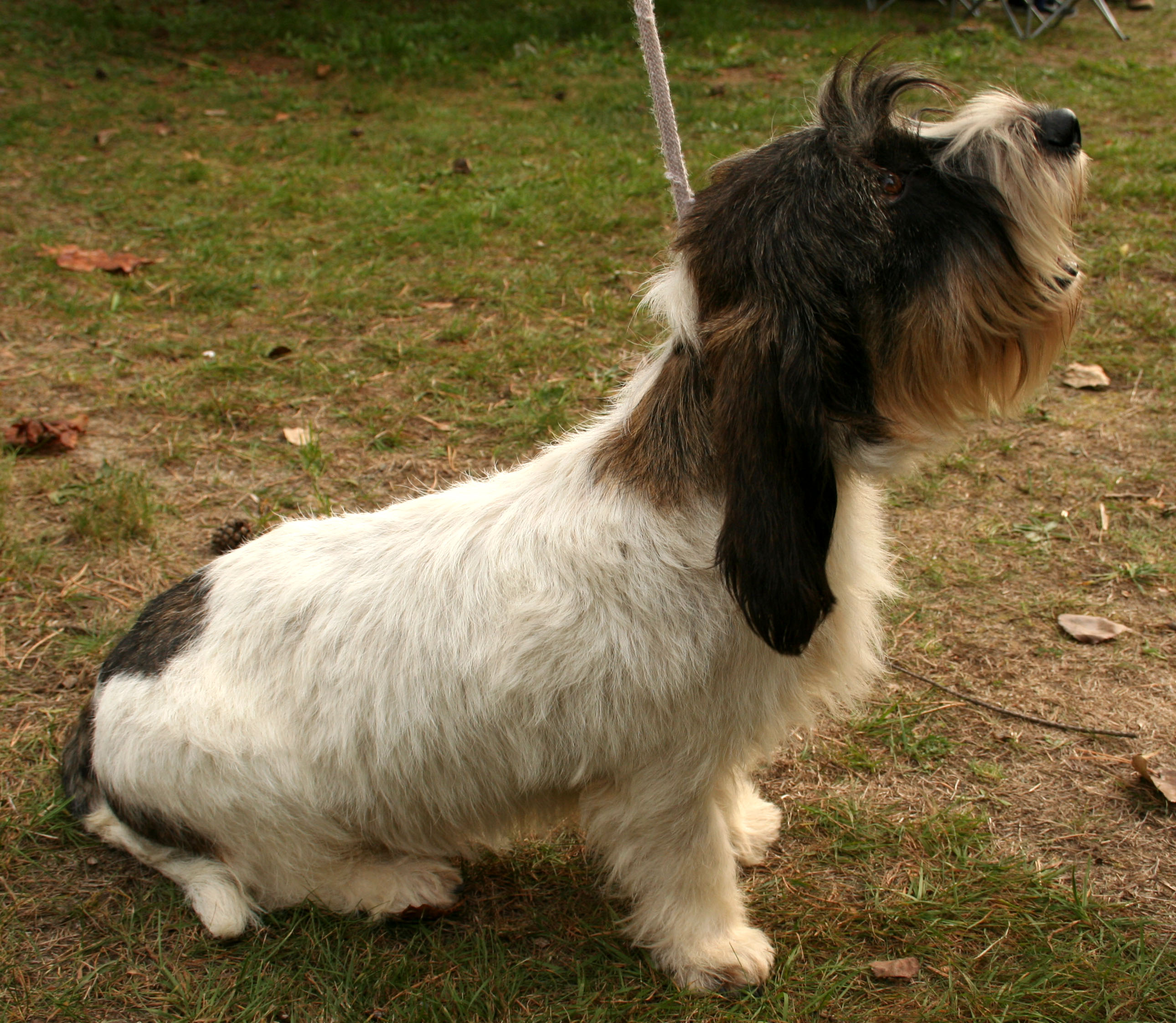
A leashed PBGV looking up outdoors, showing its coarse coat and protective brows. Pleple2000, Wikimedia Commons[6]

Rough-Coat Upkeep, Health Screening, and Home Fit
The PBGV’s tousled rough coat is functional armor rather than decoration: its eyebrows, beard, and harsh outer coat evolved to shield the face and body from coastal thorns and brambles. Both the AKC and The Royal Kennel Club emphasize keeping trimming to a minimum so the dog retains its rustic, casual silhouette. Practical upkeep means giving the coat a complete brushing at least once a week—deep enough that a comb glides cleanly through afterward—so mats and burrs do not build up in the dense undercoat. Many owners follow a monthly routine for a thorough bath and nail trim, while checking the long, hair-covered drop ears weekly to clear excess wax and debris before irritation develops.[1][3]

A PBGV standing in winter snow, illustrating its weather-resistant double coat. Nathan150, Wikimedia Commons[7]

Longevity is a notable strength, with an AKC life expectancy of 14 to 16 years. Responsible breeding still relies on targeted screening: both the AKC and the official health statement of the Petit Basset Griffon Vendéen Club of America recommend an OFA Ophthalmologist Evaluation and the DNA test for Primary Open Angle Glaucoma (POAG), with optional hip screening via OFA or PennHIP. AKC health guidance also notes attention to neck pain syndrome, hip and elbow dysplasia, patellar luxation, and cardiac or eye anomalies, alongside sensible age-appropriate portion control because some PBGVs gain weight easily when training treats pile up. Overall, this sociable pack hound generally gets along warmly with young children and other dogs—allowing for individual variation in energy and vocal habits—and The Royal Kennel Club notes it can adapt to small or medium town or country homes that welcome a loud, cheerful hound voice, commit to weekly coat and ear care, and enjoy brisk leashed outings with a curious nose.[1][3][4]
References
- American Kennel Club. Petit Basset Griffon Vendéen Dog Breed Information.
- Fédération Cynologique Internationale. FCI-Standard N° 67: Petit Basset Griffon Vendéen.
- The Royal Kennel Club. Basset Griffon Vendeen (Petit) Breed Information.
- Petit Basset Griffon Vendéen Club of America. Official Health Statement.
- Lilly M. File:Petit Basset Griffon Vendéen MWPR Katowice 2008 001.JPG, Wikimedia Commons.
- Pleple2000. File:Petit basset grifon vendeen t666.jpg, Wikimedia Commons.
- Nathan150. File:Petit Basset Griffon Vendéen.jpg, Wikimedia Commons.