The World Cat Federation (WCF) spells the breed’s name Toy Bob. Its 2018 standard allows considerable variation in the tail. The visible portion can measure from 3 cm to one-third of the cat’s body length. It may have several kinks or be straight, though the WCF prefers a short tail with a bend and some mobility. If your cat has had the same kink since kittenhood, you can leave it alone. What’s worth noticing is how your cat usually moves its tail as it walks towards you.[1]
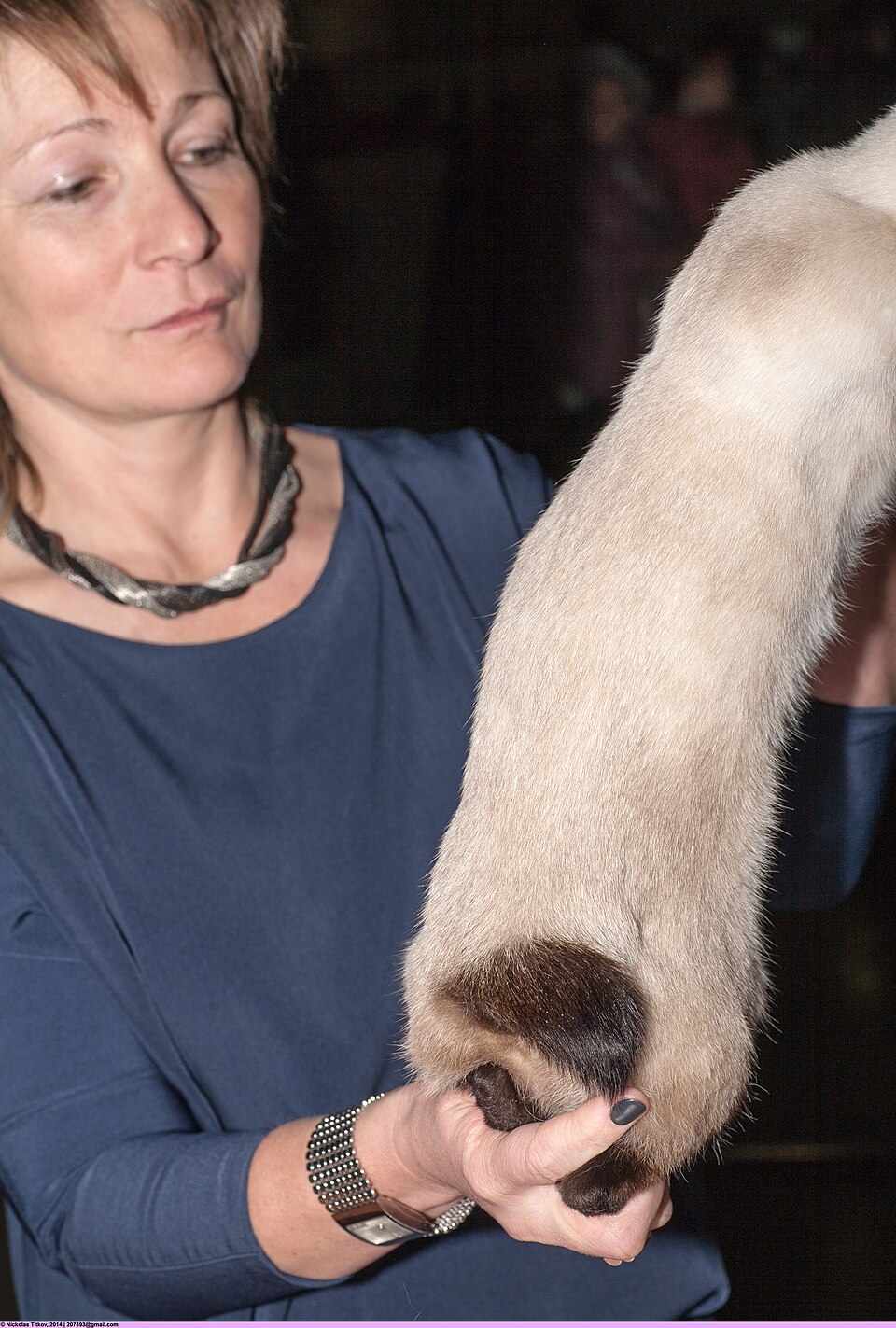
Velena-Kutc shows her short tail. Nickolas Titkov, Wikimedia Commons[8]

Velena-Kutc, the adult female in the photographs, is registered as a seal point. From behind, her dark brown tail stands out against her pale rump, its tip tucked close to the outline of her body. From the front or side, the face and legs catch the eye first. To pick out the breed’s characteristic build, look at the short, sturdy trunk, the width across the chest and the length of tail still visible behind the rump. The WCF describes an almost square body with well-muscled, solidly boned legs of medium length. The hind legs are slightly longer than the forelegs.[1][8–10]
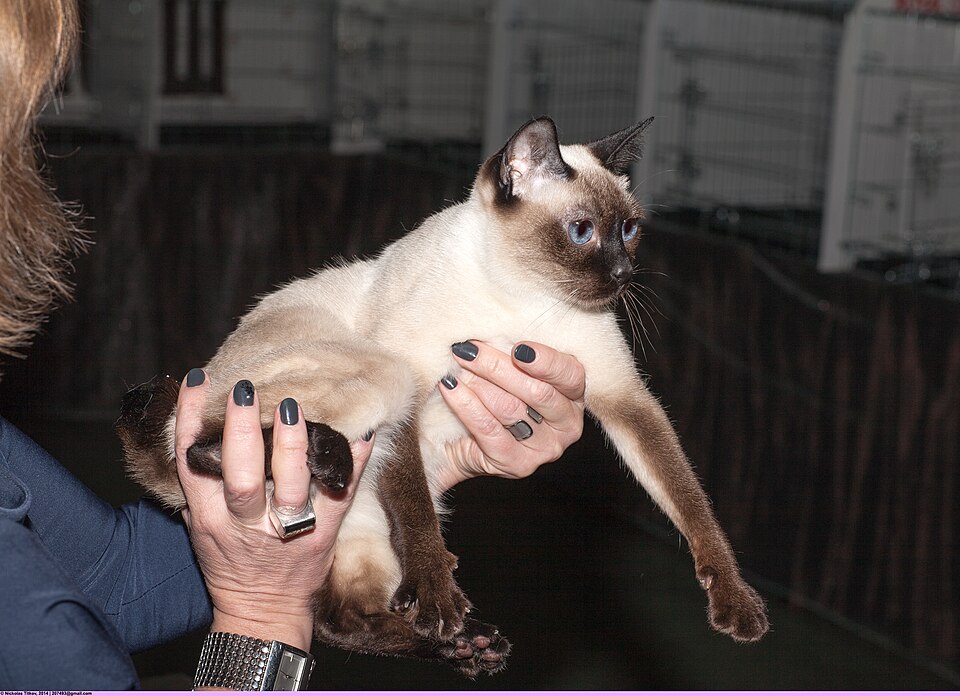
Velena-Kutc has a seal-point mask. Nickolas Titkov, Wikimedia Commons[9]

Grooming starts with the coat
Velena-Kutc’s darkest fur is on her face, ears, feet and tail. Her body is much paler. The WCF standard describes this seal-point colouring with round, deep blue eyes and calls for an even body colour that contrasts clearly with the dark points. The short coat has depth. The outer hairs and undercoat are similar in length, giving the coat a springy texture. Around Velena-Kutc’s neck and shoulders, the fur stands slightly away from her body. The Cat Fanciers’ Association (CFA) spells the name Toybob and describes both shorthair and semi-longhair varieties. That distinction comes in handy when choosing a grooming tool.[1][2][9][10]

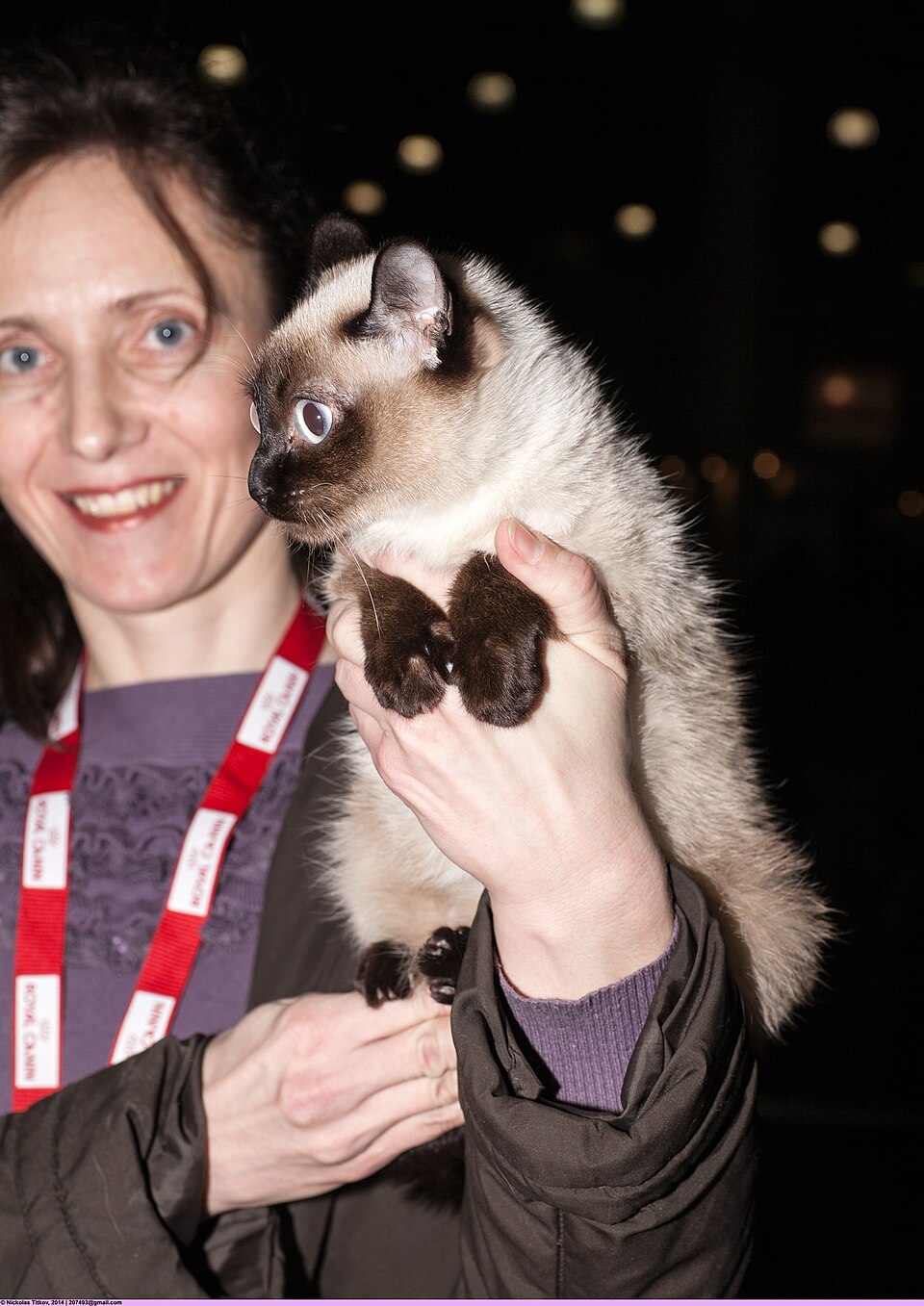
The short coat stands out at the shoulder. Nickolas Titkov, Wikimedia Commons[10]
For a shorthair, CFA recommends a weekly brushing. A steel comb works well for a semi-longhair’s weekly grooming. Pick a moment when your cat comes over and seems content to stay. If it enjoys being touched across the shoulders or back, start there. Try a few strokes, then pause and see whether it leans closer or walks away. As you remove loose hair during shedding season, you’ll also learn where your cat likes to be touched. When you reach the hindquarters, let the tail rest in its usual position. There’s no need to straighten a kink to measure it.[1][2][4][6]
Give a small cat room to choose
CFA describes Toybobs as cats that enjoy joining in with people. A Toybob may follow someone from room to room, then leave a toy behind and settle somewhere comfortable. When setting up a room, give your cat a place to watch the household and another where it can get away from passing feet. A sturdy perch that’s easy to get on and off can serve as a lookout. A cardboard box with sheltering sides can make a retreat in a quiet corner. Leave the entrance clear and let the cat show you when it wants each spot.[2–4]
With a small cat, it’s tempting to line up the food dish, water bowl and litter box in one corner. Trace the routes your cat would take. Must it pass the litter box every time it wants a drink? Does the route to its bed lead through the play area? Feline veterinary guidance recommends spreading essential resources around the home. In a household with several cats, pay particular attention to doorways and narrow passages. Two full water bowls can both be out of reach if another cat guards the only entrance. Moving one bowl to a spot your cat can reach by a different route gives it a second place to drink.[3][4]
For play, clear a short stretch of floor. Draw a toy mouse across your cat’s line of sight, then pause so it has a chance to crouch, chase and pin the mouse under its paws. A toy that always dangles out of reach leaves out the catch. Before another round, hold the toy still. Does your cat fix its gaze on the mouse again or creep closer? If it wanders off to rest, let the game end. Children can invite a cat to play the same way. The toy gives the cat something to pounce on, and the cat can choose when to approach the child. These forms of play and contact meet needs that Toybobs share with other indoor cats.[3][4]
Which changes should you tell your vet about?
As a Toybob kitten grows, record its age alongside each weight. The WCF standard expresses a preference for an adult weight below 2 kg and says development can continue until about 18 months. The UK’s Governing Council of the Cat Fancy (GCCF) raises a specific concern about deliberate selection for small size in the Toybob and calls for genetic and veterinary evidence before it will consider recognition. Bring your kitten’s weight history to the vet and discuss feeding in light of its growth and body condition. A weight preferred in the show ring is a poor reason to restrict a growing cat’s food.[1][5]
If something about the tail concerns you, start with when it changed. A bend that has been there since kittenhood gives the vet a different history from a tail that hung limp for the first time this morning after getting caught in a door yesterday. Contact your vet if your cat suddenly can’t lift its tail or an injury has broken the skin or caused bleeding. Tell the vet when you last saw the cat move the tail on its own, whether it may have been trapped or pulled, and whether the cat has passed urine and stool normally since. An injury near the base of the tail can affect nerves involved in bladder and bowel function.[6]
If your cat keeps visiting the litter box and straining but passes no urine or only a few drops, seek emergency veterinary care immediately. This is urgent even if you saw no injury. Knowing how your cat usually carries its tail and uses the litter box means that when you call, you can tell the vet exactly what has changed.[6][7]
References
-
[1] World Cat Federation. WCF Breed standard: Toy Bob. 1 September 2018.
-
[2] The Cat Fanciers’ Association. Toybob.
-
[3] Feline Veterinary Medical Association. New Feline Veterinary Medical Association Position Statement Reimagines Life for Indoor Cats. 28 August 2025.
-
[4] ISFM and AAFP. Your cat’s environmental needs: practical tips for pet owners. 2013.
-
[5] The Governing Council of the Cat Fancy. Unrecognised Breeds.
-
[6] VCA Animal Hospitals. First Aid for Tail Injuries in Cats.
-
[7] VCA Animal Hospitals. Emergencies in Cats.
-
[8] Nickolas Titkov. TOB Velena-Kutc (15819144780). Rear view. Wikimedia Commons.
-
[9] Nickolas Titkov. TOB Velena-Kutc (15980498876). Full-body view. Wikimedia Commons.
-
[10] Nickolas Titkov. TOB Velena-Kutc (15818956518). Side view. Wikimedia Commons.


