A 5,000-dollar rescue grant arrives at a breed club. Who then finds a foster home for one dog, and who shares the local organization’s bills? Since 2019 the Westminster Kennel Club has each year drawn three national breed-club rescue programs at random and funded each with 5,000 dollars. The 2026 recipients are the Bichon Frise Club of America, the Dalmatian Club of America Foundation, and the United States Kerry Blue Terrier Club. The organizer recently followed up with the recipients. The way two of them work shows how the same amount enters different care arrangements. [1]
A Bichon settles in a foster home first
According to the organizer’s interview, after a shelter refers a dog, the coordinator of the Bichon Frise Club of America Charitable Trust looks through the volunteer network for a foster home that is in a suitable place and can take that dog. The foster takes the dog in, arranges a veterinary visit, and tidies the coat. The rescue organization pays the corresponding costs. Before a permanent home appears, someone already knows where the dog is and who watches it day to day, and someone can answer the first questions the next caretaker will meet. [1]
The trust’s own adoption page requires a home visit. Household members and pets already in the home take part. For a family that wants to adopt, “we are willing to look after it” becomes several concrete questions: who is with the dog day to day, how the other animals meet it, and which spaces in the new place need to be adjusted in advance. The interview also mentions a follow-up after placement. Keeping those contacts means that, if settling-in becomes a problem, the family can find again the person who already knows that dog. [1][2]
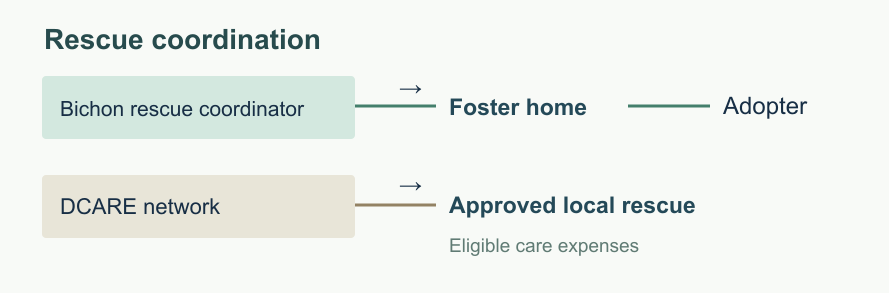
Figure: how the two award-winning organizations divide care.
A Dalmatian stays with the local organization
DCARE, the rescue-education program of the Dalmatian Club of America, uses a different arrangement. The foundation’s public account describes it as a network that coordinates and funds recognized rescue organizations. A dog may remain in the care of a regional group. The national program supplies referrals, information, and support for compliance costs. Reimbursable items listed by the foundation include the cost of collecting the dog, necessary veterinary treatment, and some behavior assessments. Each recipient and each item has its own conditions. A family that is adopting a Dalmatian cannot take that to mean it may send its own bills to the foundation. [3][4]
So the same question about a dog waiting for a home may be addressed to different people on the two paths. To learn how the dog behaves in foster care, find the foster or the regional group responsible for that dog. To learn whether a rescue organization can receive cost support, check the program’s partner qualifications and reimbursement rules. Before deciding to adopt, ask three things clearly: the most recent care record, who pays after the handoff, and whom to contact if difficulty appears. The award list says which organizations received support. What reaches one particular dog is these stretches of care that can be joined up. [1][2][3][4]