REFR describes Chinese Tank as Napoleon×British Shorthair work: round head, large round eyes, short thick neck, short legs, with SH/LH codes (CTS/CTL…). A 2024 DBE genetics paper labels one sample a Munchkin–British Chinese Tank—name presence in research, not a population health map.[1][2]
How to read the conformation
Goals include round face, broad muzzle, short straight nose with stop, short muscular neck, strong but not massive body; legs straight, not bowed. Longhair is recessive and less common. Treat ‘cartoon round face’ as registry aesthetics, not a guarantee every cat matches, and do not shame long-legged littermates as failures.[1]

Fig: BSH round-head cue for REFR Tank goals—not a registrant. George E. Koronaios, Wikimedia Commons


Fig: Short-leg cue; REFR ties Tank short legs to Napoleon/Munchkin. Sasha Krotov, Wikimedia Commons

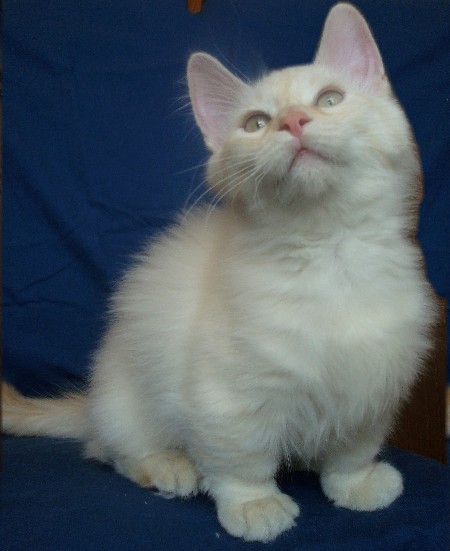
Fig: Longhair short-leg cue; REFR allows longhair as less common. Sg0668commons, Wikimedia Commons

Short-leg home care
Prioritise low platforms, non-slip floors and accessible litter boxes; comb for Persian/BSH-style mats. Five pillars still need separated resources despite ‘clingy/calm’ copy. Seek care for hesitant jumps or gait change—do not dismiss them as ‘just short legs’.[5][1]
Welfare and evidence gaps
GCCF red-lists dwarf types; FelineVMA opposes welfare-sacrificing looks. Keep REFR’s lethal-homozygote note as registry wording beside independent exams. Neither one research cat nor sweet-temperament copy is a prevalence table—state the gap and do not promote breeding.[3][4][2]
Short-leg BSH looks and research-sample limits
REFR frames Chinese Tank as Napoleon (Persian-type×Munchkin)×British Shorthair—essentially short-legged BSH—and notes homozygous short-leg embryos fail while living short-legs are heterozygous. That is registry genetics copy, not a home diagnosis, and ‘sweet temperament’ is not an orthopaedic free pass. The 2024 Animals paper includes one Chinese Tank (labelled Munchkin–British mix) in a DBE cohort—one cat cannot define population prevalence or uniform health. GCCF red-lists Munchkin/Minuet-type dwarfs; prioritise low routes and pain watch for cats already home, and do not expand breeding for the look. Keep citation numbers tied to sentences you actually read; if only an abstract was available, say so in internal notes and do not promote it to full-text evidence. A household decision list should include traceable origin, a recent exam, a budget for environment changes, and a care path when pain or elimination changes appear. Those steps fit rare breeds and local landraces alike and reduce treating association wording as a lifestyle promise. Avoid two common swaps: treating “association-allowed looks” as “proven for every home,” and treating “welfare policy raises concern” as “every similarly shaped cat is already diagnosed.” Keep source layers side by side—breed standard, indoor-environment statement, welfare policy, and the individual veterinary record—each answering a different question. If public sources lack breed-specific screening advice, say that a public prevalence/screening table was not found instead of borrowing a neighbour breed’s numbers. That is how a mid-length profile can carry both recognisable traits and executable limits. Taken together, treat the article as a three-part kit—look recognition, environment readiness, and health boundaries: check recognisable traits against association clauses, audit the home with the indoor five pillars, and return pain, lameness, elimination or skin changes to an individual veterinary path. That keeps a mid-length profile from inventing husbandry anecdotes or turning an ideal type into a promise about every cat. Add a check order: copy the association name, code and update date first, then observable coat/tail/ear/eye clauses, and only then faults and disqualifications. Turn those clauses into a look-alike checklist that never answers “is it healthy.” On environment, tick safe place, separated resources, play/predation, predictable interaction and sensory respect—and fix missing ticks. On medicine, keep vaccine/parasite records, neuter status, prior imaging/labs, and the clinic to call when something changes. If a source offers stories without records, write the gap into the adoption decision instead of filling it with adjectives. Those four steps let traits and boundaries land as household actions. Final reminder: do not pad boundaries with empty disclaimers, and do not invent first-person feeding diaries; every look claim should point back to a read standard or report sentence, and every health concern to veterinary or welfare-policy text. After nail trims, combing or litter changes, log appetite and jumping for two days so environment changes are not confused with pain signals. In multi-cat homes, do not leave the only warm spot or windowsill to the largest cat—short-legged or sparse-coated cats need alternate safe sites. Before bringing home unusual looks, ask whether local clinics can refer skin, orthopaedic or genetics questions—do not assume a boutique brand equals clinical experience. Copy the association page’s update date into household files so outdated screenshots do not settle registry arguments later. If readers keep only three lines: standards identify looks, statements govern environments, and medical records govern this one cat.