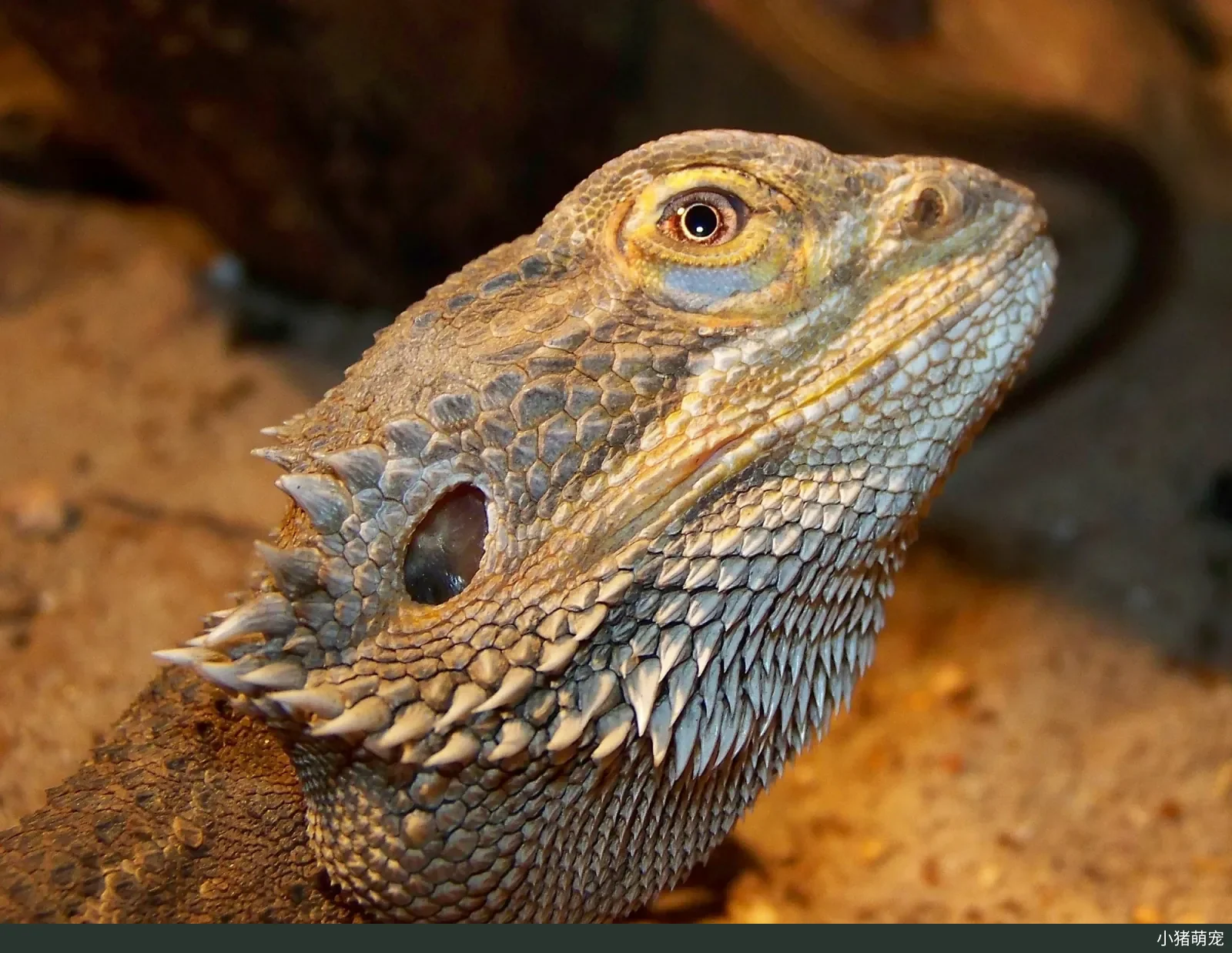
A male bearded dragon (Pogona vitticeps). Photo: William Kreijkes, source: Wikimedia Commons, license: CC BY-SA 3.0

The bearded dragon (Pogona vitticeps) is native to arid inland Australia and is one of the most common pet lizards. It can live around a decade and needs a long enough enclosure, a clear warm–cool gradient, and reliable UVB lighting; the insect-to-vegetable ratio also differs for juveniles and adults. Drawing on RSPCA, veterinary hospital, and U.S. CDC materials, this article covers origin and rules, housing, feeding, common disease, and hygiene notes.
Origin, lifespan, and where to buy
Per RSPCA Australia, the common pet-trade animal is the central (inland) bearded dragon. In the wild it ranges across arid and semi-arid country from southeast Northern Territory and western Queensland through New South Wales into eastern South Australia, living in desert, dry woodland, and scrub. It is diurnal; though mainly terrestrial, it climbs readily to bask. On size, RSPCA UK cites about 45 cm including the long tail; RSPCA Australia gives weight as 250–510 g. Lifespan figures differ: RSPCA UK says usually 10–15 years or longer; RSPCA Australia’s captive expectancy is 7–12 years. Either way, keeping one is a commitment measured in decades of years.
Australia tightly controls export of native wildlife. The Department of Climate Change, Energy, the Environment and Water (DCCEEW) states in its permit guidance that live native mammals, birds, reptiles, and amphibians may not be exported for commercial purposes, whether or not they are on CITES Appendices; the only native animals that may leave as household pets are certain parrot species—no other natives. In other words, a bearded dragon legally obtained outside Australia should not be a live animal commercially exported from Australia; ask the seller to document captive-bred origin. RSPCA Australia also warns against taking from the wild or releasing pets into the wild, notes that local keeping may require a permit, and recommends choosing animals older than 3–6 months that are already eating steadily and growing normally. Rules on keeping, trade, transport, and quarantine of non-native reptiles vary by country and region; the U.S. Centers for Disease Control and Prevention (CDC) also advises checking local law and rental rules before buying. Confirm with local authorities before purchase and keep proof of legal origin.
Enclosure, temperature, and UVB lamps
Bearded dragons are mainly ground-active, so the enclosure must be long enough; height matters less. RSPCA UK’s minimum for one adult is 120 cm long, 60 cm high, and 60 cm wide; RSPCA Australia suggests 1.2–1.8 m long, 0.6 m wide, and 0.6–0.9 m high for adults; VCA Animal Hospitals suggests length at least three times the lizard’s total length and width at least 41 cm for turning room. All three advise single housing: bearded dragons are territorial; together they may fight over food and basking spots, and even bite off a companion’s toes or tail.
Bearded dragons are ectotherms and regulate temperature through the environment, so one end of the enclosure must be warm and the other cool so the animal can shuttle. RSPCA UK suggests a basking spot of 38–42°C and a cool end of 22–26°C, with nights no lower than 20–22°C; place a natural stone at the basking spot, keep the lizard’s back at least 25–30 cm from the lamp, fit a protective guard, use a thermostat, and record both ends daily with thermometers. VCA Animal Hospitals cites a warm end of 32–38°C and cool end of 24–27°C, lights off at night, and usually no extra heat if the cool end stays 18–27°C. Numbers differ slightly; the shared point is a basking spot around 38°C, a clearly cooler opposite end, and measured temperatures—not guesses from bulb wattage. On humidity, RSPCA UK and Washington State University’s veterinary hospital both give 30%–40%; increase ventilation if it runs higher.
A UVB lamp is not optional décor. UVB lets the bearded dragon synthesize vitamin D3 in the skin so it can absorb and use dietary calcium; ordinary glass blocks UVB, so a window-side tank is not enough. VCA Animal Hospitals stresses choosing a reptile-specific UVB lamp—“full spectrum” on the packaging does not mean adequate UVB—and keeping glass or plastic out of the path between lamp and animal; mesh guards also cut output. RSPCA UK recommends a 10%–12% high-output UVB tube at the warm end so the basking ultraviolet index (UVI) is 3.0–5.0 and shaded areas fall to 0; albino and similar morphs need weaker light, with a basking maximum of 3.0. Run lights 12 hours on and 12 hours off. UVB output fades with use; a lit lamp is not necessarily an effective one: VCA suggests replacement every 6 months or per manufacturer guidance; Washington State University’s veterinary hospital suggests every 6–8 months for juveniles and yearly for adults; RSPCA UK advises following the manufacturer and measuring periodically with a UVI meter.
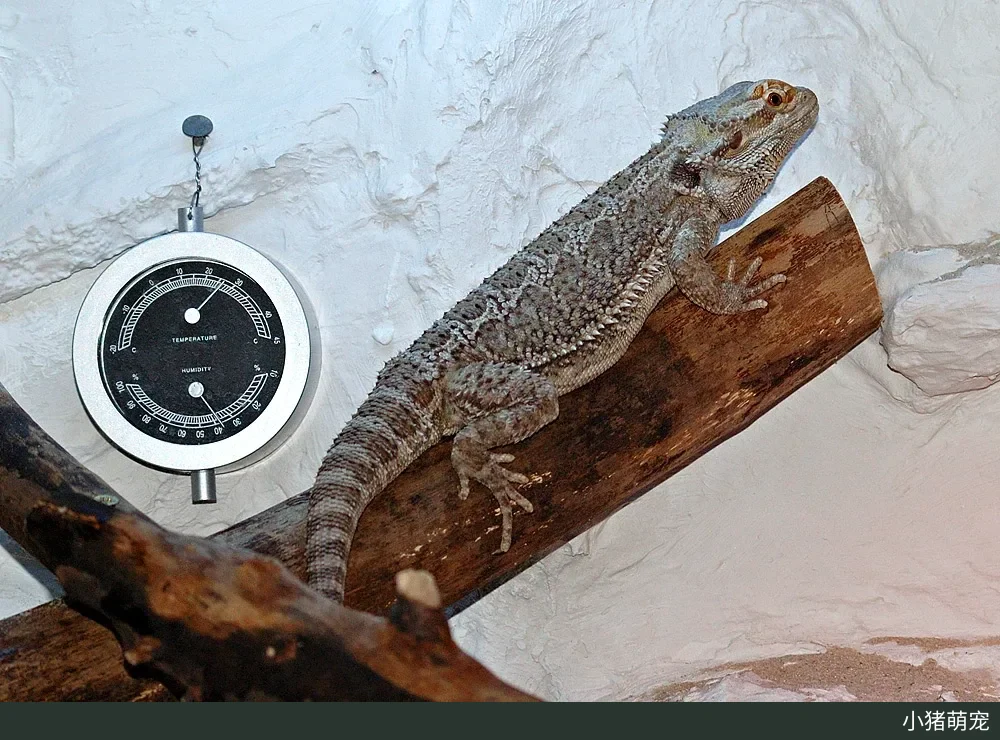
Bearded dragon in its enclosure. The setup needs a basking spot, UVB lighting, and a cool retreat; see above for temperature and lamp details. Photo: André Karwath, source: Wikimedia Commons, license: CC BY-SA 2.5

Juvenile vs. adult diet ratios
Bearded dragons are omnivores: they eat live insects and leafy greens. RSPCA UK suggests roughly 65% live food and 35% vegetables for juveniles, gradually increasing vegetables with age; adults over 30 cm long about 40% live food and 60% vegetables. Feed juveniles twice daily and adolescents and adults once daily, preferably in the morning for daytime digestion. RSPCA Australia cites wild-diet research that is more plant-heavy: under 4 months about 70% animal and 30% plant; 4–12 months half and half; adults about 90% plant and 10% animal. Washington State University’s veterinary hospital suggests for adults about 25% insects, 50%–55% dark leafy greens, 20% chopped vegetables, and fruit under 5%, with juveniles mainly on insects. Exact ratios differ; the direction is the same: younger animals lean more on insects, adults more on vegetables.
A few feeding details are worth remembering. Insects should not be wider than the lizard’s head or mouth; gut-load feeder insects with nutritious feed for 24–48 hours beforehand, then dust with calcium at feeding. Remove uneaten live insects—some will bite the lizard back. RSPCA UK advises avoiding spinach (it interferes with calcium absorption) and not overfeeding cabbage or kale. Washington State University’s veterinary hospital notes that most feeder insects are low in calcium, so without supplementation metabolic bone disease is a risk; vitamins and minerals can also be overdone—RSPCA UK notes that when UVB is adequate, large extra dietary D3 is not needed. Choose supplement type and frequency with a reptile-experienced veterinarian.
Common disease and hygiene
Metabolic bone disease (MBD; veterinarians also call it nutritional secondary hyperparathyroidism) is among the more common problems in pet bearded dragons. VCA Animal Hospitals notes it is seen most often under two years of age and usually stems from diets high in phosphorus and low in calcium, insufficient vitamin D3, or lack of UVB. Common signs include a swollen lower jaw, softening of jaw and facial bones (“rubber jaw”), swollen hind limbs, and trembling legs when walking; severely affected lizards cannot support themselves and lie flat. Radiographs may show thinned bone or fractures without trauma. RSPCA UK adds that progressive disease can leave permanent deformity of limbs, jaw, spine, or tail. Treatment must be set by a veterinarian from blood calcium and phosphorus and kidney function; VCA is clear that owners should not self-treat, and not every case recovers.
Other common issues listed by VCA Animal Hospitals include fungal “yellow fungus disease” (CANV), adenovirus infection, intestinal parasites, stomatitis, and respiratory infection. RSPCA UK warns that loose substrates such as calcium sand, wood chips, and walnut shell can be swallowed and cause gut blockage; females may lay eggs without mating and can dystocia without a diggable nesting box. Any drop in appetite, lethargy, weight loss, or other abnormality should bring a prompt visit to a reptile-experienced veterinarian. Reduced winter activity may be brumation-like “torpor,” but VCA advises contacting a veterinarian first when activity or feeding falls sharply rather than assuming brumation on your own.
Hygiene also protects the household. On a page updated 13 January 2026, the CDC writes that reptiles often carry Salmonella in the gut even when they look clean and healthy; people can be infected from the animal itself, the enclosure, water, and equipment; veterinarians cannot stop them shedding. Children under 5, adults over 65, and immunocompromised people are at higher risk of severe illness; the CDC advises against reptiles in such households, and children under 5 should not handle reptiles or their environment. Daily practice includes washing hands with soap and running water after holding, feeding, or cleaning; keeping enclosures and gear out of the kitchen and not washing them in kitchen sinks; not letting the lizard roam free indoors; and not kissing it or holding it near the face. If you truly cannot keep it, contact a pet shop, rescue, or zoo for rehoming—the CDC notes that released reptiles mostly die, and some threaten local wildlife.
References
-
RSPCA (UK). How To Care For Your Bearded Dragon. Page undated; consulted 2026-10-22.
-
RSPCA Australia Knowledgebase. How should I care for my bearded dragon?. Updated 2023-10-03.
-
Gregory Rich, Laurie Hess, Rick Axelson (VCA Animal Hospitals). Bearded Dragons: Housing. Page undated.
-
Gregory Rich, Laurie Hess, Rick Axelson (VCA Animal Hospitals). Bearded Dragons - Diseases. Page undated.
-
Washington State University Veterinary Teaching Hospital. Bearded dragon husbandry. 2026-03-02.
-
U.S. Centers for Disease Control and Prevention. Reptiles and Amphibians | Healthy Pets, Healthy People. 2026-01-13.
-
Australian Government DCCEEW. Do I need a permit?. Page undated.
-
Piggy Tuck Pets · Welcome to my pet planet