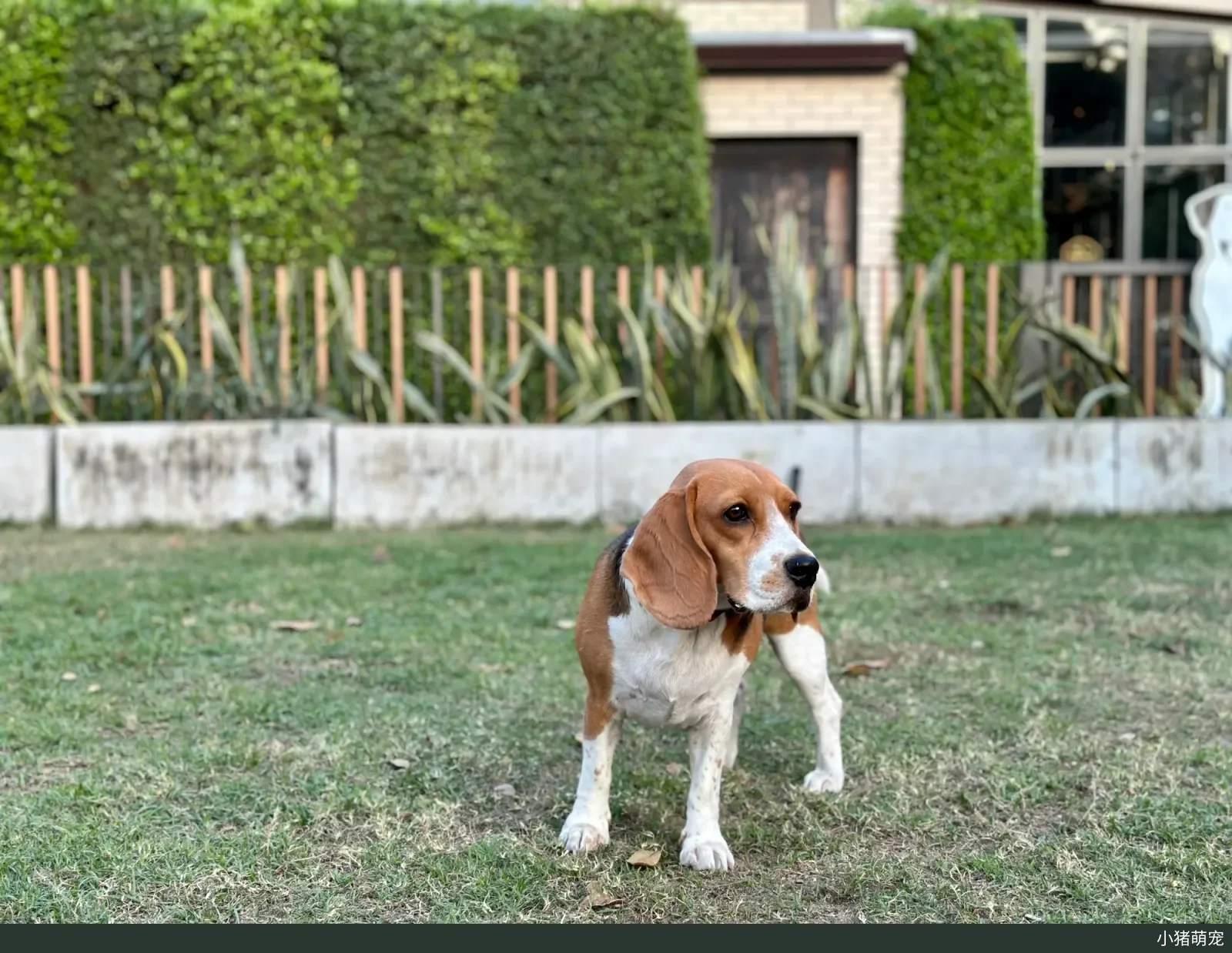
Beagle Coco standing alone at dog park Trail and Tail (photographed 2023). Photo: Slyronit, from Wikimedia Commons, CC BY-SA 4.0.
The Beagle is a small scent hound from Britain, originally pack-hunted on rabbits and now mostly a family companion. Compact, with long hanging ears and a mild expression, it is friendly and sociable—yet often “led by the nose” and vocal. Drawing on AKC, FCI, and The Royal Kennel Club breed standards and veterinary research, this article covers origins, appearance, temperament, exercise and training needs, and common health issues.
Origins and history
The Beagle is an old British hunting dog. The Royal Kennel Club (RKC) describes it as the smallest of Britain’s pack hounds, bred to pursue rabbits and other small game that hunters could follow on foot without riding as with larger hounds; by the fifteenth century the breed was established in England. An AKC breed-history article notes that “Beagle” first appears in English writing in 1475; modern Beagles are thought possibly to descend from Talbot Hounds that entered Britain with William the Conqueror—though that is speculation, and early pedigrees were never fully recorded.
There was once a “pocket” size. AKC records that Elizabeth I kept small Beagles about 9 inches at the shoulder; the RKC says they were small enough to fit in a saddlebag or even a pocket. That miniature type is no longer common in Britain. In the United States, AKC says Beagle-like dogs existed before the Civil War, but the breed was not truly established until the 1880s: in 1885 a Beagle named Blunder became the first Beagle registered with the AKC. The Fédération Cynologique Internationale (FCI) places the Beagle in Group 6, “Scent hounds and related breeds,” among small hounds, with Britain as country of origin, formally recognized in 1955.
Appearance and size standards
The AKC standard sketches the Beagle in one line: like a “miniature Foxhound,” solid, and “big for his inches.” The head is slightly domed; ears are set low, long and soft, nearly reaching the nose tip when drawn forward; eyes are large, brown or hazel, with a mild, somewhat “pleading” expression. The RKC standard describes the coat as short, dense, and weatherproof; the tail is set high and carried gaily but not curled over the back, with a white tip.
Size depends on which standard you follow. AKC divides Beagles into two classes: 13 inches (about 33 cm) and under at the withers, and over 13 up to 15 inches (about 33–38 cm); over 15 inches is a disqualification. AKC’s breed page gives reference weights under 20 lb (about 9 kg) and 20–30 lb (about 9–14 kg). RKC and FCI have a single type, with ideal height 33–40 cm. On color, the RKC lists tricolor (black, tan, white), lemon and white, red and white, tan and white, black and white, and all white among others; AKC accepts any hound color, but merle and brindle are disqualifying.

Beagle Makhi standing with tongue out (photographed 2025 at Freagles of India). Photo: Slyronit, from Wikimedia Commons, CC BY-SA 4.0.
Temperament, exercise, and training
Pack hunting shaped the Beagle’s disposition. The RKC standard calls it a “merry hound,” friendly and alert, neither aggressive nor timid; AKC notes Beagles were bred to hunt in packs, so they like company and are usually easygoing. VCA Animal Hospitals veterinary materials also say they generally get along with people and other dogs, and usually with children, but tolerate solitude poorly and bore easily.
The flip side of that charm is a dog often “led by the nose.” VCA warns that Beagles are strongly scent-driven and easily distracted outdoors; they may bark loudly when bored or on a trail; training can also meet stubbornness and independence, so consistent, reward-based methods work best. Keep them on leash where there is no fence, and make yard fencing secure. They are highly food-motivated—treats are useful rewards—but VCA also notes that appetite needs portion control, and training treats count toward the daily ration.
On exercise, VCA recommends daily activity—walks, play, and scent games all suit; without enough, Beagles may become noisy, destructive, or look for ways to escape. The RKC breed page’s reference activity level is up to about one hour a day; recommendations differ by organization and should follow the dog’s age and condition. Hiding treats for them to find and leaving sniffing time on walks put that nose to work. The same talent has serious uses: AKC notes that since 1984 the U.S. Department of Agriculture’s “Beagle Brigade” has helped screen for prohibited food at airports, ports, and borders.
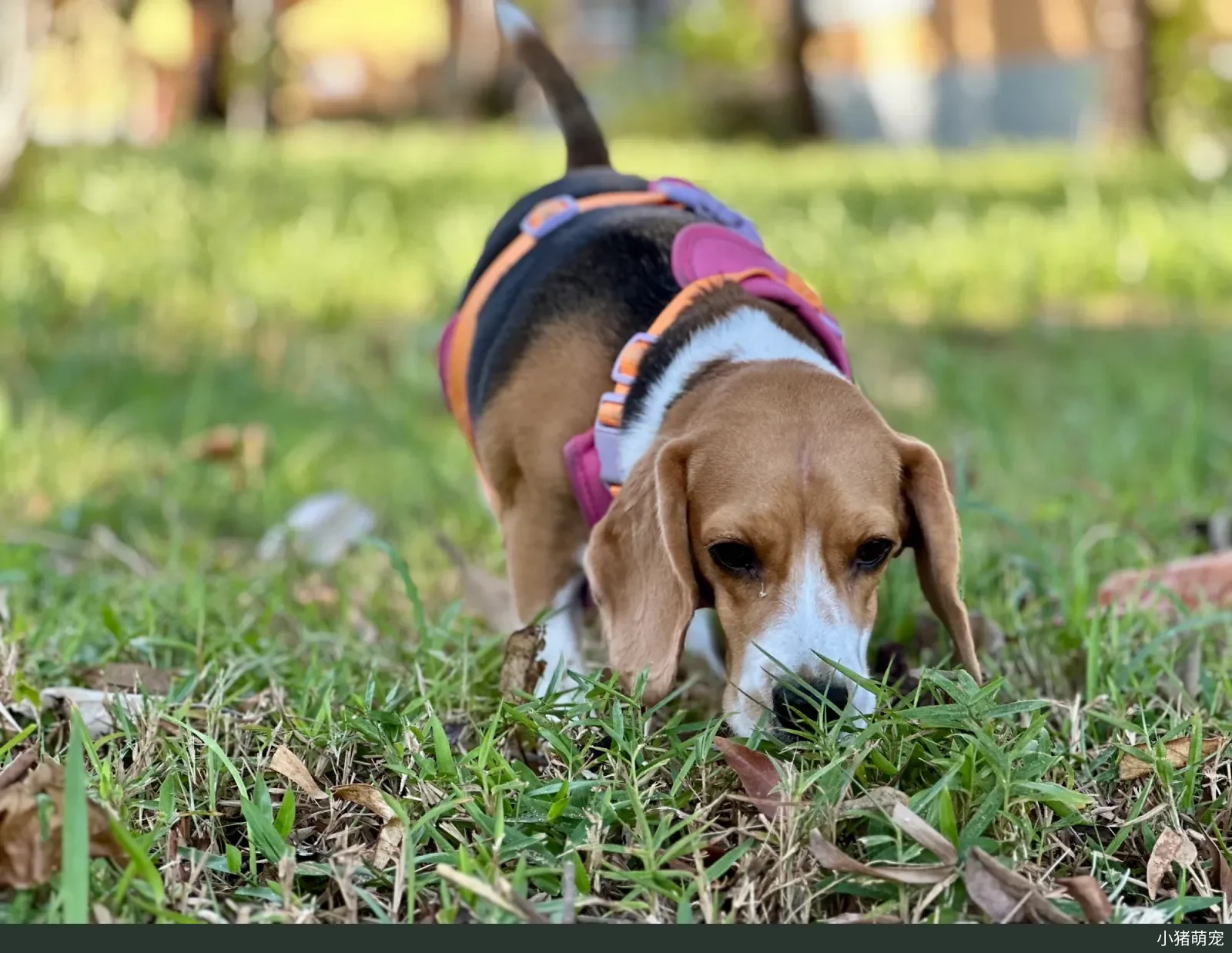
Coco sniffing with head down on the grass (photographed 2023). Photo: Slyronit, from Wikimedia Commons, CC BY-SA 4.0.
Common health issues
Overall, Beagles are not an extreme-conformation breed. A 2025 VetCompass study of UK primary-care veterinary records found that among 3,729 pet Beagles randomly sampled in 2019, the most common diagnoses were obesity (24.27%), periodontal disease (17.78%), overgrown nails (11.61%), otitis externa (11.18%), and anal-sac impaction (10.59%); among 322 Beagles with a recorded death in the study period, median age at death was 11.28 years. Researchers urged owners and veterinarians to prioritize weight control and dental care. The study covered only UK pet Beagles, not laboratory Beagles, and depends on clinic-record accuracy.
Weight and ears are the two day-to-day priorities. VCA notes Beagles’ strong appetite and food drive; obesity worsens joint and spinal problems, so portions and regular exercise matter. Those long hanging ears are a Beagle hallmark and also linked to otitis externa: a 2021 VetCompass study found Beagles had an odds ratio of 2.54 for otitis externa versus crossbreds, and drop-eared breeds overall were higher risk than erect-eared ones. VCA recommends regular ear cleaning.
On inherited disease, Musladin-Lueke syndrome (MLS) is an autosomal recessive condition in Beagles with widespread skin and joint fibrosis and stiffness. A 2010 PLoS ONE study confirmed it is caused by a founder mutation in ADAMTSL2. Per the 2025 VetCompass paper, before the UK RKC’s Assured Breeder Scheme closed in 2024, participating breeders had to test all breeding Beagles for MLS and Lafora disease (a recessive epilepsy-related disorder). VCA materials also list congenital heart defects, cherry eye (prolapsed third-eyelid gland), epilepsy, hypothyroidism, allergic dermatitis, intervertebral disc disease, degenerative joint disease, and cataracts as concerns, without incidence rates. When choosing a puppy, ask breeders for health-test records on the parents; seek veterinary care promptly if something seems wrong.
References
-
American Kennel Club. Official Standard for the Beagle. Approved 10 May 2024; effective 30 July 2024.
-
American Kennel Club. Beagle Dog Breed Information. Publication date not stated.
-
AKC Staff. Beagle History: From Ancient Small Pack-Hounds to Snoopy. American Kennel Club, updated 5 February 2024.
-
Fédération Cynologique Internationale. FCI-Standard N° 161 BEAGLE. Current standard published 8 September 2026.
-
The Royal Kennel Club. Beagle | Breed Standards.
-
The Royal Kennel Club. Beagle | Breeds A to Z.
-
VCA Animal Hospitals (LifeLearn Inc.). Beagle.
-
O’Neill DG, et al. Beagles kept as companion animals in the UK – demography, disorders and mortality. Companion Animal Health and Genetics, 2025.
-
O’Neill DG, et al. Frequency and predisposing factors for canine otitis externa in the UK – a primary veterinary care epidemiological view. Canine Medicine and Genetics, 2021.
-
Bader HL, et al. An ADAMTSL2 Founder Mutation Causes Musladin-Lueke Syndrome, a Heritable Disorder of Beagle Dogs, Featuring Stiff Skin and Joint Contractures. PLoS ONE, 2010, 5(9): e12817.