At the 1922 Winter Carnival in Portland, Maine, a large dog stood on his hind legs and put his front paws in Arthur Walden’s hands. The dog in the photograph was Chinook, the leader of Walden’s sled team and the dog who gave the breed its name. A family today can leave the sled out of the picture. But when a dog this strong and this pleased to be going out with you heads for the door, how do you learn to walk together? [1][2]

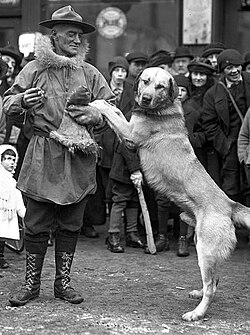
Walden and Chinook greet each other at the Winter Carnival. Evening Express, Wikimedia Commons[2]
Walden had driven sled dogs in northwestern North America. Back in New Hampshire, he set out to breed a dog strong enough to haul freight and fast enough to keep pace with lighter sled dogs. He bred from the offspring of a mastiff-type dog and a Greenland sled dog. His team later went to Antarctica with the Byrd expedition, hauling supplies from the ship to the base. The dogs had to finish one trip and set out on the next. You can see what that work called for in the Chinook’s build and stride. [1]
To get a sense of an adult Chinook’s size, picture a male standing 24 to 26 inches (about 61 to 66 cm) at the shoulder, or a female standing 22 to 24 inches (about 56 to 61 cm). Measured from the point of the shoulder to the point of the buttocks, the dog is a little longer than it is tall. It has moderate bone and firm muscle. Watch one trot and you can see the front legs reach well ahead and the hind legs extend behind. Up close, look for a tawny coat, a broad head that tapers toward the muzzle, and brown, almond-shaped eyes with dark rims. The ears can stand upright, hang down, or fold off to the side. [1][3]

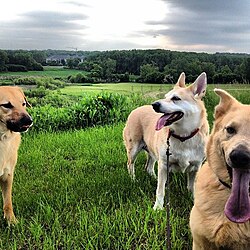
Three Chinooks stand together on the grass. Kathleen Riley, Wikimedia Commons[3]
Make room for a weekday walk
Chinooks are often quiet indoors, energetic outside, and happy to go where their people go. Of the activities the American Kennel Club (AKC) lists, long walks and hikes are among the easiest to work into family life. Think of an ordinary workday. Who will take the leash? Where is there room to stretch your legs? If that person has to work late, who else can go? A mountain trail makes for a fine weekend outing. The walk you can manage when everyone has work or school tells you more about the routine you can sustain. [1]
Different stretches of the same route can serve different purposes. On a familiar, quiet stretch, give yourself and the dog room to settle into a stride. At a crossing, practice stopping and waiting. Before a turn, use a cue everyone in the family knows. When the dog glances back and follows you around the corner, offer praise right then and carry on together. The dog gets a sustained stretch of exercise as well as a reason to pay attention to the person holding the leash. Adjust the distance to the dog’s age, condition, and how easily it is walking and turning that day. [1]
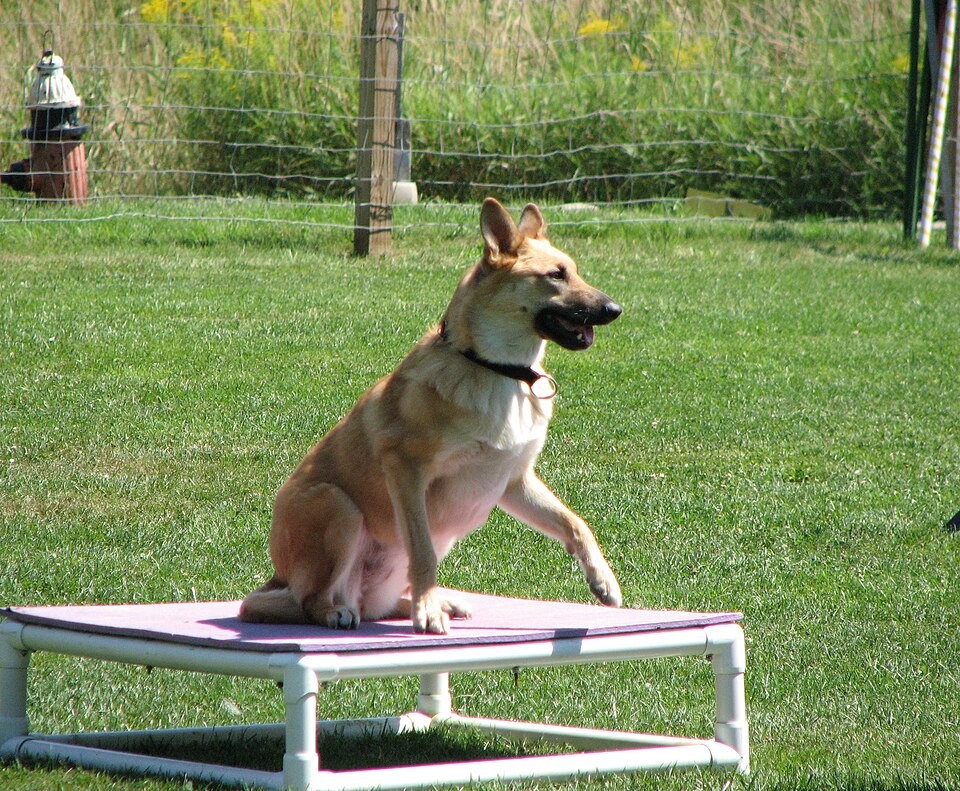
Mahoosuc waits on the agility course. jude, Wikimedia Commons[4]

The photographer jude caught Mahoosuc finishing a five-second hold during an agility run. Running the course and waiting on the platform were both part of the event. A walk calls for much the same cooperation. Your dog can wait while you get the leash ready before opening the door, pause to give someone pushing a stroller room to pass, and walk on when you give the cue. If your family enjoys learning things with a dog, these everyday skills are a place to start. Obedience, tracking, or agility can come later. [1][4]
Teach a greeting with four paws on the ground
One lesson worth teaching early comes before you even leave the house. A young Chinook may be so excited to see someone familiar that it jumps up to greet them face to face. With a little puppy, it’s easy to bend down and catch it. Once the dog stands thigh-high, that same greeting carries a lot more weight, especially for a child or a visitor with their hands full. The AKC recommends early socialization, puppy classes, and positive reinforcement to teach the behavior you want at home. [1]
Ask an adult the dog knows to help. As they approach, have them greet the dog quietly while all four paws are still on the ground. They can bend down to say hello or offer a small treat low enough for the dog to dip its head. If the dog jumps, the person pauses and waits until all four paws are down before greeting it. Start with one calm hello. Try again later with another family member, at the door or out on a walk. With children, an adult can hold the leash and leave enough space for the dog to settle before the child says hello. Whoever comes through the door, the dog learns the same way to get the attention it wants. [1]
Plan for care after the walk
The Chinook’s tawny coat has two layers and sheds a little throughout the year. Once a week, when the dog has settled after a walk, give the coat a thorough brushing to lift out dirt and loose hair. During shedding season, usually twice a year, allow time for a longer brushing session every day. Use one of those weeks to gauge how much grooming your family can fit in. Nails also need regular trimming. Overlong nails can make it painful to put a paw down and interfere with walking and running. [1]
If you are considering a puppy from a breeder, ask to go through the screening results for each parent. The Chinook Club of America lists hip evaluations for dysplasia, eye examinations by a veterinary ophthalmologist, and DNA tests for the multidrug resistance 1 (MDR1) variant and for chondrodysplasia. Match each parent’s identity to the test and its recorded result. A Canine Health Information Center (CHIC) number tells you that the required screenings were completed and the results made public. Both normal and abnormal findings can be recorded, so read the result for each test. [5]
Come back to that weekday walk. Who can go regularly? Who will take a moment to practice a greeting when the dog is delighted to see someone? Who has a little extra time for brushing on an evening in shedding season? Put those jobs on your calendar and it becomes easier to picture life with a Chinook. For a family that likes walking together and enjoys practicing the small things, an ordinary route gives the dog a use for the same stamina and teamwork its ancestors brought to a sled. [1]
References
-
[1] American Kennel Club. Chinook Dog Breed Information.
-
[2] Evening Express. Arthur T. Walden and Chinook. February 11, 1922.
-
[3] Kathleen Riley. Chinook dogs. September 6, 2013.
-
[4] jude. Chinook Olympics 07 136. 2007.
-
[5] Chinook Club of America. Health Statement. Effective September 1, 2022.