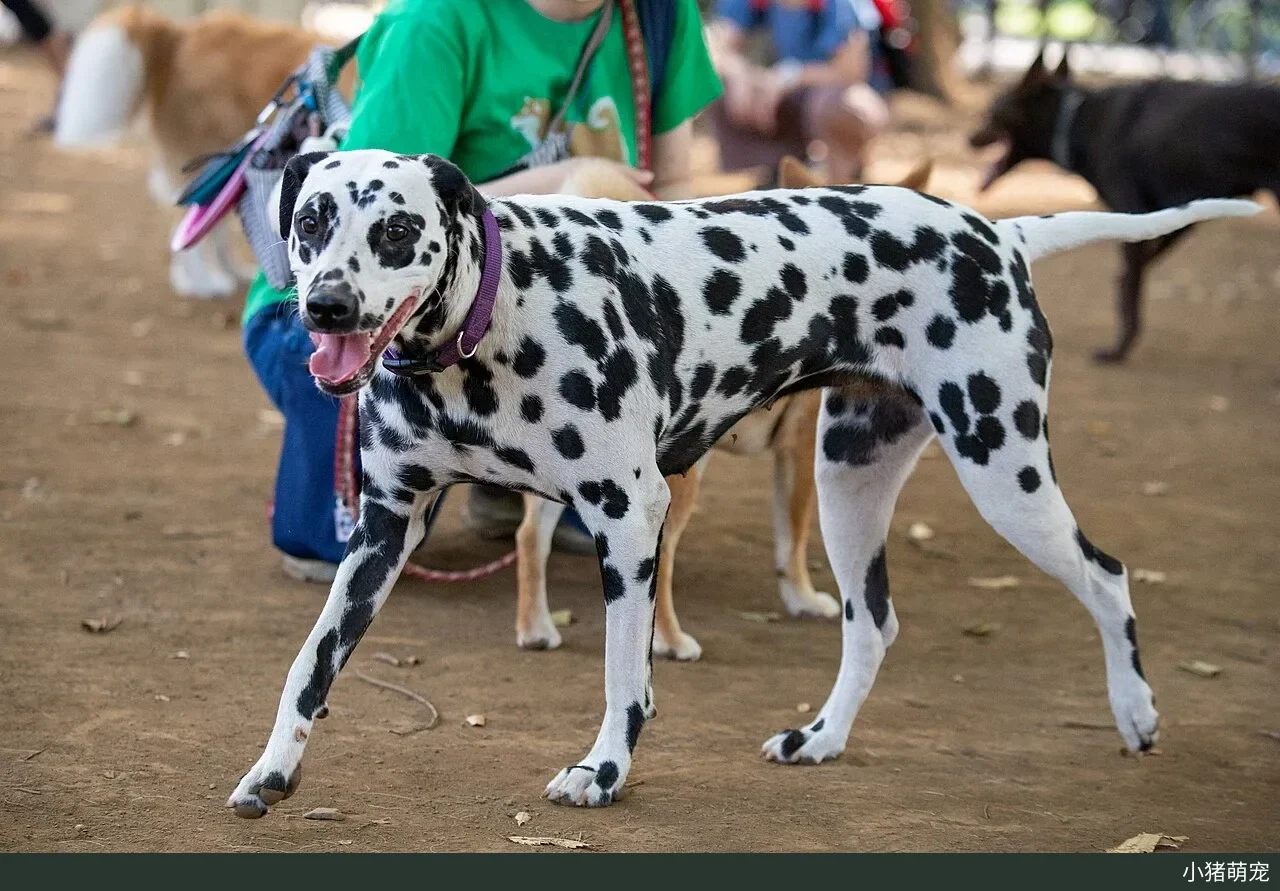
A black-spotted Dalmatian on an outdoor walk, photographed September 2020. Source: whity (Daisuke Shirono) / Wikimedia Commons, CC BY 2.0.
The Dalmatian is the familiar “spotted dog.” The FCI registers Croatia as its country of origin; the British called it the “coach dog”: it once trotted beside carriages, guarding horses and cargo, and later became a firehouse mascot. It has outstanding stamina and needs plenty of daily exercise; puppies are born pure white, and the spots take weeks to appear. Anyone considering the breed should know about two inherited health risks: congenital deafness and urate stones.
Disputed origins and the coach-dog years
The Dalmatian’s ancestry has long been contested. Per the historical sketch in FCI Standard No. 153 (current version published 13 October 2010), spotted dogs of this type appear in an altar painting from about 1600–1630 in a church in Veli Lošinj on the Croatian island of Lošinj, and in a mural in Zaostrog in Dalmatia; Croatian church chronicles of 1719 and 1737 record it under the Latin name “Canis Dalmaticus.” On that basis the FCI registers Croatia as country of origin and places the breed in Group 6, “Scent hounds and related breeds.” The Royal Kennel Club, however, finds little solid evidence for an origin on the Dalmatian coast; the AKC also says that among breeds with murky pasts, the Dalmatian is among the most disputed. A cautious summary: the name comes from the Dalmatia region; the exact origin remains unsettled.
What made the breed famous was coach-dog work. The FCI standard notes that in 1771 the English naturalist Thomas Pennant called it “Dalmatian” in Synopsis of Quadrupeds, and that Thomas Bewick’s 1790 work used “Dalmatian or Coach Dog.” The Royal Kennel Club explains that by the late eighteenth century these white dogs with spots were used to follow coaches and guard passengers and goods; in the Regency period (1795–1837), a spotted dog trotting beside a carriage became a status symbol, and at night they watched the stables. Later they ran ahead of horse-drawn fire engines to clear the way. The Dalmatian Club of America (DCA) says that at chaotic fire scenes they also helped calm the horses. Fire engines are no longer horse-drawn, but the “firehouse dog” image has stayed.
Breed standardization came much later: per the FCI standard, the Englishman Vero Shaw wrote the first informal standard in 1882; after the Dalmatian Club was founded in Britain in 1890, it became the first official standard; the FCI published its own first version in 1955. The current FCI standard lists the use as “hunting dog; companion dog, family dog, suitable for various types of training.”
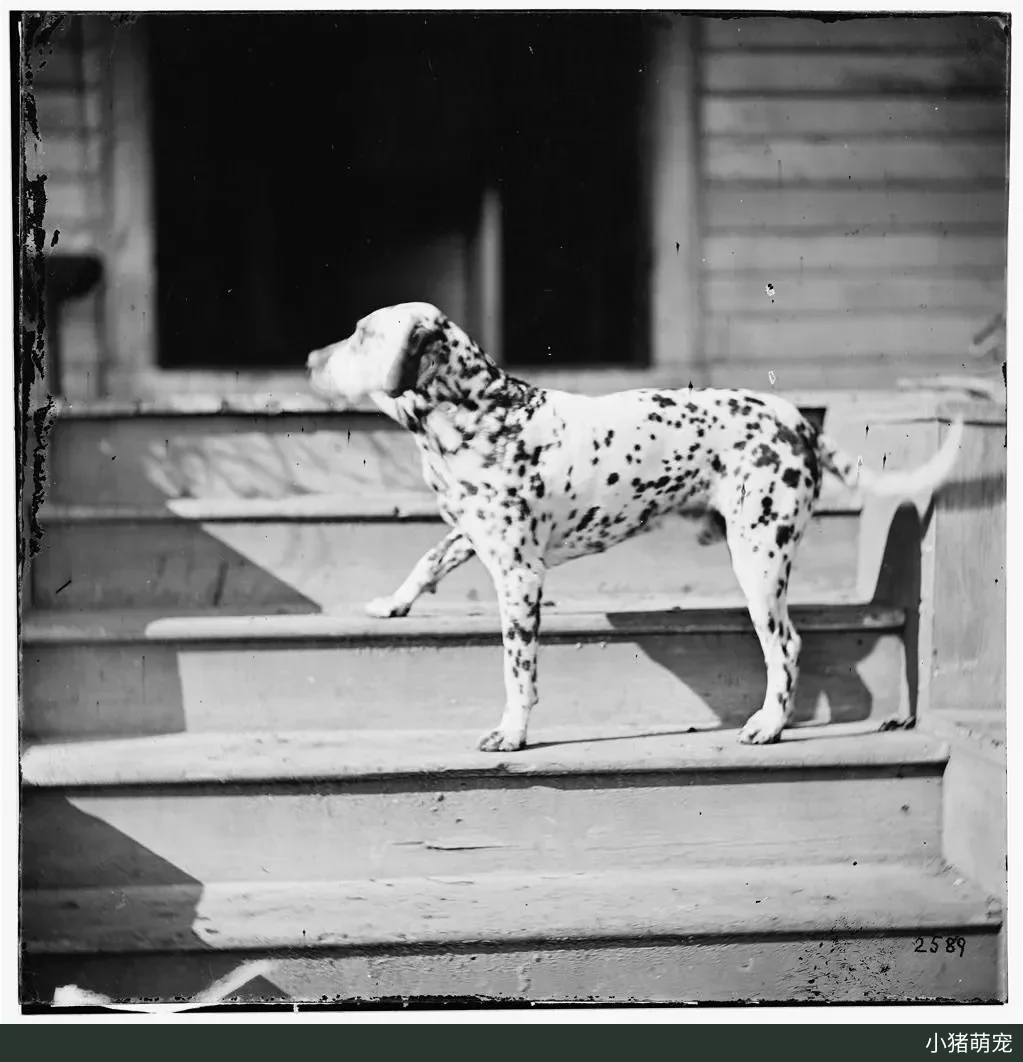
About March 1865, City Point, Virginia, U.S.A.: a Dalmatian belonging to General Rufus Ingalls stands on a wooden cabin step; the negative sleeve is labeled “Coach dog.” Source: Library of Congress Prints and Photographs Division / Wikimedia Commons, no known copyright restrictions.
How spots develop, and the standard
Many people are surprised the first time they see Dalmatian puppies: they are born all white. An AKC article updated in September 2026 explains that true spots usually begin to appear at about two weeks of age and may keep developing past one year. Large areas of color present at birth are not spots but “patches”; the two differ in both development and genetics. The AKC standard disqualifies patches; the FCI standard also disqualifies patches around the eyes or elsewhere on the body.
The two major standards describe a “handsome spot” similarly: pure white ground color, with black or liver-brown spots, and both colors must not appear on the same dog (“tricolor,” a disqualification in both). The FCI says black spots ideally measure 2–3 cm across, liver spots slightly smaller at about 2 cm; the AKC describes spots from the size of a dime to a half-dollar, evenly distributed, with as little coalescing as possible. Spots on the head, limbs, and tail are usually smaller than on the body; ears preferably have spots too. The DCA adds that no two Dalmatians have identical spotting; liver is recessive and rarer than black, but that does not make it more “valuable.”
How the spots arise is still being pieced together. Bannasch et al. (2008) note that the Dalmatian coat pattern involves at least three spotting-related genes. The AKC article summarizes current thinking that spotting may reflect the combined action of an “extreme white” genotype (sw/sw), a roan-related mutation identified in 2021 research (colored hair mixed with white), and genetics that amplify spotting—mechanisms still to be confirmed.
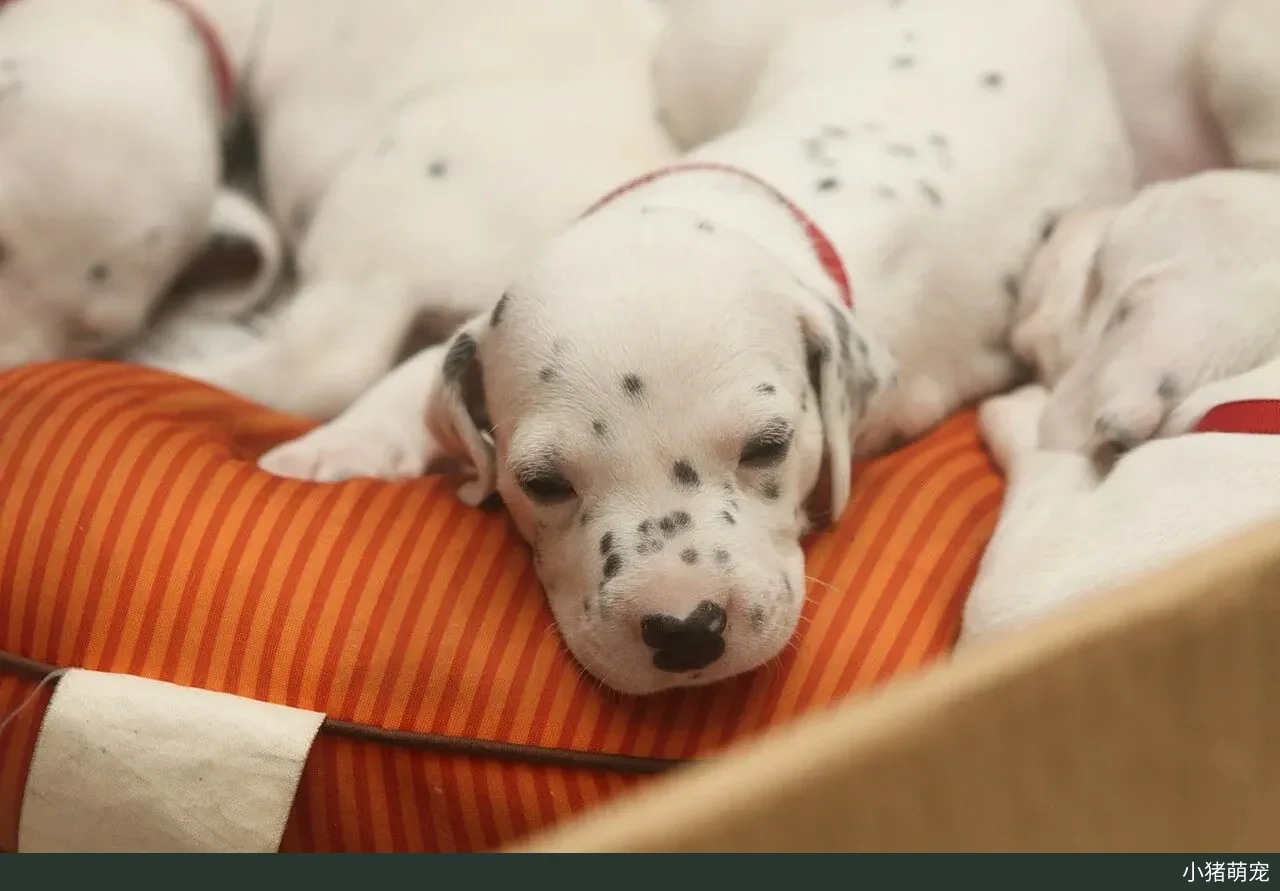
Dalmatian puppies about three weeks old, with only scattered small black dots on face and body—spots still developing; photographed December 2013. Source: Carlos Estrada / Wikimedia Commons, CC BY-SA 3.0.
Temperament, size, and exercise needs
The FCI standard describes temperament as friendly, neither shy, nervous, nor aggressive; lively, loyal, independent, easy to train, fond of water and outdoor activity, with a clear hunting instinct retained. The AKC standard asks for a stable, outgoing yet dignified temperament, with shyness a serious fault. The AKC breed page also notes that Dalmatians can be reserved with strangers, make reliable watchdogs, and with their own people are intelligent, loyal, and affectionate. On size, the FCI standard gives height at the withers of 56–62 cm for males and 54–60 cm for females; the AKC ideal is 19–23 inches (about 48–58 cm), with over 24 inches (about 61 cm) a disqualification. The AKC breed page gives weight as 45–70 pounds (about 20–32 kg) and expected lifespan 11–13 years.
For Dalmatians, exercise comes first. The DCA explains that they were historically bred to trot beside coaches all day, so they have abundant energy and need physical exercise every day; well-bred and well-raised individuals are usually not “crazy.” AKC-suggested outlets include fetch in the yard, jogging or biking with the owner, and long hikes—but bones and joints are not mature until about two years of age, so high-intensity work should wait; without enough physical and mental activity, the dog will readily “find something to do.” On training, the AKC notes Dalmatians can be sensitive and need positive, reward-based methods, plus early socialization. Grooming is easy: the coat is short and dense; the AKC suggests brushing weekly with a horsehair glove or rubber curry, nail trims at least monthly, and regular checks of the drop ears.
Congenital deafness and urate stones
Congenital deafness is the Dalmatian’s best-known genetic concern. In a 2004 Veterinary Journal paper, Louisiana State University veterinary researcher George Strain pooled brainstem auditory evoked response (BAER) data on 5,333 Dalmatians and found a 29.9% deafness rate—the highest among eight breeds studied; his 1992 study (1,031 dogs) broke that into 21.6% unilateral and 8.1% bilateral deafness. This deafness is linked to white-coat pigmentation genes: a lack of melanocytes in the inner ear leads to degeneration of auditory structures soon after birth. The research also found blue eyes positively associated with deafness, patched individuals less often deaf, and no difference by sex or between black and liver spotting. Note that these data are mainly from the United States; Strain mentions lower rates reported in Europe, possibly because most European standards disallow blue eyes. The current FCI standard does list blue eyes, partly blue irises, and deafness as disqualifications, while the AKC standard allows blue eyes.
Deafness can be detected in puppyhood. The DCA explains that responsible breeders BAER-test puppies before they go to new homes: fine electrodes under the scalp record whether the brain responds electrically to clicks played into one ear at a time, usually without sedation; testing is typically at 5–7 weeks and should not be earlier than 5 weeks. BAER only tells whether each ear “hears or not”; it does not grade hearing quality. The DCA Foundation says unilaterally hearing dogs are often hard to tell from normal dogs in daily life, though they may have more trouble locating sound direction; bilaterally deaf puppies need extra training and more careful placement. The DCA’s position: unilaterally deaf dogs can be good companions but generally should not be bred; bilaterally deaf dogs must never be bred. When choosing a puppy, ask the breeder for BAER results for the puppy and both parents.
The second issue is uric-acid metabolism. Bannasch et al. (2008) in PLOS Genetics note that most mammals convert purines to readily soluble allantoin, whereas humans, great apes, and Dalmatians end at uric acid. In Dalmatians, hepatic and proximal-tubule transport of uric acid is inefficient because of a missense mutation in SLC2A9—an autosomal recessive trait; the paper states that all Dalmatians are homozygous for the mutation. Urine and blood uric acid run high, favoring urate bladder stones that often need surgical removal. Researchers suspect the mutation is tightly linked to a locus affecting spot size and may have been “hitchhiked” when more conspicuous spotting was selected. Not every hyperuricosuric dog forms stones; OMIA-cited research shows stones are more common in males, with mean age at first stone about 4.5 years in males and 5.5 in females.
For daily care, the DCA advises that Dalmatian diets should not be excessively high in protein; ordinary commercial dog food is usually well tolerated, but extra meat and table scraps should be avoided. For dogs that have already formed urate stones, the 2016 ACVIM urolithiasis consensus recommends reducing recurrence on three fronts: more water intake, alkaline urine (pH ≥ 7), and limited purine intake; high-moisture wet food or water added to dry food can help, aiming for urine specific gravity no higher than 1.020. High-purine foods are mostly also high-protein foods, especially organ meats and fish. Whether to switch to a prescription diet or use medication is a veterinary decision based on urinalysis and imaging. If a dog urinates frequently, has blood in the urine, or strains repeatedly without producing urine, a stone may be blocking the tract—seek care promptly.
References
-
Fédération Cynologique Internationale (FCI). FCI-Standard N° 153 DALMATINSKI PAS (Dalmatian). Current official standard published 2010-10-13, English version 2011-05-30.
-
FCI. DALMATINSKI PAS (153) breed nomenclature page. Accessed 2026-10-18.
-
American Kennel Club (AKC). Official Standard of the Dalmatian. Approved 1989-07-11, effective 1989-09-06.
-
AKC. Dalmatian Dog Breed Information. Accessed 2026-10-18.
-
Coile C. Why Do Dalmatians Have Spots? The Genetics Behind Their Iconic Coat. AKC, updated 2026-09-17.
-
The Royal Kennel Club. Dalmatian | Breeds A to Z. Accessed 2026-10-18.
-
Dalmatian Club of America. FAQ’s. Accessed 2026-10-18.
-
Dalmatian Club of America. A Primer for BAER Hearing Testing. Accessed 2026-10-18.
-
Dalmatian Club of America Foundation. Hearing. Accessed 2026-10-18.
-
Strain GM. Deafness prevalence and pigmentation and gender associations in dog breeds at risk. The Veterinary Journal, 2004, 167: 23–32.
-
Strain GM, et al. Brainstem Auditory-Evoked Potential Assessment of Congenital Deafness in Dalmatians: Associations With Phenotypic Markers. Journal of Veterinary Internal Medicine, 1992.
-
Bannasch D, et al. Mutations in the SLC2A9 Gene Cause Hyperuricosuria and Hyperuricemia in the Dog. PLOS Genetics, 2008.
-
Lulich JP, et al. ACVIM Small Animal Consensus Recommendations on the Treatment and Prevention of Uroliths in Dogs and Cats. Journal of Veterinary Internal Medicine, 2016.
-
Online Mendelian Inheritance in Animals. OMIA:001033-9615 Urolithiasis in dog. Accessed 2026-10-18.