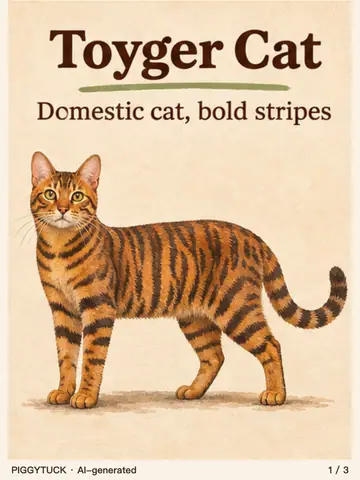
The Toyger (WCF code TOY) is a medium-sized domestic cat bred for tiger-like striping and movement. Its foundation cats included Bengals, domestic shorthairs, and street cats.[1] In the late 1980s, American breeder Judy Sugden noticed two spots at the temples of a cat she was breeding for clearer tabby markings. They gave her a starting point for a pattern that curved around the face like a tiger’s. Early foundation cats included the domestic shorthair Scrapmetal and the Bengal Millwood Rumpled Spotskin; in 1993 Sugden added a Kashmir street cat named Jammu Blu. Her mother, Jean S Mill, was one of the founders of the Bengal breed.[2]
A Toyger still needs the everyday provisions of a domestic cat: secure places to rest, regular play, and access to resources without competition.[3]
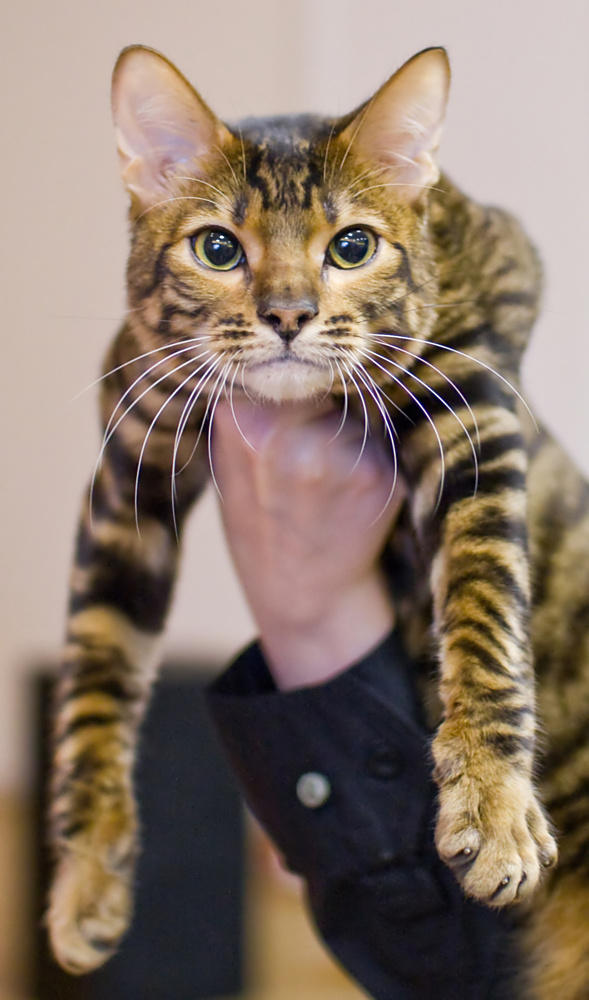
Figure: Roman Toygers Cispius held up; face and foreleg stripes visible. Heikki Siltala, catza.net[4]
Body, head, and tiger striping in the standard
The body is medium, long, and muscular with curved contours, strong and robust; shoulders may visually interrupt the topline; the neck is long and muscular; the chest is broad and deep without interrupting the neckline from head to forelegs; legs are medium so ground-to-body distance equals torso depth, equal front and back; paws are oval and large with long toes.[1] The tail is very long, set and carried low, muscular, with a blunt rounded black tip.[1] The head is medium, long, broad, and deep, with well-defined muscular rounded contours; the profile is straight with an angle change above the eyes, a slightly concave nose line acceptable; the muzzle is medium to long and deep, and from the front an upturned heart shape runs from forehead to rounded whisker pads; the nose line widens toward the end at least to the inter-eye distance, with a wide nose leather desired; the chin is very firm.[1] Ears are small to medium (small preferred) with rounded tips, wide-set toward the back of the head, with a required thumb print; lynx tips are undesirable.[1] Eyes are small to medium, wide-set, hooded and slightly slanted; a strong deep colour is preferred.[1] The coat is uniformly short, thick, very soft but resistant, with moderate undercoat; slightly longer jowl fur suggesting a frill is desired; some glitter is required—the more the better without excessive loss of contrast or white base.[1]
Only black mackerel tabby is allowed: colour from black to brown to even tan on a contrasting base; very dark clear markings on a golden-orange base are desired; lighter base areas should be uniformly light to almost white, including belly, underside of the tail base, insides of legs, and chest; paw pads and tail tip are black.[1] Body pattern is vertically aligned stripes with encircling markings on neck, legs, and tail; bold braided non-uniform stripes including stretched rosettes are preferred; facial markings align circularly, with preference for the forehead “M”; eyelid rims and lips are black, and a bright/white eye rim (“glasses”) is desired.[1] Faults include any pattern other than mackerel tabby and no glitter; certificate-excluding faults include non-recognisable pattern, missing belly and chest pattern, missing black tail tip, and blue eyes; medallion/lockets disqualify; no permitted outcrosses.[1] Points: body 20, head 25, ears 5, eyes 5, coat texture/length 10, coat colour 30, condition 5—colour and pattern carry heavy weight as the recognition axis.[1]
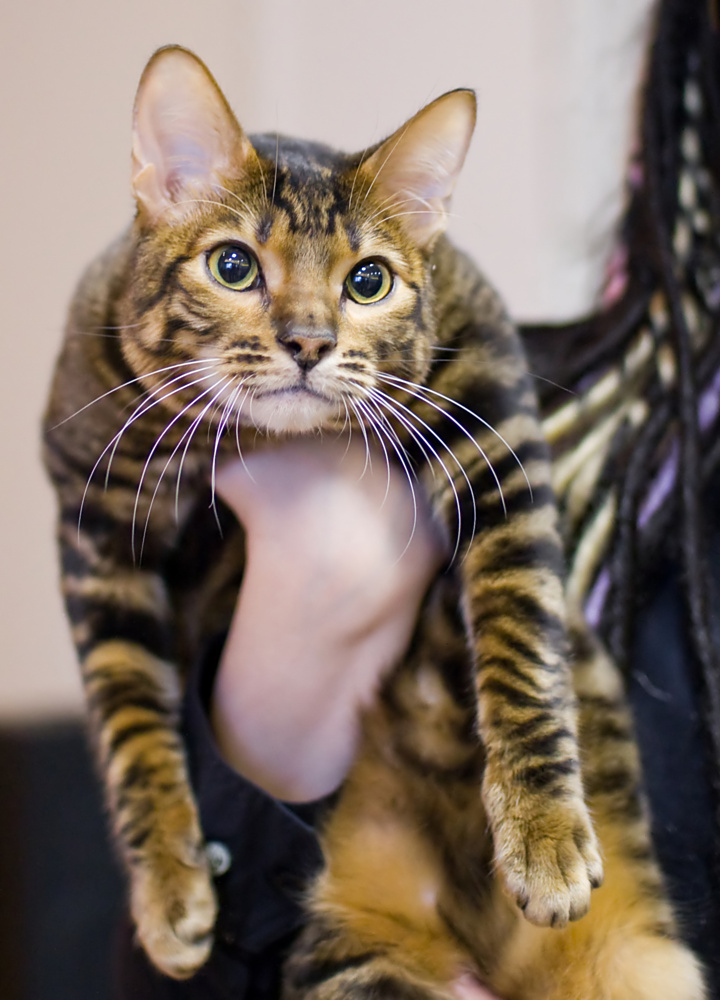
Figure: Same Toyger, a second frontal exposure with ringed forelegs. Heikki Siltala, catza.net[5]
Short-coat care and the five indoor pillars
Indoor living can reduce the chance of injury. Make room for five kinds of needs: a safe retreat, separate resources, opportunities to play and stalk, predictable positive interaction with people, and respect for the cat’s sense of smell and other senses.[3] Provide a sturdy place to climb, several places to hide, food and water away from litter, and regular opportunities to play. In multi-cat homes, spread out the resources so one cat cannot easily block another’s access.[3]
A Toyger’s short, thick coat is soft but resilient and can have a glittery sheen.[1] Gentle weekly brushing usually removes loose fur and keeps the coat in good condition. It is also a chance to check the skin and notice changes in shedding.[2] Colour and stripe contrast serve to identify the breed. Assess grooming needs by looking at the individual cat’s coat.[1][2]
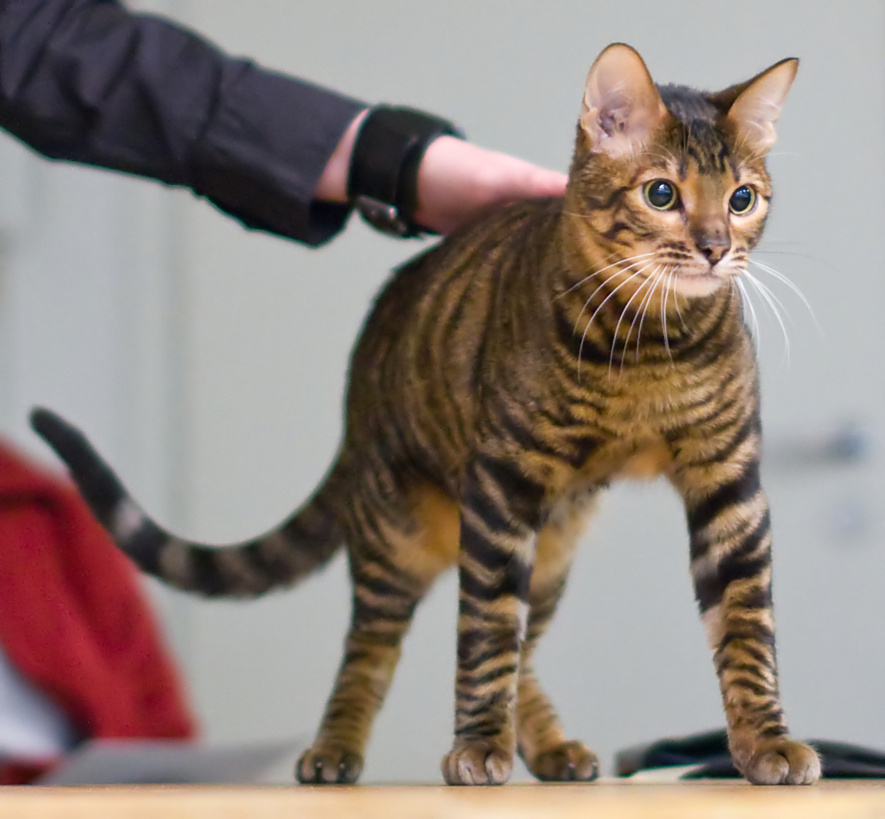
Figure: Cispius standing on a table; body stripes and ringed tail visible. Heikki Siltala, catza.net[6]
Breeding screens and health talk
The Bengal contributed to the Toyger’s development. Ask about a cardiac ultrasound for hypertrophic cardiomyopathy (HCM) and DNA tests for pyruvate kinase deficiency (PKDef) and Bengal progressive retinal atrophy (Bengal PRA). Breeders can also check hind-leg conformation, including occasional cow hocks; reduced milk production has been reported in some lines.[2]
The claim that this breed is more prone to adverse reactions to feline leukaemia vaccination remains unconfirmed. Discuss vaccination with the attending veterinarian.[2] If you notice changes in gait, breathing, appetite, or vision, have the cat examined. Coat markings and show conformation describe appearance.[1][2]
Look for a medium, muscular cat with a low-set, long, black-tipped tail and a glittering black mackerel tabby pattern. If the tail tip or underside is hidden in a photo, inspect the cat or check its registration.[1] Before bringing a kitten home, ask about cardiac ultrasound and the relevant DNA tests. At home, make time for light brushing, familiar play, and safe retreats.[2][3]
References
-
WCF (2020-01-05). Breed standard: Toyger (TOY).
-
GCCF. Toyger.
-
FelineVMA (2025-08-28). Indoor cats position statement news.
-
Siltala, H. Toyger photo 113032.
-
Siltala, H. Toyger photo 113037.
-
Siltala, H. Toyger photo 113054.