In the forests of Karelia, the first bark a hunter hears often means the search is over. A Karelian Bear Dog can follow a trail quietly on its own. Once a moose or bear comes to a standstill, the dog barks repeatedly, giving the hunter a sound to follow. When systematic breeding began in 1936, breeders sought a sturdy dog that could search independently and announce a find. The first breed standard was drawn up in 1945, and the Finnish Kennel Club registered the first dogs the following year. In the United States, the American Kennel Club (AKC) lists the Karelian Bear Dog in its Foundation Stock Service (FSS). [1][2]
To recognize a Karelian Bear Dog in profile, start with the shoulders, back and legs. This medium-sized spitz is slightly longer than it is tall at the shoulder. Sturdy legs support a substantial body, and the belly rises only slightly toward the hind legs. The breed standard from Finland gives an ideal shoulder height of 57 cm for males and 52 cm for females. In the photograph below, the dog stands broadside on grass. The white collar catches the eye against the black body. Follow the outline and you can see the line of the back, the upright ears and the tail curving over the back. [2]
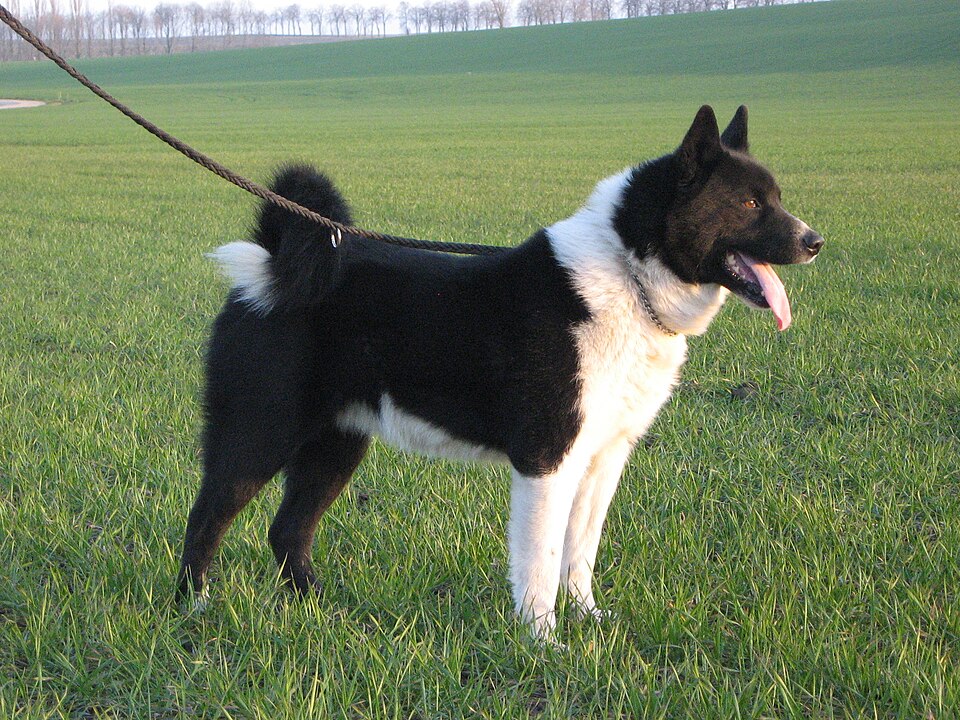
A Karelian Bear Dog stands in profile. Fraczek.marcin, Wikimedia Commons[4]

On another dog, the white markings may be less conspicuous. The standard gives black as the base color. Most dogs have sharply defined white markings on the head, neck, chest, belly or legs. The dog in the next photograph faces left and looks almost entirely dark on the side facing the camera. That makes it easy to trace the silhouette from the tips of the ears down the thick neck and shoulders, and to see the length of the legs. Looking at the two dogs together gives you more to recognize than a single white collar. [2]
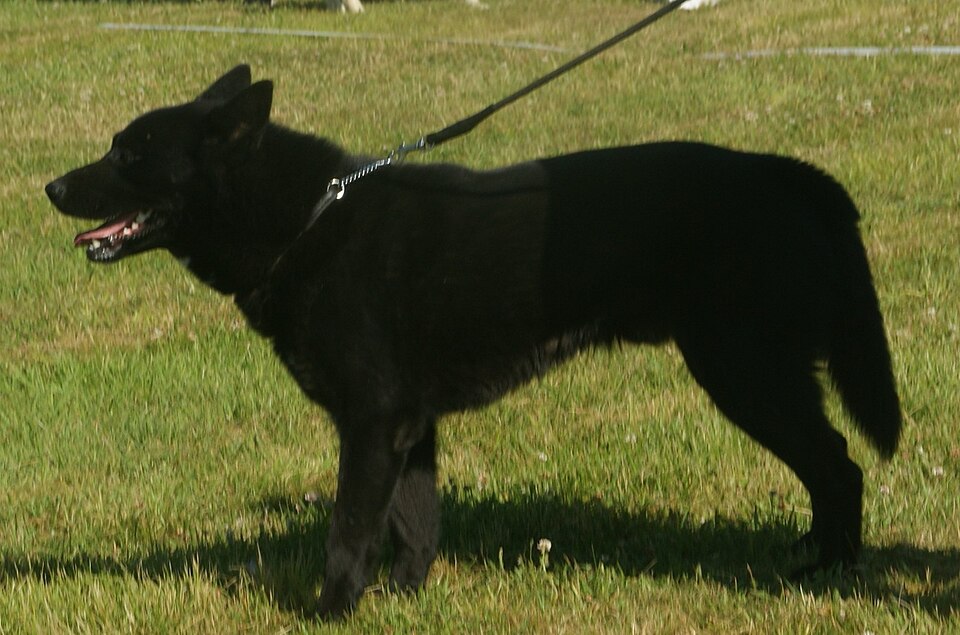
The dark coat shows the outline of the body. Canarian, Wikimedia Commons[5]

Before the first bark
On a family walk, the quiet part of the search is easy to miss. You may still be walking straight ahead when the dog at the other end of the leash has already turned to follow a scent. If you wait for a bark before reaching for the leash, you have picked the moment when the dog is most absorbed. Clip the leash on before you go through the gate, and give the dog time on walks to pause, sniff and choose a direction. A securely fenced area gives it room to explore freely. [1][2]
The AKC suggests indoor hide-and-seek. One way to play is to give the search a finish the dog can learn. Let the dog watch you place a familiar toy beside the leg of a chair, then give the signal to find it. When the dog finds the toy and looks up, say its name once. As it turns toward you, take two steps back. Reward it when it reaches you, then send it to search again. The dog gets to use its nose to find the right spot, and coming back to you becomes part of the game. [1]
Once the dog can come back from the chair, try the game in an enclosed yard, then practice on leashed walks. Call just as the dog finishes sniffing a spot and lifts its head. Reward it when it comes within reach, then let it go back to sniffing. If it stands at a fence watching a small animal on the other side, keep hold of the leash and walk a few steps away. Try again when the dog can turn to look at you. At home it may come readily from beside the toy. At the garden gate, how far from the distraction does it need to be to do the same thing? Remembering that distance will help you choose where to practice next. Repeating the dog's name from the same spot tells you little.
Build the day around several outings. A morning walk can leave time to investigate scents. Later, take a path where it is easy to turn and give the dog a few chances to change direction with you. In bad weather, hiding a toy indoors or rolling a ball along the floor gives it something to do. Families who enjoy a regular class can work agility or obedience into the week. Let the dog's age, stamina and energy that day guide the length of each outing. When deciding whether the routine will work for your family, think about who can take the dog out several times on a busy weekday. An occasional long weekend walk is a poor guide to the rest of the week. [1]
How much room is there outside your door?
Walk the route from your front door and notice where you are likely to meet other dogs. A Karelian Bear Dog may be reserved with unfamiliar people and assertive with other dogs. Territorial encounters between males deserve particular attention. If the elevator opens and a dog is already inside, can you step back and wait for the next one? Where could you turn off before reaching a narrow stretch of path? A fenced yard makes exercise easier to arrange, and several outings a day can be worked into apartment life. A narrow exit that brings dogs face-to-face every day is a more specific concern to weigh. [1][2]
If you already have a dog, watch what happens when the two meet. Can each walk away and follow its own handler? Will they have separate places to rest indoors? Families with young children also need to allow time for adult supervision. The AKC rates the breed relatively low for compatibility with young children. Picture one adult guiding the dog past another dog while also looking after a toddler. Both may need that adult's hands at the same moment. Before bringing the dog home, talk through who can share those times of day. [1]
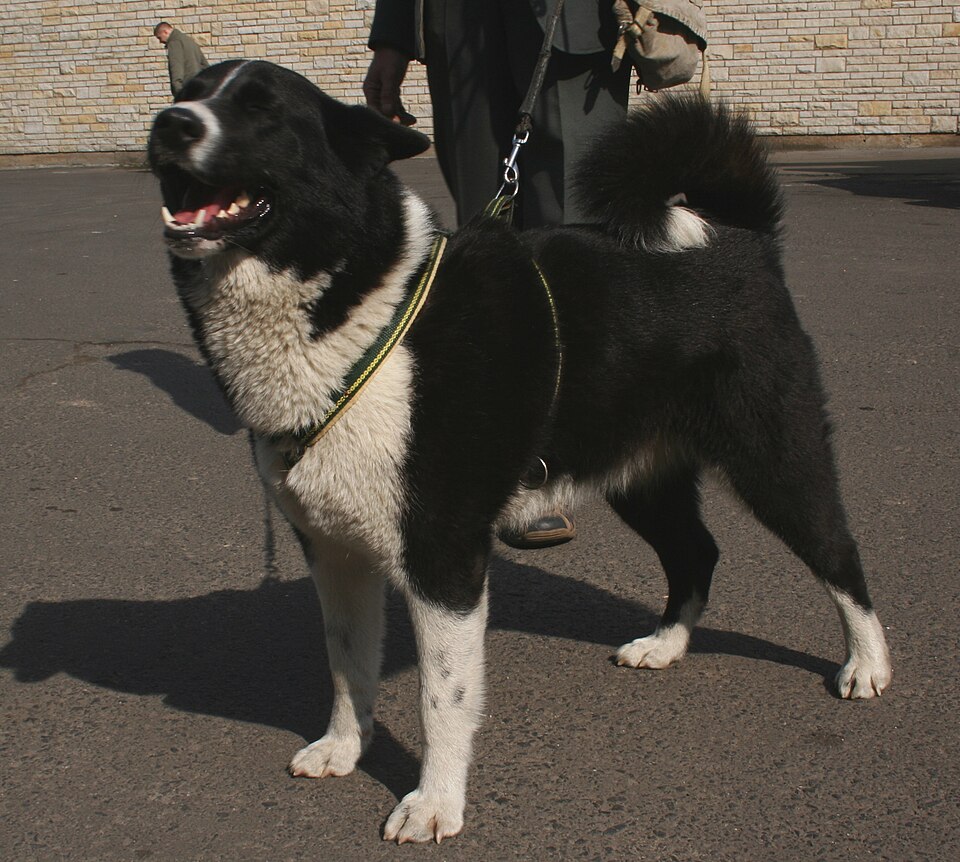
White fur stands out on the neck, chest and tail tip. Pleple2000, Wikimedia Commons[6]

What can you check during weekly brushing?
In the show photograph, the coat forms a thick ruff around the neck and chest. The Karelian Bear Dog has a double coat. The outer hairs are harsh and straight, growing longer on the neck, back and backs of the thighs. Beneath them lies a soft, dense undercoat. The AKC recommends weekly brushing and an occasional bath as needed. At the sides of the neck and backs of the legs, part the longer hairs with your fingers and brush through to the undercoat a small section at a time. Use the same session to look inside the ears for wax or debris and check the nails. The strong nails grow quickly and need regular trimming to keep them from growing long and splitting. Make toothbrushing a regular habit of its own. [1][2]
Before bringing home a puppy, ask the breeder about eye health. The European College of Veterinary Ophthalmologists lists progressive retinal atrophy associated with prcd in the Karelian Bear Dog. Ask to see the eye examination records for both parents and any relevant genetic test results. Look at which dog each report identifies and what it tested for, then ask how the breeder took those findings into account when choosing the pairing. If your own dog later starts bumping into obstacles repeatedly in familiar places, note when it happens and under what conditions. Give those details to your veterinarian and arrange an eye examination. The parents' records help you understand inherited risk. A change in your dog's vision calls for an assessment of that dog. [1][3]
References
-
[1] American Kennel Club. Karelian Bear Dog.
-
[2] Fédération Cynologique Internationale. FCI-Standard N° 48: KARJALANKARHUKOIRA (Karelian Bear Dog). English edition, 27 May 2015.
-
[3] European College of Veterinary Ophthalmologists. ECVO Manual: Breeds — Karelian Bear Dog. 2021.