A brown spotted cat with a short tail might catch your eye as a possible Pixiebob. In its standard for the shorthair, titled Pixiebob SH, the World Cat Federation (WCF) singles out three features together: the short tail, eyes set deep beneath a heavy brow, and a well-developed, fleshy chin. The International Cat Association (TICA) uses the name Pixiebob for both shorthaired and longhaired cats. A side view shows the outline of the body and tail, while a front view brings the eyes and muzzle into focus. An individual cat’s pedigree establishes its breed identity. [1][2]
When the cat stands naturally, follow the line from shoulder to hip. WCF describes a muscular, medium-to-large cat with a broad chest and prominent shoulder blades. The hind legs are slightly longer than the forelegs, so the back rises gently toward the hips. The standard allows considerable variation in the tail. Its bony length ranges from two inches, about five centimetres, to the hock, the backward-pointing joint on the lower hind leg, with the leg extended. Kinks and curls are acceptable. A resting cat may tuck part of its tail alongside its body, hiding its full length in a photograph. [1]
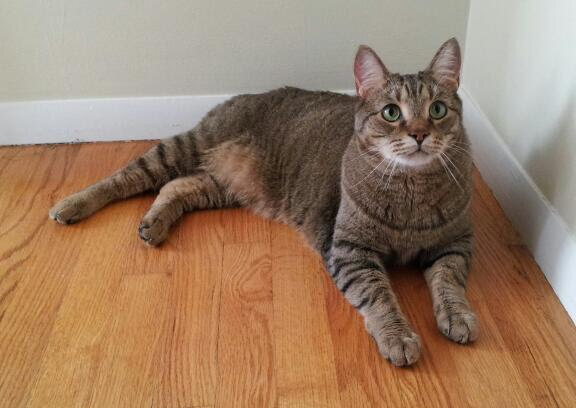
Figure: A Pixiebob in profile. Charity Davenport, Wikimedia Commons[7]

Seen head-on, the head resembles an upside-down pear. The muzzle is broad, with plump, gently rounded whisker pads. In profile, the depth of the chin is easier to see, its front edge roughly in line with the nose. Beneath bushy brows, heavy upper lids give the eyes a soft triangular shape. Pale fur rims each eye, and a dark marking runs from the outer corner down the cheek. The lids can give even an attentive cat a sleepy look. Watch what happens when a toy moves: does the cat follow it, come closer or turn back to its resting place? [1][2]
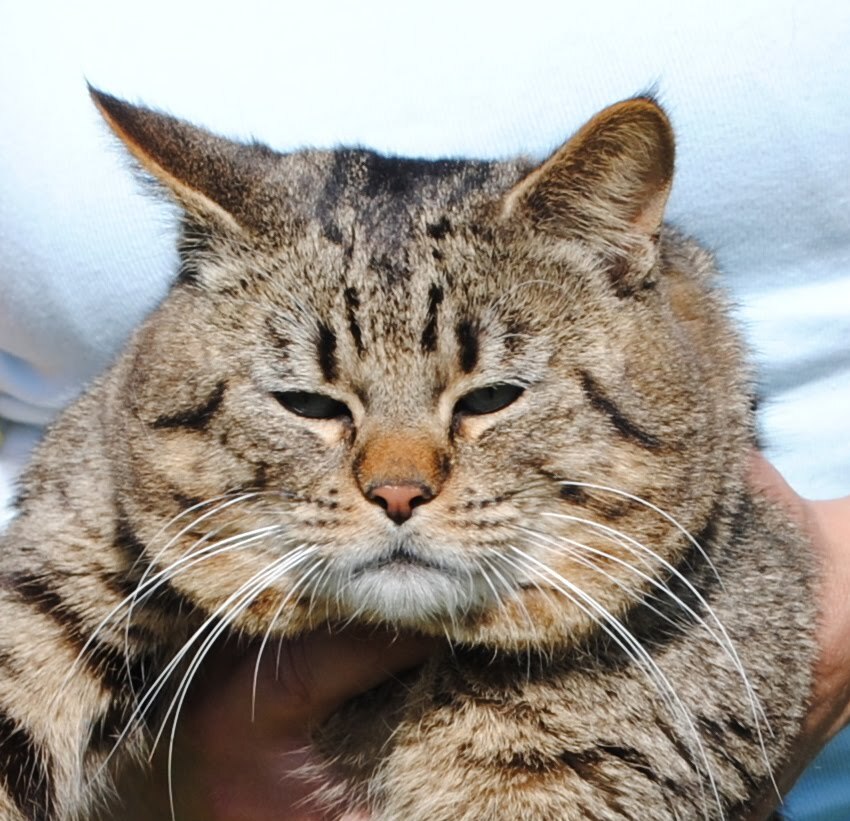
Figure: The Pixiebob’s brow and muzzle. Donna and Bryan Cox, Wikimedia Commons[8]

The WCF shorthair standard describes a brown spotted tabby with small to medium spots, including spots on the belly. Bands of lighter and darker colour on individual hairs soften the outlines of the spots. The coat itself is springy and stands slightly away from the body, with longer hair on the belly. TICA also describes a longhaired variety. The kittens pictured below give a good view of the markings across their backs. When choosing a grooming tool for your own cat, feel the coat and see whether the comb passes through it comfortably. [1][2][3]
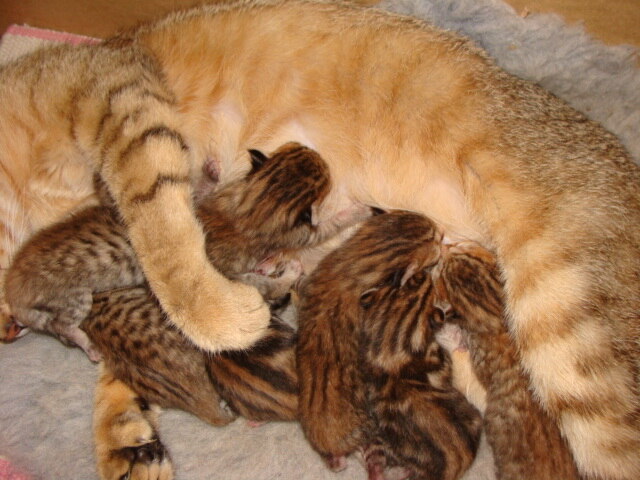
Figure: Back markings on shorthair kittens. Gertrud Keazor, Wikimedia Commons[9]

TICA recommends regular grooming. Start on a steady surface and let the cat show you where it welcomes the brush. Many cats enjoy strokes around the head and neck but are more sensitive around the hind legs, under the tail and across the belly. Keep sessions brief and put the brush away when the cat walks off. For a small tangle, support the hair close to the skin with one hand and gently tease the ends free with the other. Leave tight mats close to the skin for a veterinarian to handle. Scissors can easily catch the skin underneath. [2][3]
When setting up a window perch for a broad-chested cat, picture the whole trip up and down. A sill might hold all four paws, but does it have enough depth for the cat to shift its hind feet and turn around? Can it stretch out on its side? A sturdy low stool can provide a step up from the floor and a way back down. Leave a lower resting spot available too. Where the cat chooses to settle will tell you something about both the size of the perch and its location. [1][4]
A window that is peaceful at dawn may get busy once the household is up. The Feline Veterinary Medical Association advises making room for rest, activity and social contact indoors. Alongside a perch with a view, a sheltered bed in a quiet corner gives the cat somewhere to withdraw. A familiar blanket brings its own scent. In a home with several cats, look at the routes between favourite spots. If one cat stretches out in a doorway, can another still reach water, use a litter box or retreat to a bed? Spreading those resources around gives each cat another route. [4]
TICA describes Pixiebobs as curious cats that often join in family activities. Some learn to fetch. To invite a cat to play, draw a toy along the floor, leaving cover where the cat can crouch and watch before pouncing. Give it a chance to catch the toy. A cat that brings it back may welcome another round. One that stays put to bat it around already has a game going. Company can be quieter, too. A cushion beside your chair lets a cat that enjoys being close choose its distance and stay without being picked up. [2][4]
Britain’s Governing Council of the Cat Fancy asks for genetic and veterinary evidence about spinal, bladder and bowel risks when considering recognition of certain short-tailed breeds, including the American Bobtail and Japanese Bobtail. Those entries address the breeds named. They give no estimate of how common any of those problems might be in Pixiebobs. At a routine veterinary visit, useful topics include changes in your cat’s weight and activity, vaccinations and parasite prevention. A naturally substantial build still leaves room for weight to creep up, and a series of weights makes that change easier to spot. [2][5]
The familiar window perch can help you notice a change. A cat that used to hop straight onto the stool may start hesitating at its base or struggle to stand and turn around. Contact your veterinarian promptly about changes like these, a decline in grooming or a change in urination or bowel habits. Describe when you first noticed the difficulty, which movement has changed and whether it happens elsewhere. Knowing the routes and resting places your cat usually chooses gives you something specific to report when an ordinary trip to the window starts to look different. [6]
References
-
[1] World Cat Federation. Pixiebob SH. January 24, 2021.
-
[2] The International Cat Association. Pixiebob.
-
[3] Debra Givin. Tips for Grooming Your Cat at Home. Cat Friendly Homes.
-
[4] Feline Veterinary Medical Association. New Feline Veterinary Medical Association Position Statement Reimagines Life for Indoor Cats. August 28, 2025.
-
[5] The Governing Council of the Cat Fancy. Unrecognised Breeds.
-
[6] Cat Friendly Homes. How Do I Know If My Cat Is In Pain?.