The World Cat Federation (WCF) registers the Scottish Straight under the code SSS. The name captures the most visible difference between this cat and its close relative, the Scottish Fold. Kittens from the same litter can grow up with different ear shapes. Some keep their upright ears, while others develop a forward fold. Even a sharp photograph can be hard to interpret unless you know how old the kitten was when it was taken. [1–3]
According to the UC Davis Veterinary Genetics Laboratory, kittens that will develop folded ears are born with straight ears. The fold usually begins at three to four weeks of age. In a head-on photograph taken at two weeks, both ears may look perfectly straight even in a kitten whose ears will later fold. If you have several photographs of a kitten you are considering bringing home, put them in order by age. The more recent pictures and the kitten’s registration papers will tell you more than a close look at the ear tips in the earliest shot. [1,3]
The rounded head between the ears
Viewed from the front, the top of the head traces a gentle arc from the base of one ear to the other. The WCF standard describes small to medium ears with slightly rounded tips, set well apart. Below them are widely spaced round eyes, full cheeks and prominent whisker pads on either side of the nose. In profile, the nose is short, broad and straight, with a curved transition from the forehead to the bridge. Together, the ear spacing, cheeks and profile give a clearer picture of the standard than the description “round-faced” alone. [1]
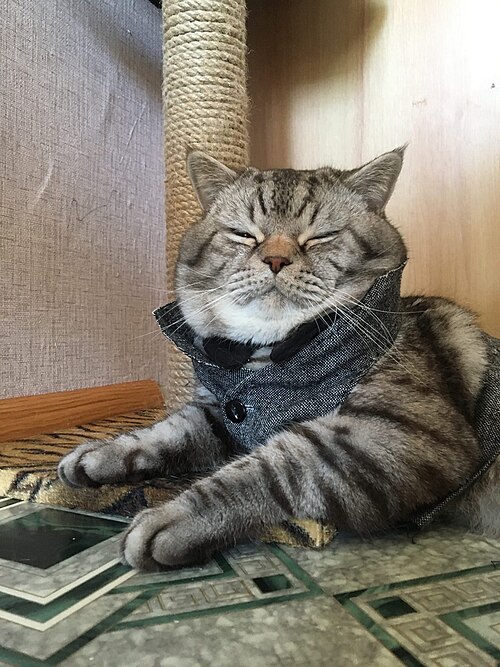
The ears of a Scottish Straight sit well apart. Eskkender, Wikimedia Commons[7]

Step back and the rest of the outline comes into view. The WCF describes a medium to large cat with a broad chest, shoulders and back, a short, strong neck, muscular legs and thick, round paws. The tail is about medium length, with a rounded tip. The standard also calls for flexibility along its entire length, from base to tip. In the doorway photograph, you can see the front paws, the width of the chest and the tail resting to one side. To see how freely the tail moves, watch the cat get up, walk and turn. [1]
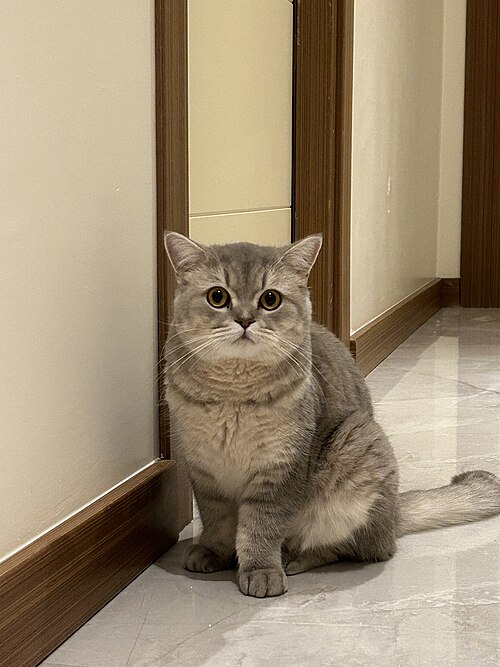
A Scottish Straight sits in a doorway. Kaylorensen, Wikimedia Commons[8]

This build can bring the British Shorthair to mind. If you want to establish a cat’s breed, its registration papers tell you more about its ancestry than its coat colour does. The WCF specifies that straight-eared kittens from Scottish or Highland matings must be registered as Scottish Straights or Highland Straights, as appropriate. They cannot be registered as British Shorthairs or British Longhairs. In the UK, the Governing Council of the Cat Fancy (GCCF) lists the Scottish Straight among its unrecognised breeds and specifically mentions its resemblance to the British Shorthair. When reading the breed name on a registration document, check which organisation issued it. [1,4]
Daily life with a Scottish Straight
When choosing a comb for a shorthaired Scottish Straight, consider the undercoat. The WCF describes a short, dense coat whose undercoat holds the outer hairs away from the body, giving the cat its plush outline. The International Cat Association (TICA) suggests combing a shorthaired cat once a week to remove loose hair. Its Scottish Straight breed profile also covers longhaired cats, which may need combing several times a week depending on how much undercoat they have. When you bring a cat home, ask how its coat has been groomed and how often. That gives you a starting point for a routine suited to the coat in front of you. [1,2]
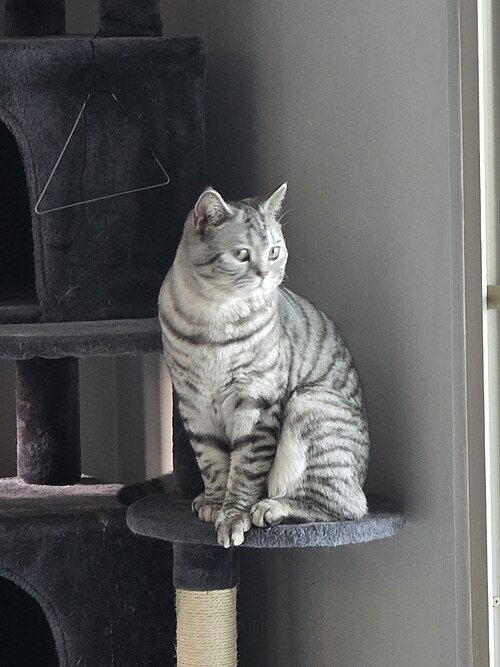
A Scottish Straight watches from a window perch. WikisMistress, Wikimedia Commons[9]

The cat on the round platform has turned to look towards the window. When arranging a room, think about where your cat can settle to watch quietly and where it can retreat out of sight. The Feline Veterinary Medical Association identifies safe resting places and access to resources in separate locations as basic needs for indoor cats. A sturdy lookout and a cardboard box or covered bed give the cat a choice of places to rest. Put food, water and litter trays in separate, accessible spots. In a home with several cats, trace the routes between them at cat level. If one cat sits in a doorway, can another still reach water, a resting place or a litter tray? [5]
A perch gives the cat somewhere to settle. Play gives it a chance to move. Draw a wand toy away along the floor, then pause. The cat can watch, creep closer, give chase or pounce, all movements that are hard to fit in if the toy keeps bobbing in front of its nose. Give interactions a familiar rhythm, too. Offer play when the cat usually comes out to explore, let it approach for a stroke, and let it leave when it chooses. These routines meet needs shared by indoor cats and help you learn how your own Scottish Straight likes to play and spend time with people. [5]
What can straight ears tell you about joint health?
The fold matters because the TRPV4 gene variant that changes the shape of the outer ear also affects bone and cartilage development. The UC Davis laboratory explains that one copy produces folded ears. The age at which associated bone and joint problems appear and their severity can vary. Cats with two copies are more likely to have severe problems. On a UC Davis test report, N/N means the fold variant was not detected. N/SF means one copy was detected, and SF/SF means two. For a kitten too young for its ears to have folded, the test can already answer the question of whether it carries the variant. [3]
The GCCF addresses the Scottish Straight and the Scottish Fold separately. In considering recognition of the Scottish Straight, its Genetics Committee called for DNA screening to rule out the fold variant. For the Scottish Fold, the council specifically identifies osteochondrodysplasia, a disorder of bone and cartilage development, as a welfare concern. Knowing how the breeds are related helps a family make sense of a genetic report. Whether an individual cat seems uncomfortable walking or has difficulty moving a joint is a question about that cat’s own movements. [3,4,6]
Notice the movements your cat repeats every day. Which step does it use to reach the windowsill? How does it turn to climb down? How does its tail move as it walks? Contact your vet if the cat repeatedly gives up on a jump it used to make easily, starts to limp, seems sore when walking or develops an unusually stiff tail. Note when the change began. A short video of the cat walking naturally and any existing genetic report can help at the appointment. There is no need to coax the cat into repeated jumps or bend its tail for the camera. The vet can use the history and physical examination to decide whether X-rays would help assess the bones and joints. “She’s stopped jumping onto her usual perch over the past few days” gives the vet a specific change to investigate. [3,6]
References
-
[1] World Cat Federation. Scottish Straight (SSS). 1 November 2026.
-
[2] The International Cat Association. Scottish Straight.
-
[3] UC Davis Veterinary Genetics Laboratory. Scottish Fold.
-
[4] Governing Council of the Cat Fancy. Unrecognised Breeds.
-
[5] Feline Veterinary Medical Association. New Feline Veterinary Medical Association Position Statement Reimagines Life for Indoor Cats. 28 August 2025.
-
[6] Merck Veterinary Manual. Developmental Osteopathies in Dogs and Cats. See “Scottish Fold Osteochondrodysplasia.”