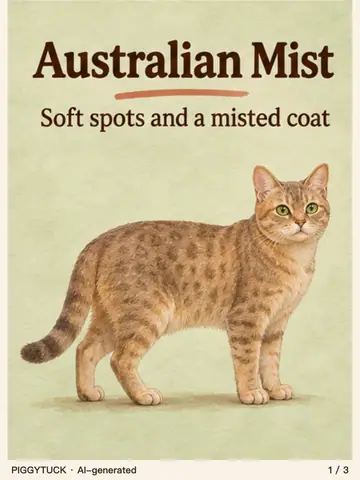
An Australian Mist (AUM) is medium-sized and muscular, and often feels heavier than it looks. Look for a broad rounded chest; medium muscular legs with oval paws; a long tail tapering from a broad base; a broad blunt wedge head with width between the ears; medium-to-large ears tilted slightly forward; large lustrous eyes slanted toward the nose—green shades only in adults; a short, glossy, elastic coat with undercoat.[1] Color and pattern are three layers: a ground lighter than the pattern, a clearly visible pattern, and a misted mantle of even ticking; spotted or marbled patterns are allowed, with warm rufous toning on nose, cheeks, and ears, and a paler underside.[1] Chocolate, lilac, caramel, gold (cinnamon), and peach (fawn) need about two years to develop fully.[1] The sections below cover type and origin, coat care and indoor life, then health questions.
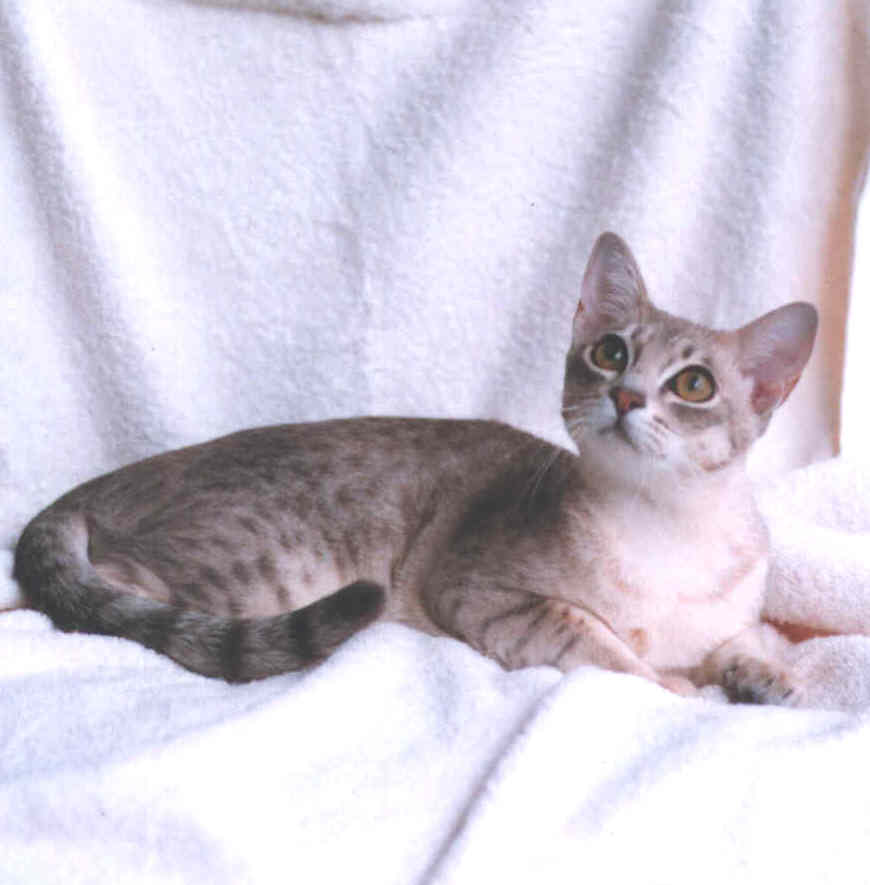
Figure: Blue-spotted Australian Mist reclining. Regis2007, Wikimedia Commons[5]

Name, pattern, and origin
Truda Straede began developing the Australian Mist in Australia in the 1970s, and the breed reached championship status there in 1986. Its foundation was roughly half European-style Burmese, one-quarter Abyssinian, and one-quarter domestic spotted tabby. Originally called the Spotted Mist, it became the Australian Mist in 1998 after marbled coats were accepted. Colours include brown, blue, chocolate, lilac, caramel, gold, and peach.[2] For showing, adult eyes must be green and the coat must carry the misted ticking. Fine bones, weak musculature, and a woolly or overly sleek coat can count as faults.[1]
Look for a paler ground, readable pattern, and ticking veil together. Spotted cats should show symmetrical spots on sides, flanks, and belly, with elongated spots or banding on the legs allowed; marbled cats show darkest patches broken internally by lighter blotches on a pale ground, with clear though uneven margins.[1][2] Pattern often reads better at a distance—the misting effect, not a failed marking.[2] Adult green eyes and rufous facial toning are further checks; kittens run paler and should not be judged as finished adults.[1]
Indoor activity and routine care
Many Australian Mists enjoy company and short bouts of play. Kittens are often lively; adults may spend longer on a lap or beside a familiar person. Some fetch or learn to walk on a harness. Introduce other pets gradually and watch the individual cat’s response to handling, children, and time alone.[2]
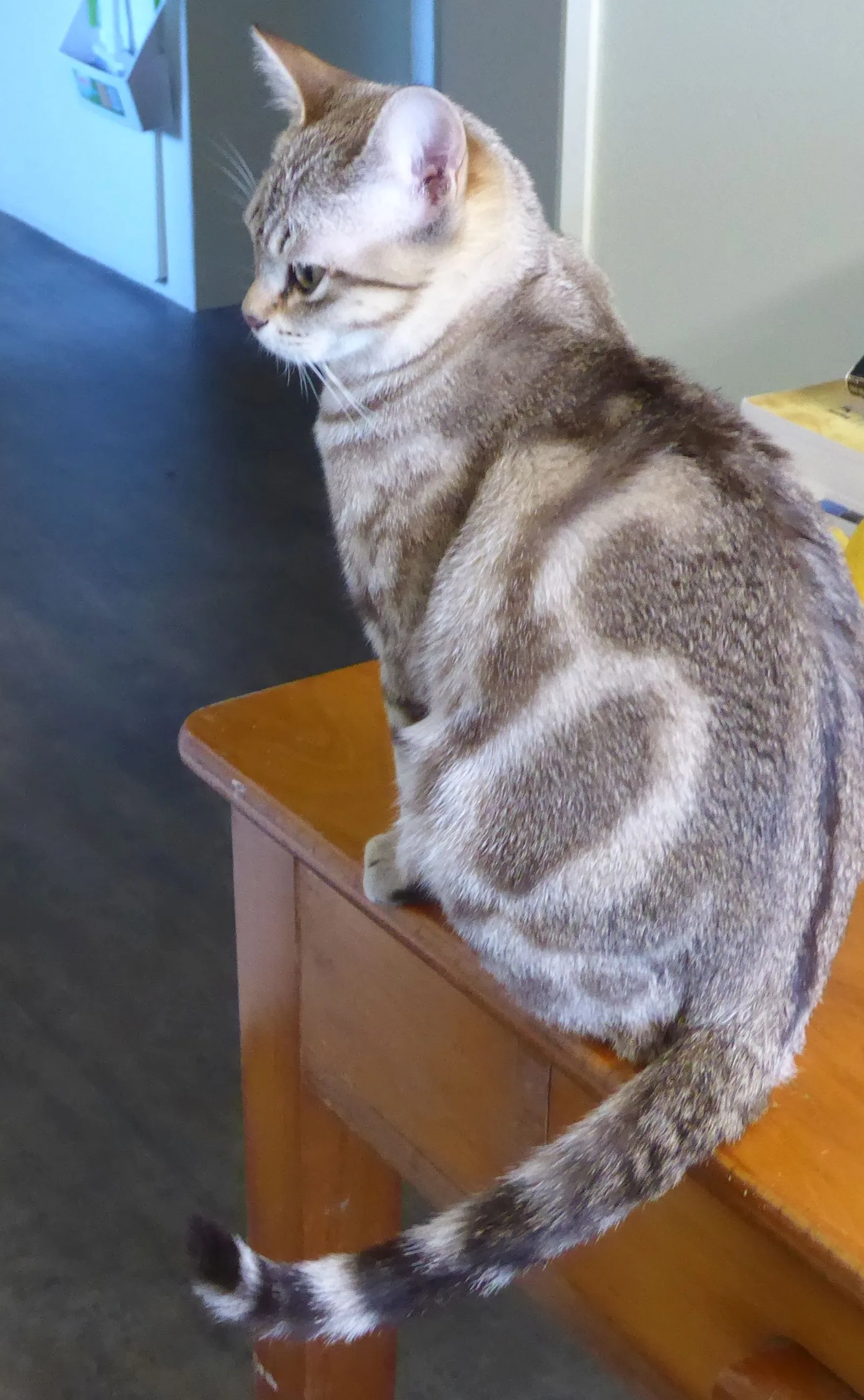
Figure: Brown marbled Mist on a wooden desk. Dr. Trudae Staede, Wikimedia Commons

Indoor cats also have emotional and behavioural needs. Provide a safe place; multiple separated key resources; play and predatory opportunity; positive, predictable human–cat interaction; and respect for smell and other senses.[3] For a companion-seeking Mist, dispersed resting spots, solid climbing, and short daily interactive play offer ways to play, rest, and spend time with people.[2][3]
The short, glossy coat usually needs only a quick weekly brush. Breed organisations describe the undercoat differently, so adjust the amount of brushing to the individual coat and season.[1][2] Check nails and ears, keep up with dental care, and provide a sturdy scratching post.[2]
A medium, hard-muscled body that looks lighter than it is calls for sturdy trees and window lookouts so curiosity lands on permitted climbing, not curtain edges.[1] Rotate wand toys and puzzle feeders, and adjust play to changes in energy from kittenhood to adulthood.[2] In multi-cat homes, keep litter, food, water, and rest spots separated to reduce crowding around a companion-seeking individual.[3] Attractive misting is a coat feature, not a substitute for enrichment matched to that cat’s energy and company needs.
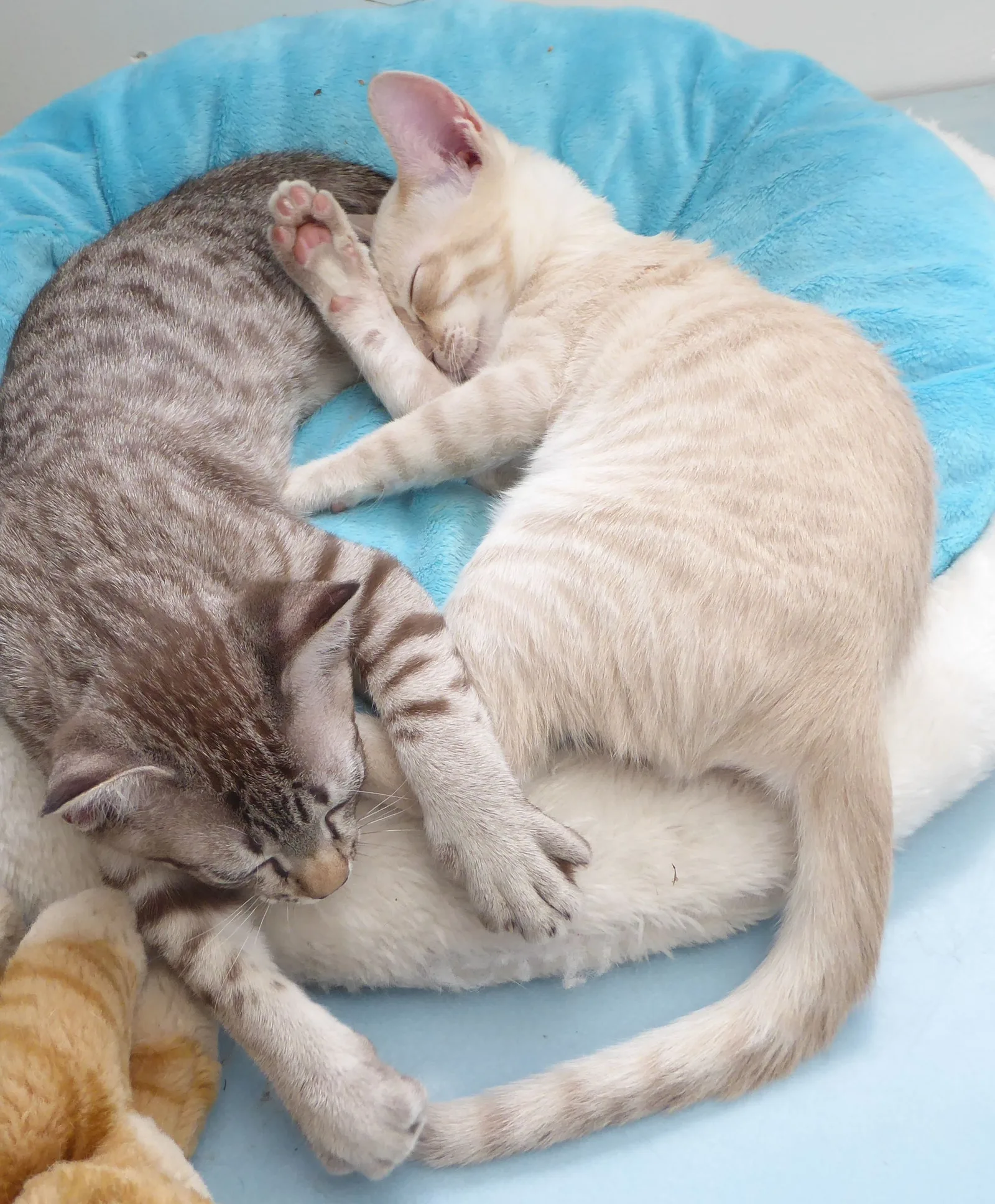
Figure: Brown and gold spotted Mist kittens asleep. Dr. Trudae Staede, Wikimedia Commons

Health questions
Australian Mists can develop hypertrophic cardiomyopathy (HCM), which may be difficult to detect when they are young. When choosing a kitten, ask whether close relatives have had a cardiac ultrasound.[2] HCM thickens the wall of the left ventricle, and a veterinarian may use echocardiography and rule out conditions such as high blood pressure or hyperthyroidism. Seek prompt veterinary attention for trouble breathing or sudden pain or weakness in the hind legs.[4] Ask your veterinarian about routine checks and follow-up imaging for the individual cat.[2][4]
To recognize an Australian Mist, check spotted or marbled pattern under a ticking veil, a medium hard-muscled body, and adult green eyes. To share a home, plan companionship, the five indoor pillars, light grooming, and HCM questions. Standards identify type; temperament and health still rest on the individual cat and veterinary judgment. If the pattern draws you in, confirm steady company and vertical play space first, then treat grooming and heart follow-up as routine—not as keeping a show-only ornament.
References
-
World Cat Federation. Australian Mist (AUM) breed standard (2010-01-01). https://wcf.de/pdf-en/breed/AUM_en_2010-01-01.pdf
-
The International Cat Association. Australian Mist. https://tica.org/breed/australian-mist/
-
Feline Veterinary Medical Association. Indoor cats position statement news (2025). https://catvets.com/news/2025-indoor-cats-position-statement/
-
Cornell Feline Health Center. Hypertrophic Cardiomyopathy. https://www.vet.cornell.edu/departments-centers-and-institutes/cornell-feline-health-center/health-information/feline-health-topics/hypertrophic-cardiomyopathy
-
Wikimedia Commons. File:Australian Mist.jpg. https://commons.wikimedia.org/wiki/File:Australian_Mist.jpg