Seen head-on, a Nebelung can look an even blue-gray. As the cat turns, a wash of silver may appear across one shoulder while the chest stays dark in the shade. The World Cat Federation (WCF) describes an even blue coat, preferably a medium blue, with silver at the tips of the hairs. Britain’s Governing Council of the Cat Fancy (GCCF) adds that on some cats the tipping is apparent only on the head and shoulders. Follow the fur from the forehead down over the shoulder as the cat moves. The highlight shifts where the hairs change direction, without the fixed edge you would see on a patch of white fur. [1][2]
The resemblance to the Russian Blue has a history. The WCF lists the breed in its semi-longhair directory as “Nebelung – Russian Blue LH (NEB),” with LH standing for longhair. The standard itself carries the shorter title “Nebelung (NEB).” The GCCF also places the Nebelung among the semi-longhairs and describes it as a distinct breed. Early in its development in the United States, breeders drew on the Russian Blue standard when drafting a description of the Nebelung. That description was later revised. The WCF’s paired names make sense in that context. A blue-gray household cat’s own pedigree is what establishes its ancestry. [1][2][3]
A front view brings the spacing of the ears and eyes into focus. In the WCF standard, the ears are large and set well apart, with slightly pointed tips and a gentle forward tilt. The eyes are also wide-set, ideally large, oval, and an intense green. Full whisker pads on either side of the nose and a firm chin give the muzzle definition even when the fur along the cheeks softens the outline of the face. A standing cat shows the proportions more clearly. The body is medium-sized, slightly elongated, and muscular, with long, slender legs, narrow oval paws, and a long tail ending in a gently rounded tip. [1]
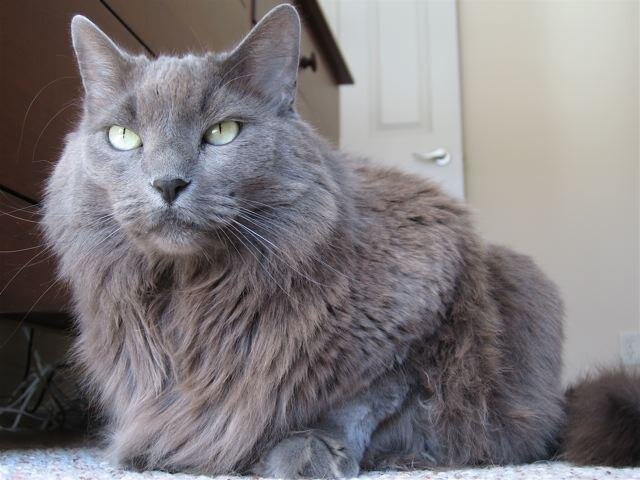
Figure: Ear placement and eye shape. MCB, Wikimedia Commons[5]

Window light picks out the longer hairs along the chest and belly. They extend far enough beyond the body that their outline tells you little about the cat’s actual width. The silver tips account for the sheen. The fullness comes from a fine, dense undercoat beneath coarser guard hairs, and the coat as a whole feels soft and silky. The WCF describes it as medium in length, with a modest ruff around the neck and relatively little feathering on the hind legs. According to the GCCF, coat length and undercoat density vary with the season. The adult coat can take about two years to develop, so a kitten may have little of the neck fur visible on a mature cat. [1][2]
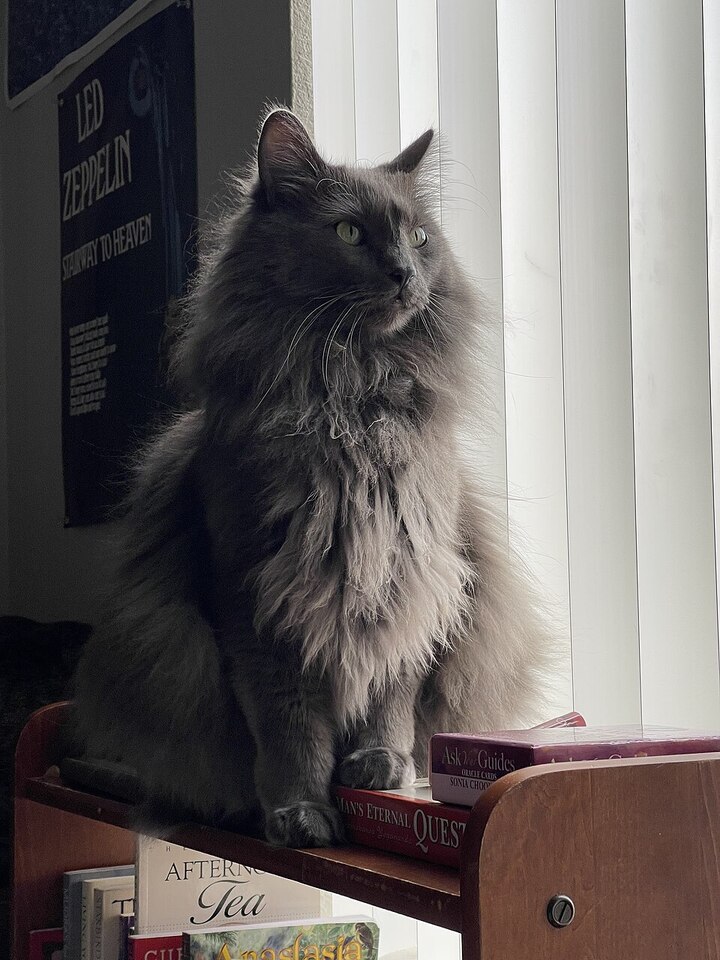
Figure: Chest and belly fur in side light. Aislingblack, Wikimedia Commons[6]

The GCCF suggests weekly grooming as a starting point. Choose a stable surface where the cat already likes to linger, and begin with a few gentle strokes over a shoulder or along the back, wherever touch is welcome. Part the longer fur under the neck or along the flanks with your fingers. Even when the surface looks smooth and catches the light, a small tangle can be forming underneath. Stop if the comb catches, since pulling it through can tug at the skin. If the cat walks away, leave the rest for another time. Over several sessions you will learn which areas comb through easily and which need closer attention. [1][2][4]
Grooming is easier when the cat chooses to stay close, and that choice matters from the day it arrives. The GCCF describes Nebelungs as sometimes reserved in unfamiliar surroundings, though they can be affectionate and playful once settled. In a quiet room, provide a sheltered bed with a view out. Sit where the cat can see you, speak softly, and let it close the distance. A cat that comes over to sniff your hand may be content with just that much contact. Leave the way back to its bed open so it can approach again or retire whenever it likes. [2][4]
Trace the routes the cat can take through your home. From its bed, can it reach water, a litter tray, and a scratching surface? If it climbs to a window perch, does it have secure footing and a clear way down? The Feline Veterinary Medical Association points out that indoor living reduces exposure to outdoor hazards while leaving the household responsible for meeting a cat’s physical and emotional needs. In a home with several cats, two water bowls in the same nook can both be out of reach if one cat occupies the entrance. Space resources apart so each cat has a way around its companions. [4]
A window provides a place to watch. An open stretch of floor gives the cat somewhere to stalk and pounce. Draw a wand toy along the floor and around the corner of a box, then pause. A cat peering around the edge may still be watching for its moment to spring. Give it time to approach and catch the toy. The veterinary association recommends pleasant, consistent, predictable interactions. Different family members can take part in play while respecting one place where nobody reaches in to touch the cat. When it returns to its cushion and closes its eyes, let the game end there. [4]
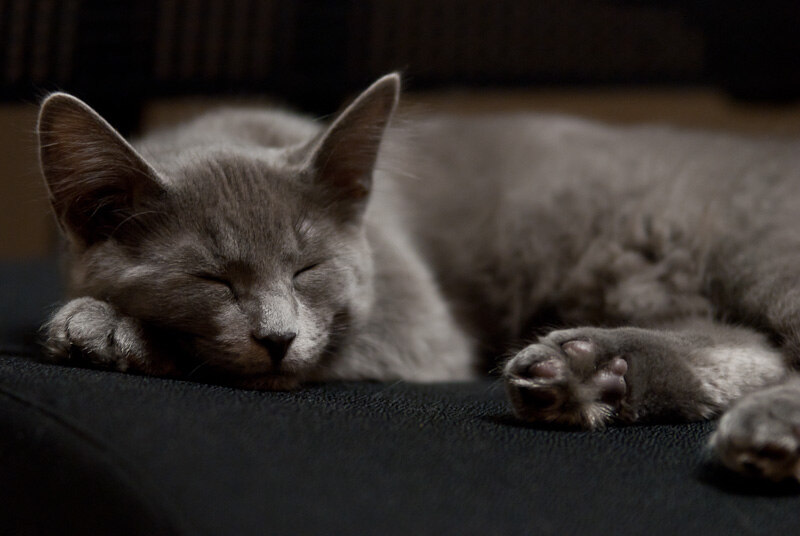
Figure: A foreleg extended at rest. Pematy, Wikimedia Commons[7]

For health concerns, start with changes in this particular cat’s routine. A cat that usually jumps onto the sill may begin lingering below it. One that enjoys grooming may start flinching whenever the comb reaches the same spot. Tell your veterinarian when the change began, what was happening at the time, and whether eating, litter tray use, or self-grooming has changed too. A new companion, a blocked route, or difficulty finding an undisturbed resting place can also help the veterinarian understand life at home. The silver in the coat and the fullness of the ruff describe appearance. Neither tells you which disease screening an individual cat needs. [1][4]
References
-
[1] World Cat Federation. Nebelung (NEB). January 1, 2010.
-
[2] The Governing Council of the Cat Fancy. Nebelung.
-
[3] World Cat Federation. Breed Standards SEMI LONGHAIR.
-
[4] Feline Veterinary Medical Association. New Feline Veterinary Medical Association Position Statement Reimagines Life for Indoor Cats. August 28, 2025.