The International Cat Association (TICA) registers the Chausie as a domestic breed. Its name comes from Felis chaus, the scientific name of its wild ancestor, the jungle cat. TICA traces the modern breeding program to a documented mating between a jungle cat and a domestic cat in 1990. The breed gained foundation registration in 1995 and became eligible for championship competition on May 1, 2013. The Chausie of today is the product of generations of selective breeding and has a breed standard of its own. [1][2]
TICA gives a telling example of what an active Chausie might do with an afternoon. Some learn to open cabinet doors and pull out the contents with a paw. Owners have even fitted childproof latches. That curiosity can last well into adulthood. A closed door gives the cat something to investigate, and an object just out of reach gives it a problem to solve. When preparing a home for a Chausie, look at which cupboards need to stay shut and what you can safely leave for the cat to rummage through. [1][4]
What does a standing Chausie look like?
In the photograph below, a Chausie named Abicatz Zamphyr stands in front of a tree. Follow the line from shoulders to hips, then look at how much space those long legs leave beneath the body. TICA describes a rectangular torso with a deep chest, fairly flat sides and long muscles. Long legs and a long stride are recurring features in the breed description. They also suggest a practical question about the layout of a room. Once the cat lands from a shelf, is there space to run a few more strides? [1][2]
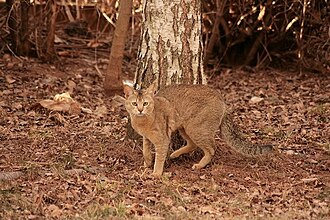
A Chausie stands in profile. Wilczakrew, Wikimedia Commons[7]

Seen head-on, the same cat has large ears set high on the head and angled slightly outward. Below the eyes, the cheekbones sit high above a long muzzle. A side view makes the outline from forehead to nose easier to see. Ear tufts are optional in the standard, which recognizes three coat colors or patterns, including solid black. The face and build together can help you recognize the breed. An individual cat’s pedigree records its ancestry and generation. [1][2]
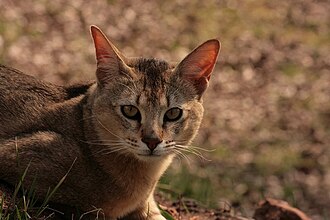
The ears angle slightly outward. Wilczakrew, Wikimedia Commons[8]

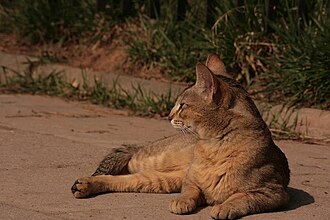
A side view shows the Chausie’s facial profile. Wilczakrew, Wikimedia Commons[9]

Give the cat something to find
Fit latches to cabinets that hold cleaners or medicines. Mealtime can give a cat somewhere safe to put those rummaging skills to use. Put some of its usual kibble in a shallow puzzle feeder, leaving a few pieces at the edge where a sweep of the paw will bring one within reach. Once the cat gets the hang of it, move the food to another spot. Watch what holds its interest. Does it reach in with a paw, push with its nose or chase a piece that rolls away? That tells you more about the next game to try than simply choosing a harder puzzle. The feline environmental guidelines offer an even simpler idea: hide portions of food in several places for the cat to find. [3][4]
For a chase, clear a continuous stretch of floor. Choose a route the cat already takes across the living room, move anything easily knocked over and leave room to land beside a sturdy scratching post or a platform wide enough to turn around on. Draw a wand toy away from the cat along the floor and pause at the edge of a cardboard box. The cat can watch from cover, chase when the toy moves again and catch it under a paw. Once it catches the toy, give it a moment to handle its prize. Even a small patch of floor can hold a whole sequence of watching, chasing and catching. [1][4]
Some Chausies bring toys back for another throw. Others like to come over and see what their people are doing. Work an invitation to play into a familiar part of the day. After clearing the dinner table, for instance, bring out a toy in the usual spot and let the cat decide whether to join in. If its eyes are still fixed on the edge of the box, give it time. When it wanders off to wash or lie down, put the string toy away. For a cat that stays playful as an adult, time set aside for a game matters as much as the height of its climbing tree. [1][3][4]
Leave a quiet way out
Walk the play route once more and look for a place the cat can go when it has had enough. A cardboard box on its side gives it cover overhead and an open end to look through. A perch in a quiet corner suits a cat that likes to watch from above. Line it with something the cat already sleeps on so it carries a familiar scent. When visitors arrive, let the cat choose when to emerge. In its 2025 position statement on indoor cats, the Feline Veterinary Medical Association identifies safe hiding places, predictable contact with people and attention to sensory needs, including scent, as features of the everyday home environment. [3][4]
In a home with several cats, look at the narrowest doorway. If one cat lies across it, can another still reach water, a litter box or a place to sleep? Several bowls side by side behind that door still share a single approach. Set up drinking, feeding and resting places in different parts of the home so the cats can move around one another. If one tends to hang back during wand play, give it a turn on its own. Even a Chausie that seeks out company needs the option of slipping away. [3][4]
Changes in familiar play can be health clues
A Chausie’s short coat usually needs only occasional brushing. For a sense of how the cat is doing day to day, small habits can be easier to track than minutes of exercise. Does it still come over at the sound of a toy hitting the floor? Has it started walking past a perch it used to reach in one jump? If a cat that regularly joined in stays less active than usual, especially if it seems weak or loses weight, tell the veterinarian when the change began and what you have noticed about its appetite and activity. The cat’s own familiar routine gives the veterinarian a more useful point of comparison than the breed’s reputation for energy. [1][4][6]
A 2022 study of several breeds found a PKLR variant associated with erythrocyte pyruvate kinase deficiency in one of the six Chausies tested. This inherited condition can cause intermittent anemia. The finding records a genetic test result. A sample of six cannot establish how often Chausies develop the disease, and it cannot explain why an individual cat has lost interest in play. If your cat already has a genetic test report, bring it to the appointment along with your observations. The report documents the cat’s test result, while your account tells the veterinarian what has changed and when. [5][6]
References
-
[1] The International Cat Association. Chausie.
-
[2] The International Cat Association. CHAUSIE (CU).
-
[3] Feline Veterinary Medical Association. New Feline Veterinary Medical Association Position Statement Reimagines Life for Indoor Cats. August 28, 2025.
-
[4] Ellis SLH et al. AAFP and ISFM Feline Environmental Needs Guidelines. Journal of Feline Medicine and Surgery, 2013, 15: 219–230.
-
[5] Anderson H et al. Genetic epidemiology of blood type, disease and trait variants, and genome-wide genetic diversity in over 11,000 domestic cats. PLOS Genetics, 2022.
-
[6] University of California, Davis, Veterinary Genetics Laboratory. Erythrocyte Pyruvate Kinase Deficiency (PK Deficiency).