The Arabian Mau takes its name from the region where it developed. The Australian cat association ANCATS traces the breed to the Arabian Peninsula and the Gulf region in its 2017 standard. The World Cat Federation (WCF) lists the Arabian Mau and the Egyptian Mau separately among its shorthairs, each with its own standard. Look for the code ARM for the Arabian Mau and MAU for the Egyptian Mau. The ANCATS breed directory also lists them separately. If you search for “Mau” alone, you can easily end up reading about the other breed. [1–3]
To recognise the Arabian Mau’s build, start with its legs. The WCF standard describes a medium-sized cat whose long legs hold its body well above the ground when it stands naturally. Its paws are oval. Follow the line of the legs up to the body and you can see the muscle that gives the torso its substance. A medium-long tail tapers towards the tip. Together, these proportions give the cat a rangy outline while retaining a sense of strength. [1,4]
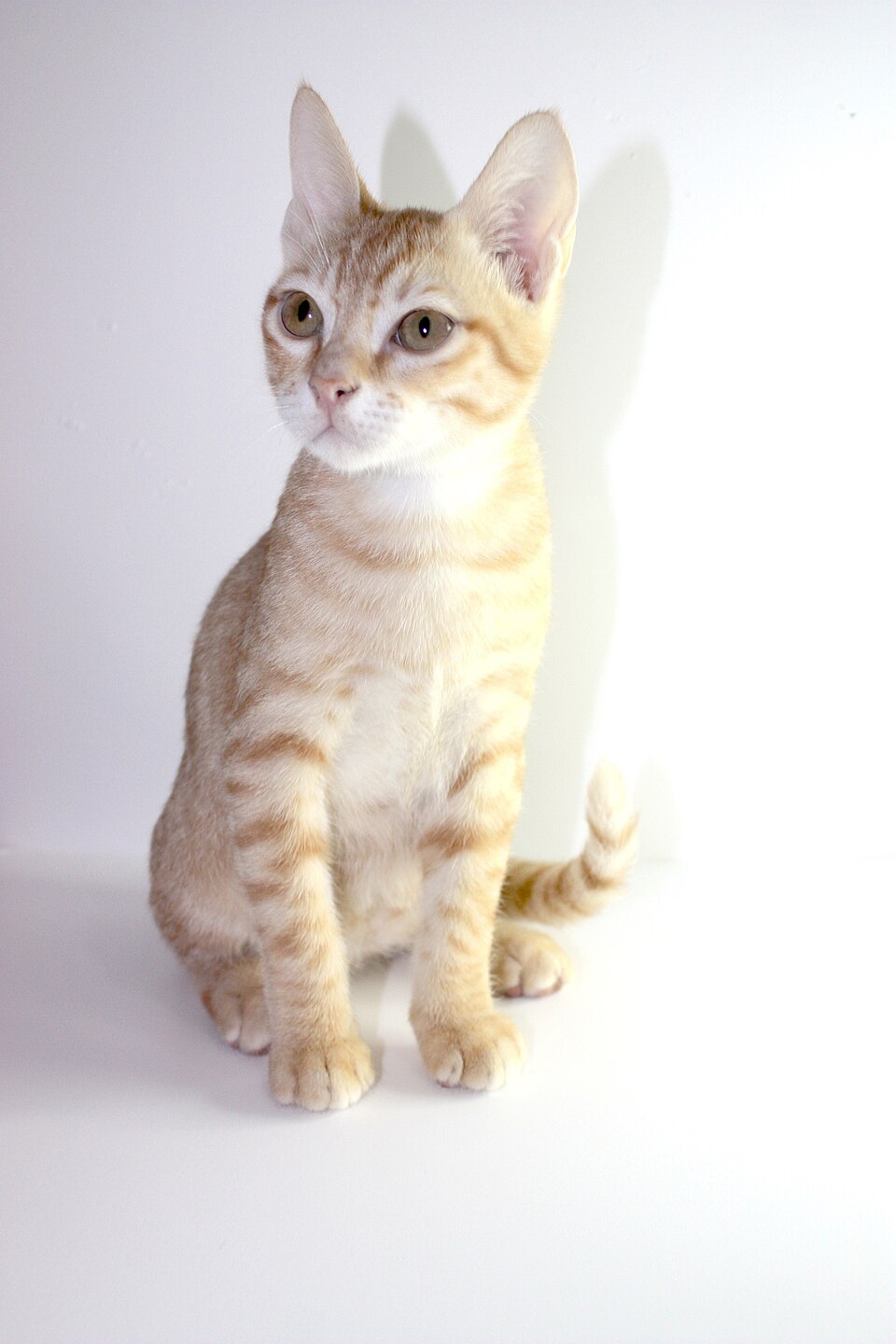
A three-month-old kitten sits upright. SolnishkoA, Wikimedia Commons[9]

In this photograph, you can trace the three-month-old kitten’s front legs from chest to paws, while its hind legs are tucked underneath. A seated view is a good one for studying the ears and face. To see how the legs and torso fit together, watch the cat when it gets up and walks past. The kitten’s large ears angle out to either side, and the curve of its cheeks makes the face look round at first glance. The standard describes a head slightly longer than it is wide, with distinct whisker pads on either side of the muzzle and a pronounced chin visible in profile. [4]
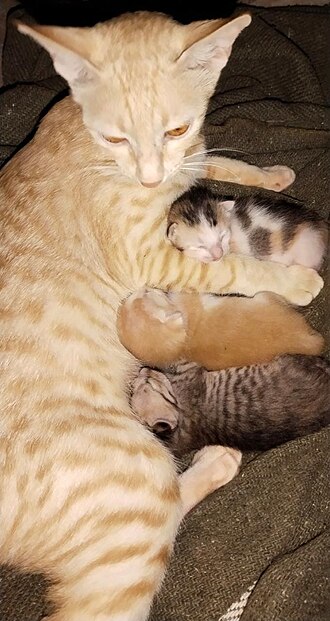
The short coat lies close along the flank. Nandhiniraji, Wikimedia Commons[10]

The pale ginger cat lying on its side offers a closer look at the coat. From the back to the hind leg, the hair lies flat, and the stripes follow the curve of the flank. The WCF describes a close-fitting coat with no undercoat. In an adult, the hair should feel firm to the touch. The standard allows considerable variety in colour and pattern, including solid white, red and tabby. Long legs, a muscular body and a close short coat are the features to look for together. Tabby markings alone tell you little about a cat’s ancestry. [1,4]
Start where your cat chooses to settle
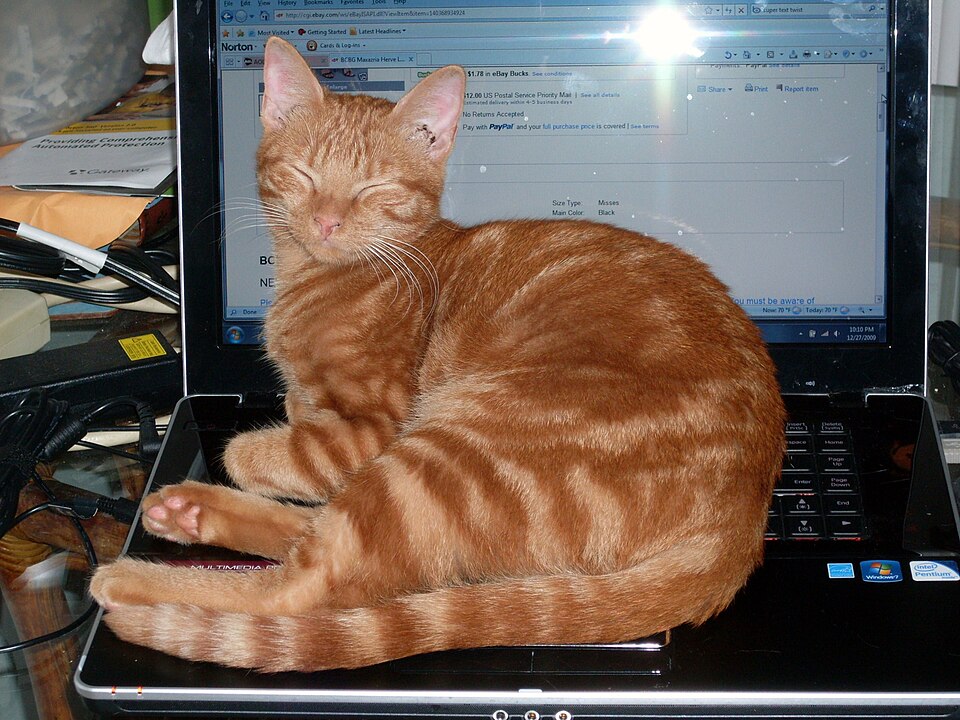
Ginger dozes on the keyboard. Lewsooz, Wikimedia Commons[11]

Ginger had been in the household only a short time when the owner took this photograph of the cat asleep on a computer. An everyday choice like this is a good place to start when arranging a home for an Arabian Mau. Where does your cat like to pause? If it often settles near your desk, give it a stable perch nearby, wide enough to turn around and stretch out while it watches you. In a quiet spot, set out a cardboard box lined with familiar bedding. That gives the cat somewhere to slip out of sight whenever it wants. Let it choose between the two. [5,6]
Once things are in place, crouch down and look at the routes from the resting spot to the water, food and litter tray. Two water bowls side by side at a narrow doorway may look plentiful. Yet one cat sitting in that doorway can block access to both. Put the bowls in different places so there is another way to get a drink. Give eating, toileting and resting their own quiet spots, too. In a home with several cats, watch whether each can finish a meal undisturbed and whether any cat has to pass a housemate blocking the exit from a hiding place. [5,6]
Long legs tell you how an Arabian Mau is built. Let the cat’s response guide how far and how fast a game goes. Draw the end of a wand toy along the floor away from the cat, then pause with the toy still in sight. The cat may turn its head and watch. It may crouch and wait for the toy to move again before pouncing. Give it a few chances to pin the toy under a paw. When it lets go, see whether it follows again. Even at floor level, there is room in the game for watching, waiting and catching. [4–6]
Follow the cat’s familiar rhythm during quieter moments, too. When it approaches, offer a hand to sniff. Give its cheek a gentle stroke, then pause to see whether it leans in again. When it goes back to bed, give it that time to rest. Wash bedding in rotation so that one cushion or blanket still carries a familiar scent. For a cat that spends most of its time indoors, being able to choose when to join someone and when to be alone is part of everyday freedom of movement. [5,6]
Watch the route your cat knows well
To keep track of mobility at home, get to know the way your cat usually reaches a favourite spot. Does it jump straight onto the sofa, or has it always used the footstool on the way up? Does it land as smoothly as usual on the way down? Occasionally take a short video from the side while the cat goes about its day. Keep the approach, the landing and the next few steps in the same clip. If something changes later, you can show your veterinarian exactly which part of the movement has become difficult. [7]
If a cat that used to jump onto the sofa every day repeatedly hesitates at the edge, starts taking a detour or pauses before stepping into the litter tray, contact your veterinarian. Describe when you first noticed the change and which other activities it affects. Jumping less often or to a lower height can be a sign of pain. An examination can help establish the cause. While waiting for the appointment, a stable intermediate step can keep a favourite resting place within reach. Bring an older clip and a recent one if you have them. They show the difficulty where it occurs, without asking the cat to repeat a jump for a toy. [7,8]
References
-
[1] ANCATS. Arabian Mau, January 2017 breed standards, p. 36.
-
[2] World Cat Federation. Shorthair.
-
[3] ANCATS. Find a Kitten.
-
[4] World Cat Federation. Arabian Mau.
-
[5] Feline Veterinary Medical Association. New Feline Veterinary Medical Association Position Statement Reimagines Life for Indoor Cats. 2025.
-
[6] Ellis SLH et al. AAFP and ISFM Feline Environmental Needs Guidelines. 2013.
-
[7] Cat Friendly Homes. Providing Care for a Senior Cat.
-
[8] Cat Friendly Homes. Degenerative Joint Disease (Arthritis) in Cats.
-
[9] SolnishkoA. File:Arabian Mau Kitten.jpg. Wikimedia Commons.
-
[10] Nandhiniraji. File:Arabian Manu.jpg. Wikimedia Commons.
-
[11] Lewsooz. File:Ginger on comp.jpg. Wikimedia Commons.