Immigrants brought the American Bulldog’s ancestors to the United States. On a Southern farm, one dog might guard the homestead, work cattle alongside the farmer and give chase when livestock got loose. Keeping up took stamina, changing direction took agility, and catching and holding an animal took strength. That work helps explain how a dog so solidly built can be so quick on its feet. In November 2019, the American Kennel Club (AKC) admitted the American Bulldog to its Foundation Stock Service (FSS), the breed’s registration category with the AKC. [1][2]
How to recognize the American Bulldog’s build
In a standing dog, follow the outline from the shoulders along the back to the hind legs. An American Bulldog has a broad, deep chest and a relatively short back, with muscular hindquarters to match the strength of the front end. On the dog pictured below, brindle patches against the white coat make the shoulder and thigh easy to pick out. The AKC lists males at about 56–64 cm at the shoulder and 34–45 kg, and females at about 51–58 cm and 27–36 kg. Picture a dog of that size on the other end of the leash. Who in the family will be able to take it through the front door and out for its daily walks? [1][2]
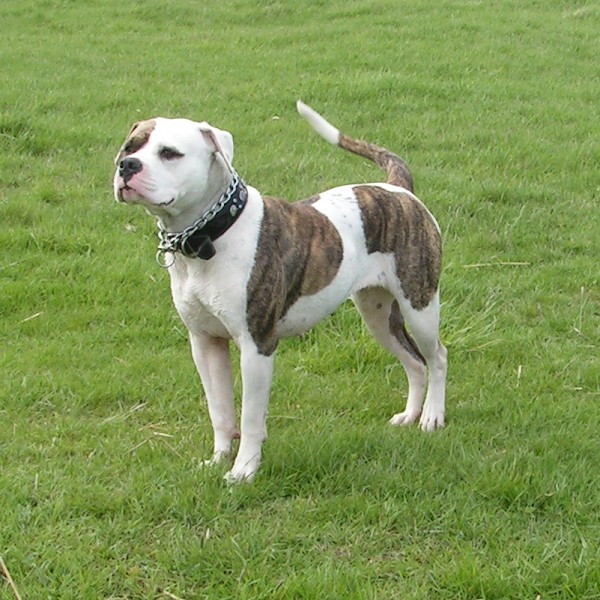
图:An American Bulldog in full stance. sannse, Wikimedia Commons[3]

From the front, you can see how the forelegs sit beneath the chest. The breed standard describes sturdy forelegs that stand roughly perpendicular to the ground when viewed head-on. The chest is broad, and the shoulders need room to move freely. Watch the dog take a few strides and you can see how the parts work together. The front legs reach forward, the hind legs drive back, and the line of the back stays steady. That movement tells you more about what the dog’s build allows it to do than head size or chest width alone. [2]
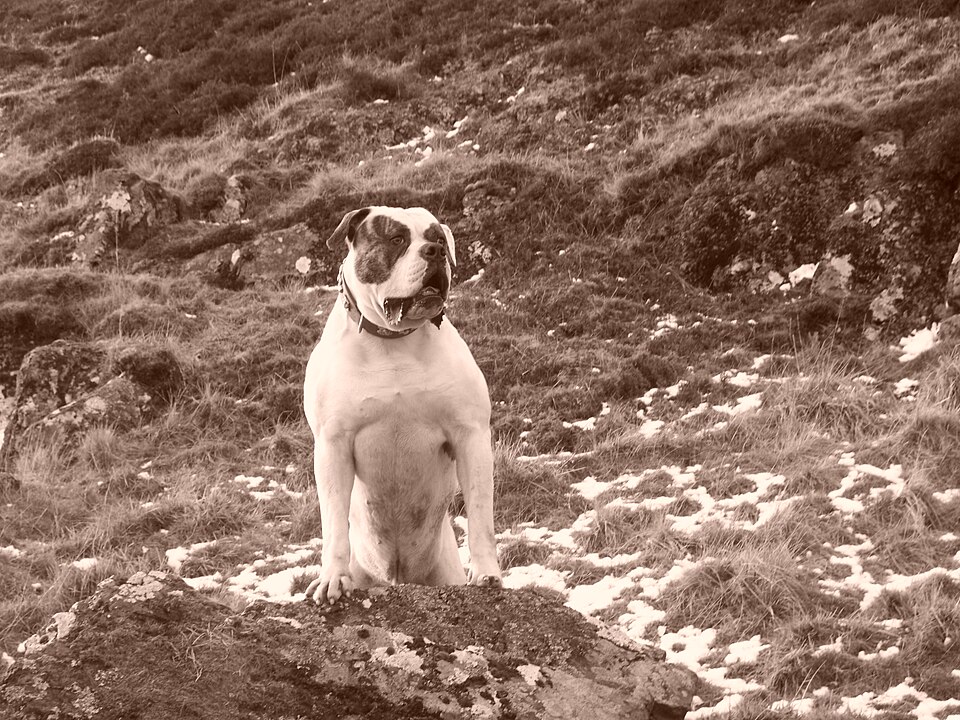
图:The American Bulldog’s chest and shoulders. Bigbulldogs, Wikimedia Commons[4]

Several features help you recognize the head. The eyes are set well apart, the jaw muscles are pronounced, and the muscular neck tapers from the shoulders toward the head. The natural ears are set high. They may hang down, stand partly upright or fold back. The coat is short and lies close to the body. White is the traditional color, and a white coat can carry patches of brindle or brown, among other colors. Compare the standing dog with the close-up below to see how much facial markings can vary within the breed. [2]
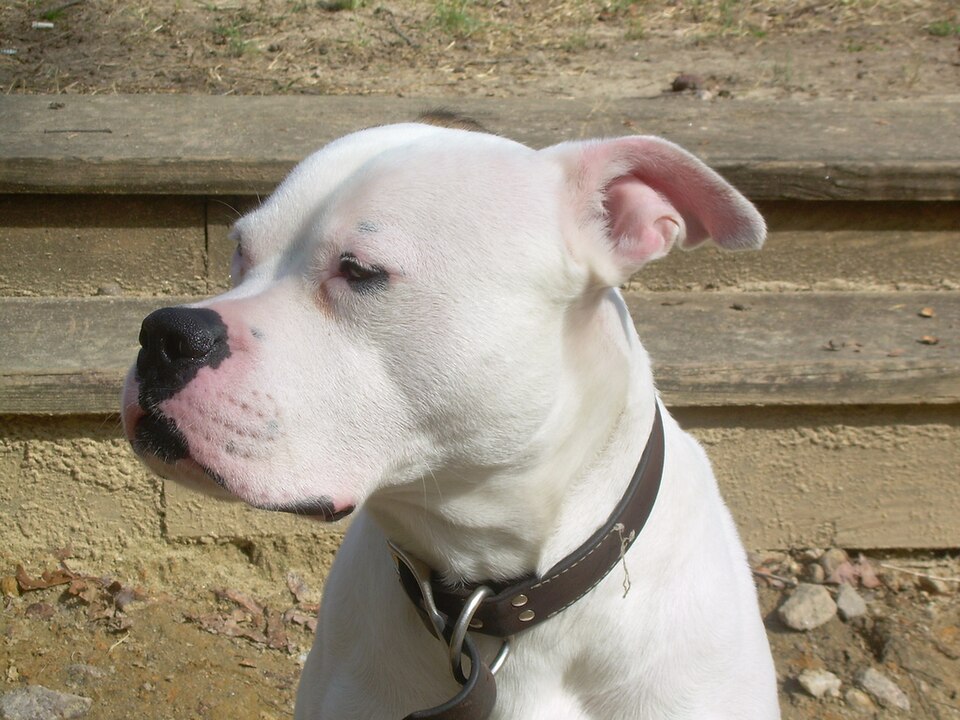
图:The head of a Scott-type American Bulldog. Kroon78, Wikimedia Commons[5]

How can a puppy burn off energy?
An American Bulldog puppy can be eager for action while its bones and joints are still developing. The AKC recommends low-impact activity at this stage. A single outing can give the puppy several things to do. Let it walk and sniff on level ground, call its name and give it time to turn toward you, then practice pausing at the door on the way home. The puppy gets to move and explore while learning to pay attention to you. If you hope to hike together someday, keeping pace with each other and coming when called are skills you can build now. More demanding running and jumping can wait. [1]
Once the dog is an adult, jogging, hiking, tug games and training exercises can all be part of the routine. Each offers something different. Moving together means matching your pace. An unfamiliar trail has new scents to investigate. During tug, letting go on cue can be part of the game. The activity and the distance should suit the dog’s condition and the exercise it already gets. When you picture life with an American Bulldog, imagine the weekend hike gets canceled. What will you still have time to do together on an ordinary workday? [1]
Think about a yard in the same way. With someone outside, it can be a place to practice coming when called or to hunt for a toy. Once everyone heads indoors, the same patch of grass offers much less to do. The AKC cautions that leaving an American Bulldog alone in the backyard for long stretches can lead to behavior problems as energy builds up. Try mapping out your busiest day. Who will take the dog out in the morning and evening? Who has time to play in between? If the usual walker has to work late, who can take over? Those answers tell you how much use the dog will get from the space. [1]
A door routine that lasts into adulthood
An excited bounce that seems endearing in a puppy can pull someone off balance once an American Bulldog reaches full strength. Going out the front door gives the whole family a chance to teach one simple routine. Clip on the leash and wait until all four paws are on the floor and the leash hangs loose. Then step outside together. When everyone who walks the dog follows that sequence, the puppy can learn what gets the door to open. The AKC recommends establishing routines early and sticking with them as the dog grows. Puppy classes give the dog and the people who care for it a chance to practice together. [1]
The breed profile describes a confident, friendly dog, and the standard allows for some reserve around strangers. Early socialization can start with a brief, calm encounter. When another dog comes into view on a walk, leave enough space for both dogs to stay relaxed. Practice having your puppy look back at you, then walk on together. If you have young children, decide ahead of time who will take the leash and who will look after the children when a visitor rings the bell. How smoothly those moments go depends on how your dog responds and whether an adult is there to guide it. [1][2]
Keeping track of joint health
The short, close coat is straightforward to care for. Brush it regularly, bathe the dog when it gets dirty, and expect seasonal shedding. A regular brushing session is a handy reminder of the other small jobs. Check the nails every few weeks and trim as needed, brush the teeth regularly, and clean the ears monthly or as needed. Baths may take up little time on a family calendar. Walks, training and these recurring bits of care will come around much more often. [1]
Joint health is worth discussing before you bring a puppy home. The AKC recommends hip and elbow evaluations and advises breeders to screen prospective parents for inherited conditions before breeding. Ask a breeder which evaluations each parent has had, which dog each report belongs to and what the results were. Keep copies alongside a separate set of records for the puppy’s own examinations. The parents’ results tell you something about the family history. Decisions about your dog’s health and exercise also depend on its own development and veterinary examinations. Bring the records to the checkups and vaccination visits your veterinarian schedules. They give you a starting point for discussing how the puppy can be active now and what it might be ready to do as an adult. [1]
References
-
[1] American Kennel Club. American Bulldog.
-
[2] Standard for the American Bulldog. Breed standard linked from the American Kennel Club’s American Bulldog profile.