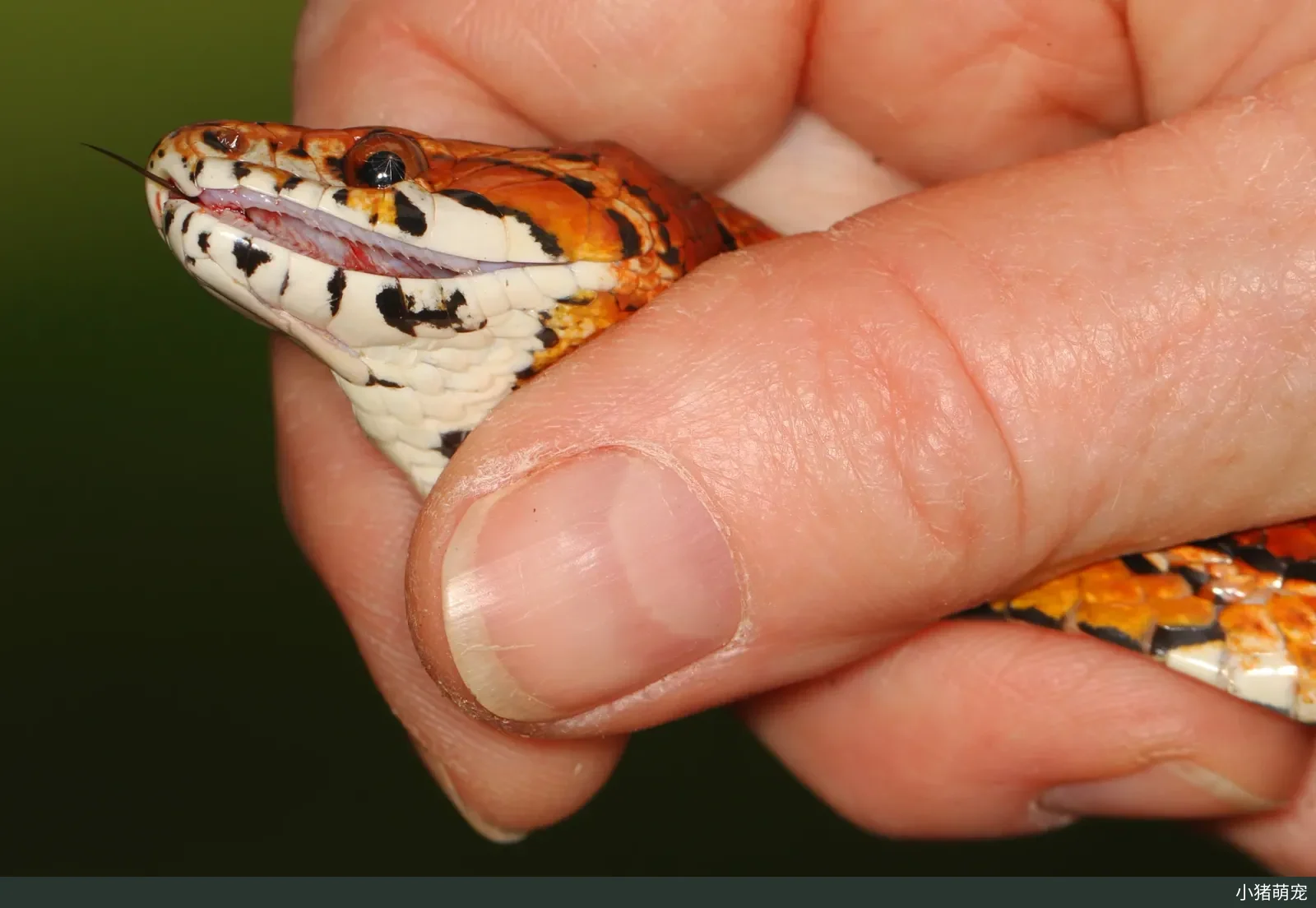
A wild corn snake photographed in May 2014 on Sapelo Island, Georgia, U.S. Photo: Judy Gallagher; source: Wikimedia Commons; license: CC BY 2.0
The corn snake (Pantherophis guttatus) is native to the southeastern United States, nonvenomous and generally mild-tempered; veterinary sources often list it among the easier pet snakes to care for. Still, it can live more than a decade, needs an escape-proof enclosure with warm and cool zones and frozen–thawed rodent prey, and requires attention to shedding and health changes; in some countries and regions, keeping it is itself restricted by law. The points below are drawn item by item from veterinary sources, animal-welfare bodies, and government texts.
Native range and habits
According to the University of Georgia Savannah River Ecology Laboratory (SREL) species account, corn snakes range across the southeastern United States: from southern New Jersey south through the Carolinas to the Florida Keys, and west to eastern Louisiana. They live in open pine woods, abandoned fields, hardwood forest, and farmland edges, and often hunt rodents around barns and sheds. Wild adults are generally 0.91–1.2 m long, with a few exceeding 1.5 m; body color runs from orange to reddish brown, with 27–40 black-edged blotches on the back and a black-and-white checkerboard belly. There are two explanations of the name: the Royal Society for the Prevention of Cruelty to Animals (RSPCA) says they often appear near corn cribs hunting rats; the Queensland government of Australia says the belly pattern looks like colored ornamental corn.
On habits, SREL records that corn snakes are mainly active at dawn and dusk, more nocturnal in hot weather, and hide by day under logs, bark, debris, or in burrows. They can climb trees but are more terrestrial than their relative the eastern ratsnake. Juveniles mostly eat frogs and lizards; adults shift toward rodents and birds, and also take bird eggs. Corn snakes are nonvenomous and kill prey by constriction. Pet-trade corn snakes are mainly captive-bred, with morphs from gray to bright orange. On lifespan, RSPCA writes about 10–15 years; VCA Animal Hospitals veterinary material writes 12–15 years with good care; VCA also notes that with ideal diet and husbandry adults may reach 1.2–1.8 m.
Enclosure, temperature, and humidity
Security comes first. VCA’s veterinary guidance requires a well-ventilated, escape-proof snake enclosure with sealed seams and a lockable lid. Size can follow RSPCA advice: the box should let the snake stretch out fully, with width and height each at least one-third of body length—for example a 150 cm adult needs at least 150×50×50 cm. Hatchlings can be stressed in too large a space; start smaller and size up, or add several small hides in a large box. RSPCA also recommends keeping them singly, because corn snakes are solitary in the wild and single housing makes health watching easier.
Corn snakes are ectotherms: the enclosure needs a warm-end / cool-end temperature gradient so the animal can move to regulate body temperature. RSPCA figures: warm zone 28–30°C, cool zone 20–24°C; with normal room temperature, night heat can be off, and a drop to 16–20°C is still safe—use a non-light-emitting ceramic heater or heat mat only when colder. All heat sources should be on thermostats, heat lamps behind guards, with a digital thermometer at each end and daily logging. VCA’s husbandry temperature for corn snakes is 25–30°C, broadly consistent. On humidity, RSPCA suggests about 40%–50%; increase ventilation if it runs high. Whether UVB is essential is not fully settled: VCA notes veterinarians disagree on whether snakes need ultraviolet light, but considers some UVB harmless and possibly beneficial; RSPCA recommends a low-output (2%–7%) reptile UVB tube on the warm side, lower intensity for albino animals, on a 12-hour on / 12-hour off cycle.
On substrate and setup the two organizations emphasize different points. VCA recommends easy-to-clean materials such as newspaper, kitchen paper, towels, or artificial turf, and warns that sand, gravel, wood chips, corn cob, and similar particulate substrates may be swallowed and cause intestinal blockage; cedar shavings are toxic to reptiles. RSPCA recommends reptile organic soil or a soil–sand mix that lets the snake burrow, treating paper only as temporary substrate for observation right after arrival. Either way, feces should be removed promptly. Place at least one hide at each end, plus climbable branches; RSPCA suggests a separate “humid hide” lined with damp sphagnum to help shedding. VCA warns against hot rocks—they are dangerous, ineffective, and can cause injury. Run a new enclosure empty for a week to stabilize temperatures before adding the snake.
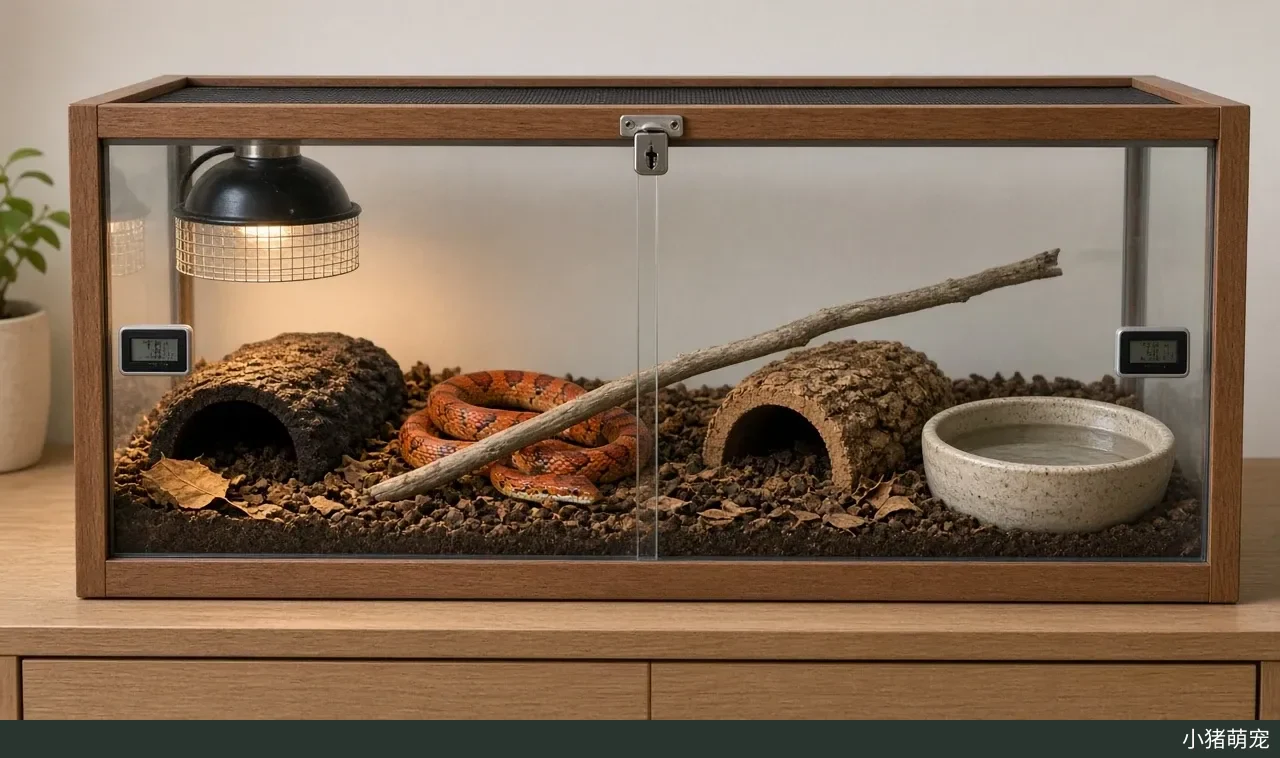
Example corn-snake enclosure: a guarded heat lamp at the warm end, hides and thermometers at both ends, climbing branches in the middle, and a water bowl at the cool end. AI-generated illustration.
Feeding, shedding, and common illness
Corn snakes eat whole prey, so nutrition is relatively complete. RSPCA advises feeding dead mice: hatchlings get one pinkie (newborn, still hairless) every 5–6 days, stepping up size with growth; adults get one adult mouse every 7–14 days; prey should be a little wider than the snake’s thickest point; about once a month a quail or rat can add variety, with regular weighing to avoid under- or overweight. VCA’s veterinary material stresses not feeding live rodents: a mouse bite before it is eaten can cause serious or even fatal infection; frozen–thawed or freshly killed rodents are safer. Both organizations say that if the prey itself is healthy, extra vitamins are usually unnecessary. Do not handle for 48 hours after feeding, to reduce the chance of regurgitation. Keep a clean water bowl in the cool zone, changed at least daily, large enough for the snake to soak. In winter some corn snakes enter a “brumation”-like state with reduced appetite, but body weight should not drop markedly.
Snakes shed periodically; normally the skin comes off in one piece, and growing juveniles shed more often. RSPCA notes that before a shed the snake may hide and move less, then rub against enclosure furnishings to remove the old skin. If shedding is incomplete, a lukewarm soak can help—do not peel hard, or you may damage the new skin beneath. The clear scales covering the eyes are “spectacles”; if they remain after a shed, see a reptile veterinarian promptly. The Merck Veterinary Manual (pet owner edition) lists incomplete shed causes including low humidity, skin parasites, malnutrition, infection, and lack of rough surfaces to rub against; it suggests soaking several hours in 25–29°C water, then gently easing residual skin with gauze; spectacles must never be forced off. RSPCA also notes that recurrent bad sheds usually improve once husbandry is corrected.
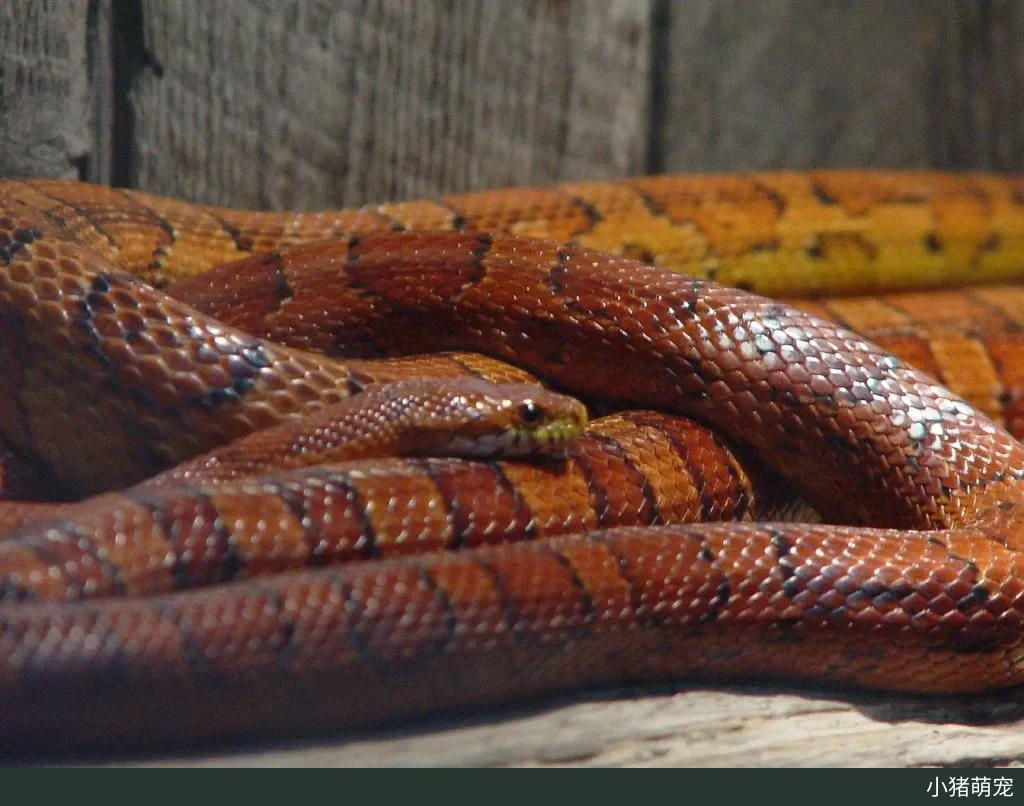
A freshly shed corn snake (original title: Corn snake - freshly shed). Photo: Clevergrrl; source: Flickr; license: CC BY-SA 2.0
Common pet-snake diseases listed by VCA include stomatitis, internal and external parasites, skin infections, respiratory disease, and septicemia. Day to day, watch for these signals:
- Stomatitis (commonly “mouth rot”): bleeding spots on the gums; bloody thick mucus or cheese-like pus in the mouth; in severe cases a swollen mouth, open-mouth breathing, and refusal to eat.
- Respiratory infection: excess oral mucus, nasal discharge, lethargy, reduced appetite, wheezing, gurgling, or open-mouth breathing.
- Mites: RSPCA notes that unusually long soaks in the water bowl, or tiny black dots on the snake or around the bowl, may indicate mites.
- Skin infection: more common in overly wet or dirty setups—reddened belly, small blisters.
- Cryptosporidiosis: the pathogen parasitizes the stomach, thickening the wall; signs include a rounded mid-body swelling, regurgitating food after meals, and weight loss. VCA notes some snakes carry the organism without disease yet still shed it in feces; the condition can be hard or impossible to cure.
Stomatitis, skin infection, and respiratory infection are all linked to poor temperature, humidity, or hygiene, so a daily glance at climate and prompt feces cleanup costs less than treating later. VCA advises seeing a reptile-experienced veterinarian for any abnormality, and using annual exams and fecal microscopy to catch intestinal parasites. RSPCA also reminds that reptiles may carry Salmonella—wash hands before and after contact with the snake and its equipment.
Beginner suitability and legal notes
Is the corn snake right for beginners? VCA’s veterinary material rates it as usually easy to handle, mild-tempered, and relatively low-maintenance for a snake, with a moderate size and strong adaptability to captivity. But “low-maintenance” is not “casual”: it may stay with you for more than a decade; food is whole frozen rodents—VCA says plainly that if you cannot accept feeding mice to a snake, a snake is probably not the pet for you; temperature, humidity, and escape prevention must be maintained for the long term. Handling has rules too: RSPCA suggests supporting near the head with one hand and near the tail with the other, lifting the whole snake rather than grabbing; keep out-of-enclosure sessions to about 10–15 minutes so body temperature does not drop; an S-curved neck is a threat signal—try another day; avoid handling during shed and for two days after feeding. Keep household cats, dogs, and other pets separated as well.
Law is a step that must be checked before keeping one. Corn snakes have no natural distribution in China and, under the definition in the Measures for the Administration of Invasive Alien Species issued by the Ministry of Agriculture and Rural Affairs and three other departments, are an alien species; Article 9 of those Measures provides that no unit or individual may introduce, release, or discard alien species without approval. In a May 2022 reply to an online query about pet snakes including corn snakes, the Huainan Municipal Forestry Bureau cited Articles 60 and 81 of the Biosecurity Law: unauthorized release or discarding of alien species requires capture or recovery within a set time and a fine of 10,000 to 50,000 yuan. On whether personal keeping requires a permit, a November 2022 Fujian Provincial Forestry Bureau reply explained that nationally or provincially key-protected species, “three-haves” list species, and CITES Appendix I and II species require lawful permits—but because the inquiry used only common names without scientific names, no specific conclusion could be given, and individuals were advised not to keep alien species. In other words, the official replies found so far do not give a uniform answer on “whether keeping a corn snake requires a permit.” If you plan to keep one, consult the local forestry authority with the scientific name Pantherophis guttatus, buy from legitimate channels and keep source records; if you no longer want it, use lawful transfer routes—never release it outdoors.
Rules elsewhere differ widely. In Australia, the Queensland government lists the corn snake as a “prohibited invasive animal” under the state’s Biosecurity Act 2014; individuals may not keep, feed, move, give, sell, or release it, and must report sightings immediately, on the grounds that escape into the wild could prey on and compete with native animals. Even in the native United States, SREL notes that corn snakes are protected in Georgia and South Carolina. Readers living overseas should follow the current rules of their local authorities.
References
-
Gregory Rich, Rick Axelson. Snakes: Colubrid. VCA Animal Hospitals. Undated page, accessed 2026-10-23.
-
Gregory Rich, Rick Axelson. Snakes: Housing. VCA Animal Hospitals. Undated page, accessed 2026-10-23.
-
Gregory Rich, Laurie Hess, Rick Axelson. Snakes: Feeding. VCA Animal Hospitals. Undated page, accessed 2026-10-23.
-
Gregory Rich, Laurie Hess, Rick Axelson. Common Diseases of Pet Snakes. VCA Animal Hospitals. Undated page, accessed 2026-10-23.
-
RSPCA. Corn snake care. Undated page, accessed 2026-10-23.
-
Stephen J. Divers. Disorders and Diseases of Reptiles. Merck Veterinary Manual (pet owner edition), comprehensively reviewed August 2020, updated June 2026.
-
University of Georgia Savannah River Ecology Laboratory. Corn Snake (Pantherophis guttatus). Undated page, accessed 2026-10-23.
-
Business Queensland. American corn snake. Queensland government, accessed 2026-10-23.
-
Ministry of Agriculture and Rural Affairs, Ministry of Natural Resources, Ministry of Ecology and Environment, General Administration of Customs. Measures for the Administration of Invasive Alien Species. Promulgated 31 May 2022, revised 15 July 2025.
-
Huainan Municipal Forestry Bureau. Inquiry on which pet turtles and pet snakes may be kept legally without a permit. Reply dated 8 May 2022.
-
Fujian Provincial Forestry Bureau (Fujian Provincial People’s Government portal). Does keeping corn snakes or hognose snakes require a permit?. 30 November 2022.
-
Xiaozhu Pets · Welcome to my pet planet