Topaz can turn up in the pedigree of a Maine Coon. A 2024 study of domestic cats included just such a cat. Its breed was Maine Coon, and part of its ancestry traced back to a Ukrainian project that bred cats for blue eyes. If the name comes up when you are choosing a kitten, it is worth following both parents’ lines back a few generations. The project began with two male cats. Either could pass blue eyes on to his descendants, but each passed on a different genetic variant.[1][2]
The two founding males of the Topaz line
In 2016, Nikital Cattery in Ukraine began breeding cats with blue eyes and small patches of white fur. The two founding males were Roxi and Seymour, and the cattery named the line Topaz. Ukraine is where that project began. An earlier line, the blue-eyed Altai, traced back to domestic cats in Kazakhstan. The French Céleste line began with a son of Roxi. None of Seymour’s descendants took part in its early development. Each of the three names points to a distinct breeding history.[1][2]
Early accounts described Roxi as an Altai cat and Seymour as a cat from Russia whose ancestry was unknown. The picture changed when researchers compared the descendants’ pedigrees with their DNA. The blue-eye variant they found in the Altai cats, which they named DBEALT, also turned up in Seymour’s descendants. Roxi’s line carried DBECEL, the variant previously identified in Céleste cats. Both are variants of the same gene, PAX3. An old pedigree records how a cat was identified at the time. A genetic report can tell you which variant a particular descendant inherited.[1][2]
Pharus Lux Cattery in Ohio still uses the name Topaz. Its April 2026 account mentions a preliminary Ukrainian standard and describes its own plans for the American line, including the hope of developing a standard through an organization such as The International Cat Association (TICA). The cattery describes itself as registered with TICA. Topaz has no entry in TICA’s public breed directory. In France, the name that received preliminary breed status from the LOOF registry in 2021 was Céleste. When someone shows you registration papers, look for the issuing organization, whether the papers identify a cattery or an individual cat, and the exact name in the breed field.[2][3][4]
Eye color varies even within one line
On one of Seymour’s mixed-breed daughters, the patch of white running from her chin to her chest is easy to see. The eye color takes a closer look. Both eyes appear mostly gold, but the researchers identified a patch of a different color in each iris. This pattern is called sectoral heterochromia. In a family described as blue-eyed, the blue can occupy just a sliver of an otherwise gold eye.[1]
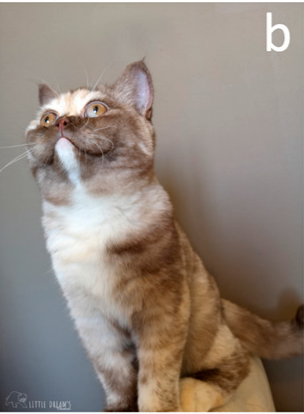
Seymour’s daughter has sectoral heterochromia in both eyes. Marie Abitbol et al., Animals, Figure 1b
The next cat, a Persian cross from the Alaska line in France, also traces back to Seymour. Here the colors occupy a whole eye each. One is gold and the other blue. The Maine Coon with Topaz ancestry in the third photograph has two blue eyes. Coat length, face shape, and white markings vary across the three photographs, too. Their pedigrees tell us what connects these cats to the same project.[1]
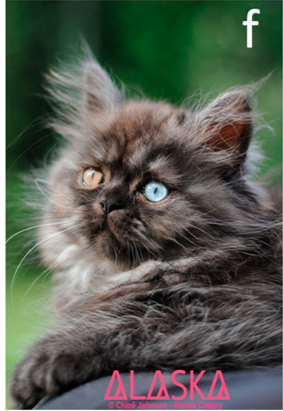
This Persian cross belongs to the Alaska line. Chloë Johnson (Alaska Cattery), Animals, Figure 1f
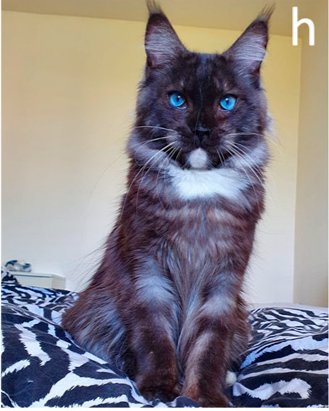
This Maine Coon has Topaz ancestry. Marie Abitbol et al., Animals, Figure 1h
Give a new cat a place to retreat
As your cat settles in, you can learn more about how sociable it is by watching where it ventures out to eat and where it retreats to rest. Give it a quiet hiding place it can reach whenever it wants. Leave space between its food, water, litter box, and resting spots. If you have more than one cat, walk the routes each will need to take. If one cat sits in a doorway, can the other still get to water or a litter box? Two bowls side by side share the same approach. A second water bowl in another room gives the cat another route.[5]
When your cat comes out to explore, draw a toy away from it along the floor so it can crouch, chase, and pounce. Let it come to you for company and walk away when it chooses. Play at roughly the same time each day, and leave a blanket with a familiar scent where it likes to rest. Does it prefer to chase a toy across open floor or spring from behind cover? Where does it settle afterward? Those small choices tell you what this particular cat enjoys.[5]
What one litter revealed about hearing
One litter of five kittens shows why both sides of the pedigree matter. Their mother, from Seymour’s line, carried DBEALT and had no visible blue in her eyes. Their father, from Roxi’s line, carried DBECEL. The researchers had DNA from both parents and four of the kittens. Of those four, two blue-eyed kittens each inherited a single variant, one the mother’s and one the father’s. The other two were males who inherited both variants. One was white and the other almost entirely white. Both were reported deaf. Looking at the mother’s eyes alone would have missed the variant she could pass on.[1]
Those two kittens give reason to take the risk of deafness seriously when the variants come together. A single litter is too small to estimate how common deafness is across the Topaz line. Elsewhere in the study, the researchers examined a line of blue-eyed Maine Coons with Topaz ancestry. Of the two founders’ variants, they found only DBECEL in the Maine Coons they sampled. Cats with the same line name in their pedigrees can inherit different combinations. When a breeder says the parents have been genetically tested, look for the name of each cat on its report, the variants the test covered, and the result for each parent.[1]
To find out whether the kitten you plan to bring home can hear with both ears, ask for its own brainstem auditory evoked response (BAER) report. Have the veterinarian explain the results for the left and right ears separately. A cat that hears in only one ear may still turn when called, so everyday responses can be misleading. Read the kitten’s hearing report alongside the parents’ genetic results. One tells you how each ear responded on the day of the test. The others help explain what the kitten could have inherited. In decisions about future breeding, the Feline Veterinary Medical Association puts the cat’s health and quality of life ahead of selection for appearance.[1][6]
References
-
[1] Marie Abitbol et al. (2024). Different Founding Effects Underlie Dominant Blue Eyes (DBE) in the Domestic Cat. Animals, 14(13), 1845.
-
[2] Marie Abitbol (November 23, 2022). Panachure classique, blanc dominant et "panachure minimale - yeux bleus" chez le chat. LOOF seminar handout.
-
[3] Beacon Fire Farm. Pharus Lux Cattery. Project overview, April 2026.
-
[4] The International Cat Association. Browse All Breeds.
-
[5] Feline Veterinary Medical Association (August 28, 2025). New Feline Veterinary Medical Association Position Statement Reimagines Life for Indoor Cats.
-
[6] Feline Veterinary Medical Association (2024). 2024 Responsible Breeding in Feline Medicine.