The curtain covers most of the window, but the cat casts a clear silhouette against it. Two large, upright ears are the first things to catch the eye. Below the shadow, the cat sits on the sill with its forelegs straight, its chest high and its tail hanging over the edge. This is a Serengeti. The International Cat Association (TICA) lists it as an Advanced New Breed. Cats in this class can appear at TICA-sanctioned shows while the breed works toward Championship status. [1–3]
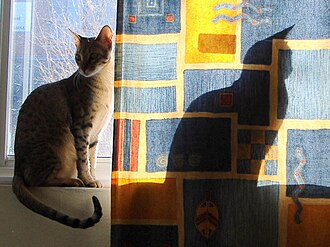
The curtain outlines the Serengeti’s ears. Kickboxer~commonswiki, Wikimedia Commons[10]

That silhouette owes something to the African serval. Karen Sausman of Kingsmark Cattery in California set out to breed a domestic cat with a similar build. She chose two breeds, the Bengal and the Oriental Shorthair, and used no serval in the cross. The Savannah, another long-legged, spotted cat, has a different history. TICA records that the first known Savannah, born in 1986, had a serval father. The two breeds can look alike, but the crosses that produced them were distinct. [1,2,4]
Recognizing the Serengeti’s build
In the seated portrait against a pale background, start with the head. The ears rise well above it and curve into rounded tips. Below them are round eyes. Follow the line from the chin down to the shoulders and the length of the neck comes into view. TICA describes the ideal Serengeti as a medium-sized, muscular cat that carries itself upright and stands squarely. Much of the impression of height comes from the neck and legs. Even sitting with its front paws together, this cat’s head is a long way above its paws. [1]
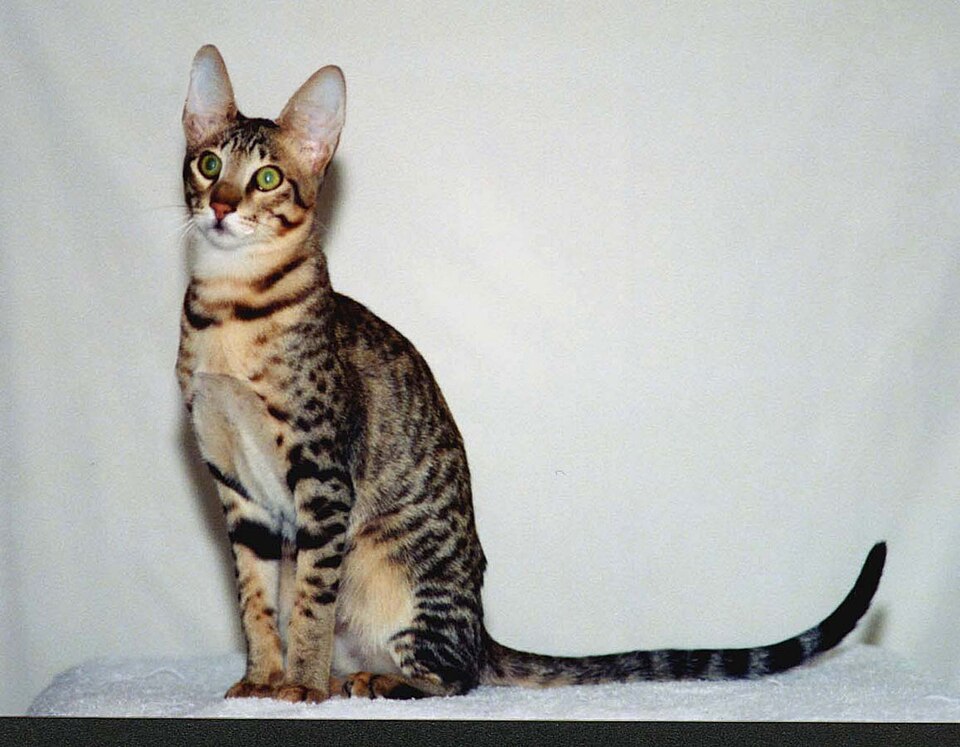
The upright ears frame the Serengeti’s long neck. Shandris, Wikimedia Commons[11]

A side view of a Serengeti named Lopsy catches the cat in mid-stride and shows how the coat pattern changes across the body. You can pick out individual dark spots along the ribs, longer markings near the shoulder and bars across the legs. Taken together, the seated portrait and the walking shot give you several features to look for at once: the ears, the neck, the length of the legs and the outline of the body. A close-up of spots alone would tell you much less. [1]
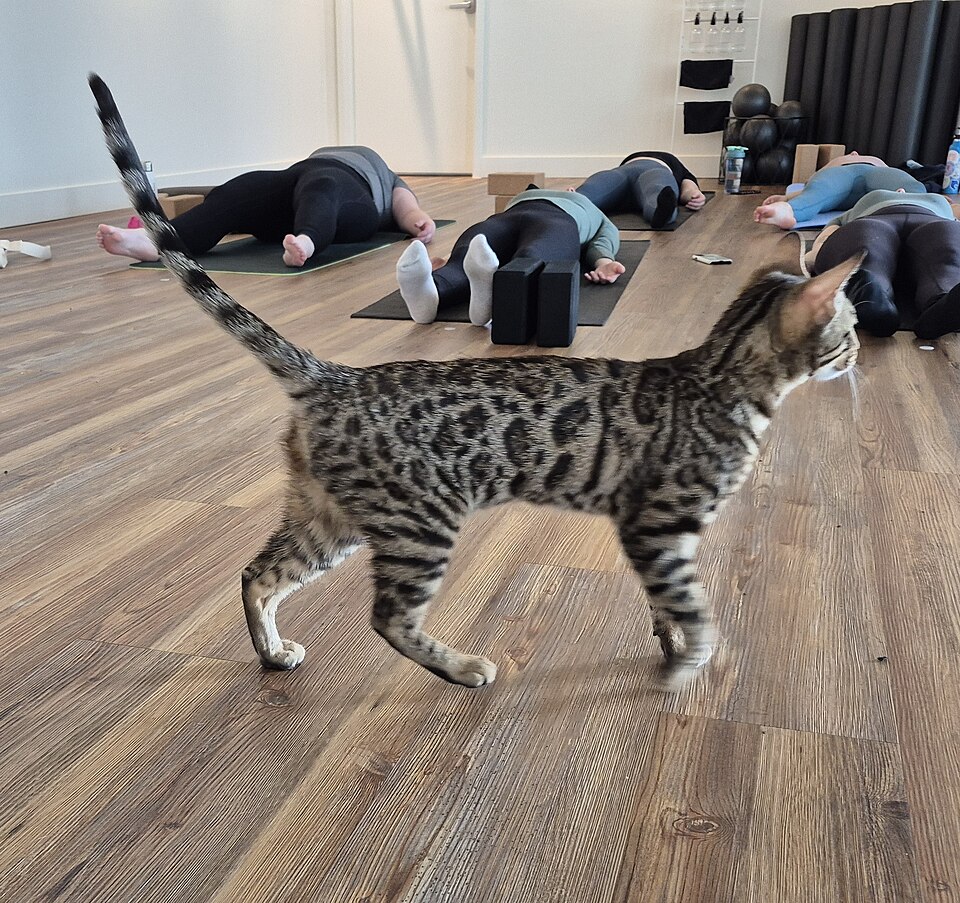
Dark spots run along Lopsy’s flank. Stormypoint Serengeti, Wikimedia Commons[12]

Let your cat choose how close to come
TICA describes Serengetis as sometimes reserved in unfamiliar surroundings. Once settled, they often follow people, climb to high places and race through the house. Those habits can help you decide where to put a perch. Notice where people spend the most time and which side the cat usually approaches from. If your cat keeps jumping onto your desk to see what you’re doing, try a sturdy cat tree beside it. From a platform of its own, the cat can still see you. Watch whether it climbs up by choice, settles for a while and finds an easy way down. [1,5,6]
Sometimes your cat may want company for only a minute. Pause what you’re doing and let it approach. If it rubs against your hand, respond. If it turns toward the window, let the visit end there. Give it a sheltered resting spot as well. A cardboard box lined with a familiar blanket gives the cat somewhere to retreat when guests arrive or people are walking back and forth. When you wash the bedding, rotate the blankets so a favorite sleeping corner keeps some of its familiar scent. Even a cat that seeks company can make use of a quiet place. [5,6]
Leave room for a chase, too. Clear a stretch of floor and draw a toy mouse across it. Pause long enough for the cat to fix its eyes on the mouse, crouch and pounce. A toy that always dangles just out of reach allows for plenty of pursuit. Slowing it down and letting the cat pin it under a paw gives the hunt a catch as well. On the next pass, change direction or bring back a favorite toy. The pauses give a cat that enjoys running time to watch and choose its moment. [1,6,7]
To see how well the room works for your cat, start at its favorite spot and trace the routes to its food, water, scratching post and litter box. This is especially revealing in a home with several cats. If one cat falls asleep in a doorway, which water bowl or litter box can the other still reach? A second bowl beside the first leaves both behind the same doorway. Put water bowls, litter boxes and resting places in several accessible locations. The Feline Veterinary Medical Association recommends spreading resources out so that each cat can reach what it needs when it needs it. [5,6]
Notice how your cat reaches a favorite spot
A familiar perch also gives you a chance to notice changes in your cat’s health. As you go about the day, take note of what your cat eats and how much, whether it steps in and out of the litter box easily, and how it gets up the cat tree. These are the kinds of details your veterinarian will ask about at a routine checkup. The physical examination also covers the muscles, joints, spine, mouth, skin and coat. Knowing how your cat usually moves at home helps the veterinarian interpret what they find in the exam room. [8]
A change may be as quiet as a pause beside the desk. A cat that used to spring straight up now often stands below, looking at the perch. It may still follow you into the room while jumping down, scratching or grooming less often. If you keep seeing a change, contact your veterinarian and describe when it began and which movements have become difficult. While you wait for the assessment, a stable intermediate step can make the usual perch easier to reach. Move hard-to-reach essentials within easy reach as well. Your cat can still get to a place it enjoys, and you have something specific to tell the veterinarian: how it used to get there and how it gets there now. [8,9]
References
-
[1] The International Cat Association. Serengeti.
-
[2] The International Cat Association. Standing Rules, Version C, 3 June 2026.
-
[3] The International Cat Association. Advanced New Breeds.
-
[4] The International Cat Association. Savannah.
-
[5] Feline Veterinary Medical Association. New Feline Veterinary Medical Association Position Statement Reimagines Life for Indoor Cats. August 28, 2025.
-
[6] Feline Veterinary Medical Association and International Cat Care. Your Cat’s Environmental Needs.
-
[7] Cat Friendly Homes. Playing With Your Cat.
-
[8] Cat Friendly Homes. What Your Veterinarian Looks for During Checkups.
-
[9] Cat Friendly Homes. Treating Chronic Pain with NSAIDs.
-
[10] Kickboxer~commonswiki. File:Serengeti.jpg. Wikimedia Commons.
-
[11] Shandris. File:Serengetimalecat.jpg. Wikimedia Commons.
-
[12] Stormypoint Serengeti. File:Lopsy brown spotted serengeti AOP.jpg. Wikimedia Commons.