One part of a Brittany’s original job required it to stand still. In Brittany, in western France, hunters took these dogs into the field to find birds such as partridge and woodcock. The dog would range out, searching by scent. When it located a bird, it would stop and point, showing the hunter where to look. Both parts of that work help explain what a Brittany needs at home today. It needs room to explore and a person to work with.[1]
Look at Mick standing on the grass. His shoulders sit a little higher than his rump. His back is short, his chest reaches about to his elbows, and there is plenty of daylight beneath his belly. Seen together, those proportions explain how the breed standard can describe the same dog as compact and long-legged. The Brittany is a medium-sized sporting dog, often white with large patches of orange or liver. To recognize its outline, look at the length of the back in relation to the legs. The patches can fall in quite different places from one dog to the next.[1][2]

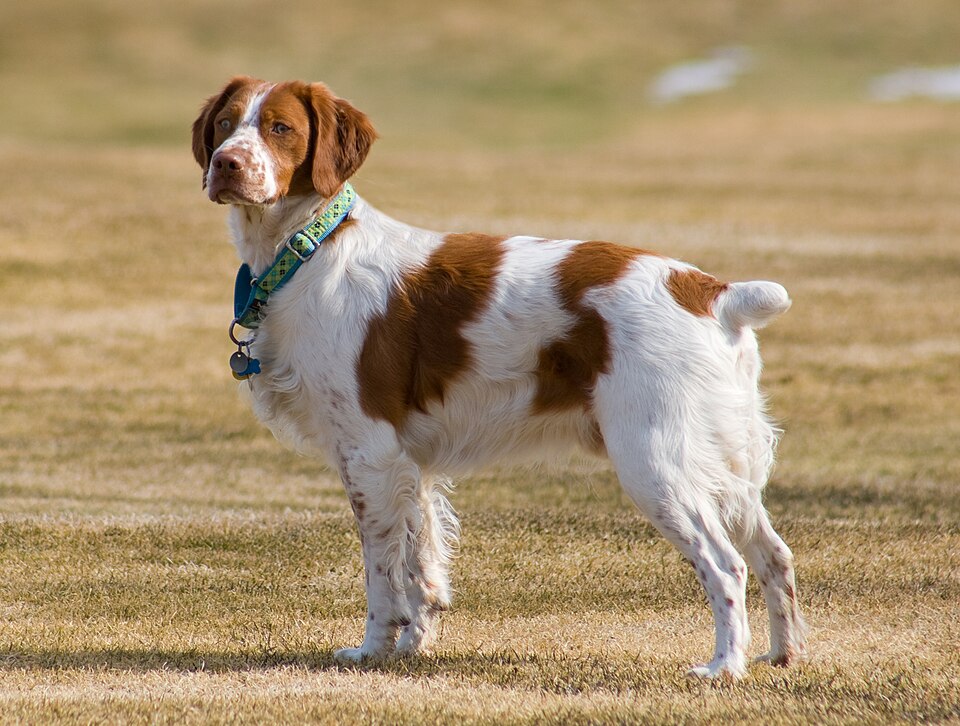
Mick stands naturally on the grass. Pharaoh Hound, Wikimedia Commons[2]
Leave room for a brisk walk
The American Kennel Club (AKC) lists long, brisk walks, hikes, and runs on leash among the activities Brittanys enjoy. Start by looking at your route. Is there a stretch where you and the dog can settle into a stride before the next crossing? Pick out a few safe grassy spots along the way where the dog can slow down and sniff. One outing can then offer sustained exercise as well as time to investigate a scent.[1]
Try fitting that walk into an ordinary workday. If there is only time for a bathroom break before work, who will take the longer outing, and where can they go? If the usual walker gets home late, who else can take the leash? A yard gives you somewhere to practice, but opening the back door and putting on your shoes to walk together are two separate entries in the day’s schedule. If weekdays amount to hurried trips downstairs, a weekend hike still leaves five days with little opportunity to get out together.[1]
When you meet a Brittany you might bring home, ask the person who cares for the dog to take you along on a walk. Notice where the dog picks up the pace, which smells bring it to a standstill, and whether it follows when the walker changes direction. Ask how far it usually goes and what other exercise it gets. Its age, health, and current fitness give you a starting point for your first walks together. You can learn more about how well your paces match on that outing than from another adult dog’s running mileage.
Make coming back worthwhile
A Brittany absorbed in a patch of grass already has something worth doing. Give the dog an easier place to learn what happens when you call. The AKC recommends patient, encouraging training for Brittanys, with socialization and basic training beginning in puppyhood.[1] Agree on one recall cue that everyone in the household will use. Start a few steps apart in a quiet, enclosed space. Call once. When the dog comes within reach, reward it there, then give a release cue and let it go back to exploring. Coming to you can lead straight back to the scent that caught its interest.
On a walk, keep the leash attached. Try calling just after the dog has had a look around, while it can still readily turn toward you. If all you get is a glance, close the gap a little. Give the dog a chance to take the last few steps and deliver the reward at your side. To practice over a longer distance, choose somewhere quiet and familiar. On a new stretch full of interesting smells, shorten the distance again. When someone else takes the leash, tell them where the dog came back and what was going on at the time. That gives them a place to start their next practice.
Agility gives you another way to practice working together. In the photograph, a Brittany tucks its front legs to clear a bar. Part of the skill comes just after the moment pictured. Where does the dog go when it lands? It has to pick up the handler’s direction while it is still moving. Families who enjoy teaching a dog new moves can begin with turns and changes of direction on the ground, then look for a class suited to the dog’s ability. Even an ordinary fork in a path offers a chance to call the dog in, take the turn together, and carry on.[1][3]

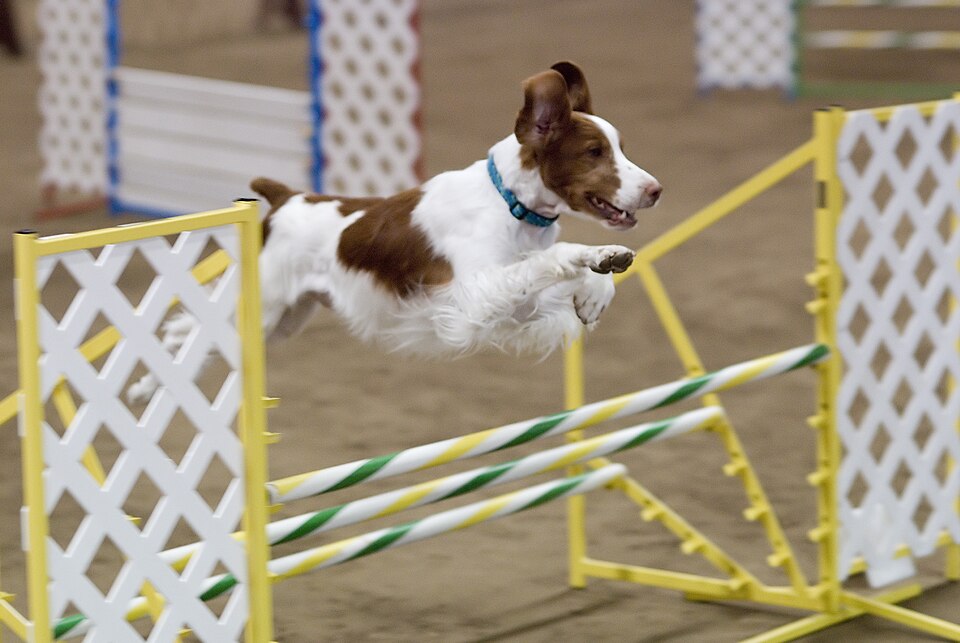
A Brittany clears a bar at an agility trial. Ron Armstrong, Wikimedia Commons[3]
Check the ears and leg feathering after a walk
Run a hand over the coat before and after a walk and you’ll soon learn which areas need the comb. The hair on a Brittany’s body is dense and mostly short. It lies flat or has a slight wave, and a soft brush or grooming mitt will smooth it. Look back at Mick’s standing photograph. The longer hair along the backs of his front legs and thighs hangs in small tufts called feathering. After a walk through grass, feel along those tufts, then ease a comb through them to lift out bits of grass. That is where a little extra grooming time pays off.[1][2]
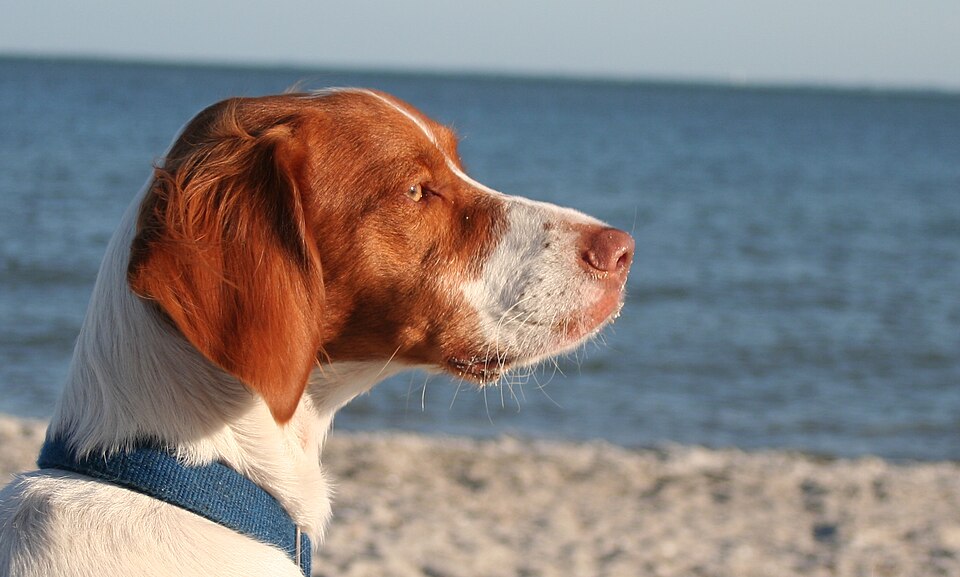
Hank shows his ear in profile. Uber Phot, Wikimedia Commons[4]

At the beach, Hank has turned his head so you can see where his ear sits, high on his head, and how the flap falls against his cheek. The photograph shows the outside. At home, gently lift the flap to check the inside for bits of grass or a buildup of wax. Wipe the visible area if it needs cleaning. Check how the nails are wearing, too. If everyday activity doesn’t wear them down, the AKC suggests trimming them about once a month. Regular toothbrushing also belongs in the routine.[1][4]
If you’re asking a breeder about a litter, ask to see the hip evaluation and the veterinary ophthalmologist’s report for each parent. The AKC breed profile lists both screenings for breeding dogs. They address the risks of hip dysplasia and eye disease, and each report describes the parent that was examined. When planning hikes or runs for your own Brittany, a veterinarian can assess that dog’s fitness for the activity. A change in the way the dog walks is a particular reason to arrange an assessment.[1]
Before deciding to bring a Brittany home, walk a route from your front door. Where could you stride out, where could the dog linger in the grass, and where could you practice calling it back? Once home, allow a few minutes for a comb through the leg feathering and a look under the ears. If that outing and the small jobs afterward sound like a routine your family would enjoy repeating, you have a place in your day for both sides of a Brittany’s nature. It can range out to explore and come back to work with you.
References
-
[1] American Kennel Club. Brittany Dog Breed Information.
-
[2] Pharaoh Hound. File:Brittany Spaniel standing.jpg. Wikimedia Commons, 2009.
-
[3] Ron Armstrong. File:Brittany agility jump.jpg. Wikimedia Commons, 2007.
-
[4] Uber Phot. File:Brittany Spaniel Dog.jpg. Wikimedia Commons, 2008.