The Maine Coon traces its history to the northeastern United States, where some early Maine Coons were born with extra toes, a trait called polydactyly. Whether the trait arose in North America or arrived with domestic cats from overseas remains an open question. In 2015, The International Cat Association (TICA) gave these cats the name Maine Coon Polydactyl and the code MCP, allowing them to compete separately for championship titles. TICA’s standard places them in the same breed group as Maine Coons with the usual number of toes, registered under the code MC. [1][2]
Extra toes on a broad-pawed, longhaired cat tell you that the cat is polydactyl. Its pedigree and registration records are what establish its Maine Coon identity. Extra toes occur in other domestic cats, and polydactyl Maine Coons themselves come from several breeding lines. The registry matters, too. Britain’s Governing Council of the Cat Fancy (GCCF) explicitly lists polydactyl Maine Coons among the breeds it does not recognise. When reading a registration record, look at the breed name alongside the association that issued it. [2][3][4]
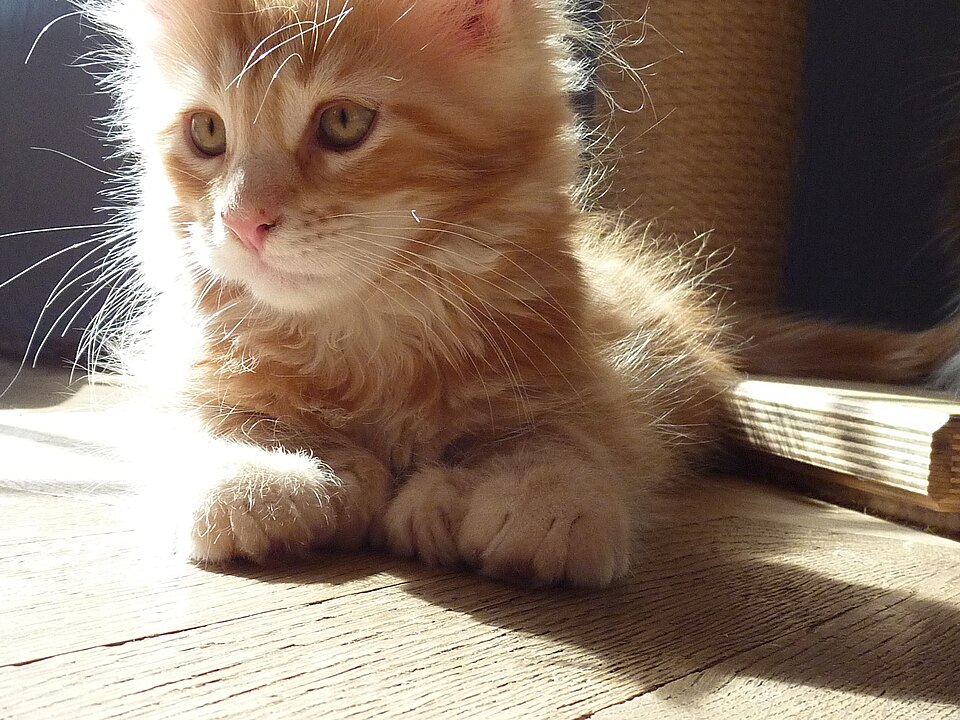
A polydactyl Maine Coon rests on its front paws. Ventus55, Wikimedia Commons[11]

Where do the extra toes grow?
The cat in the first photograph has both front paws flat on the board. The photographer records six toes on each, though the broad tufts of fur are easier to see head-on than the individual toes. The side view below shows a kitten reaching out with a white paw. One toe stands clear of its neighbour. Veterinary researchers have described two recognisable shapes. A short extra toe can sit apart like the thumb of a mitten. An extra toe about as long as its neighbours can sit alongside them, making the whole paw look wide. A single cat can have one shape on its front paws and the other on its hind paws. [4][5]
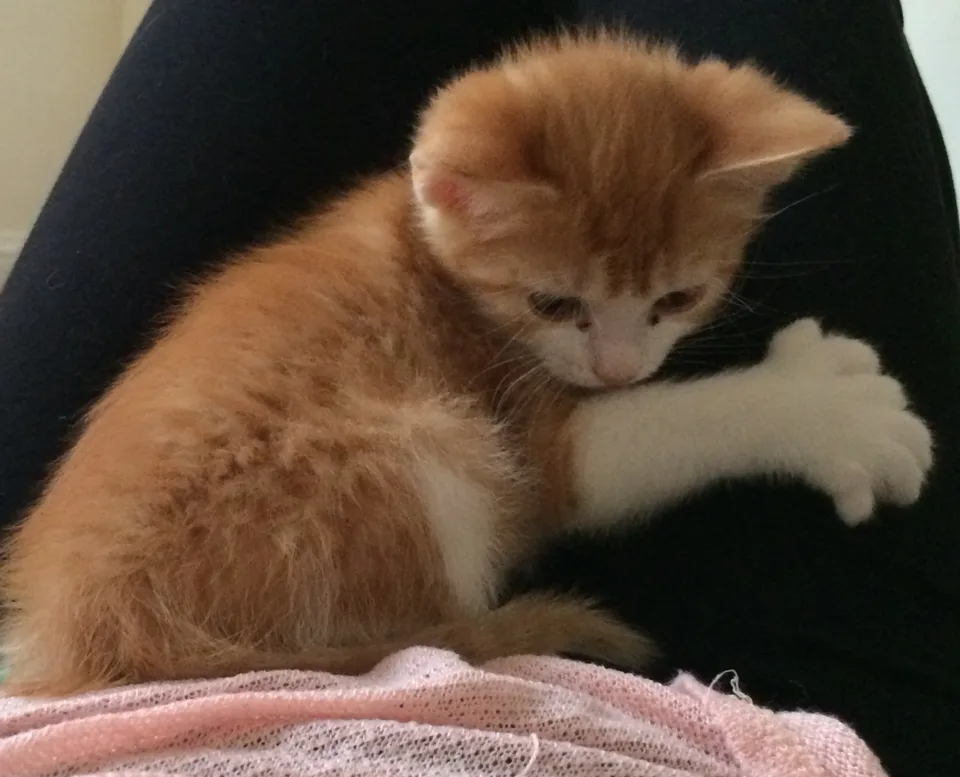
An extra toe stands out in profile. Jamesishere, Wikimedia Commons[12]

Most domestic cats have five toes on each front paw and four on each hind paw. The dewclaw ordinarily sits a little higher up on the inside of each front paw. In polydactyl Maine Coons, the extra toes take several forms. On examining the paws and their X-rays, researchers found fully formed extra toes, slender toes tucked beside the dewclaw and even a tiny extra claw with no toe bone beneath it. Some cats had the usual number of front toes and extra toes on their hind paws. Counting across the widest part of a front paw can leave a claw tip hidden from view. [5][6]
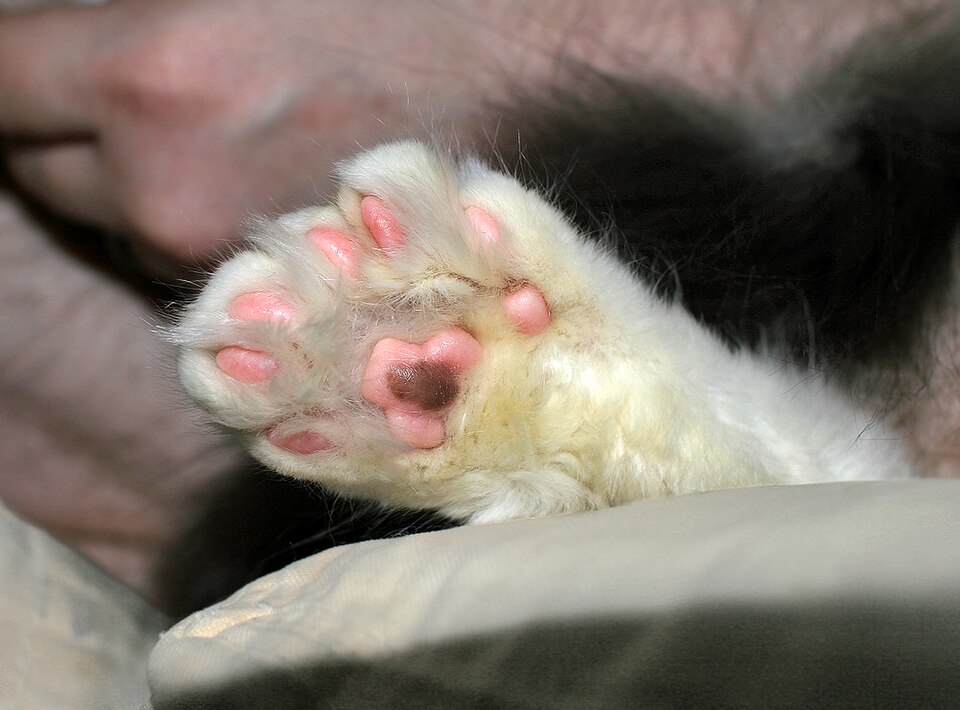
A polydactyl kitten shows the sole of its left hind paw. Onyxrain, Wikimedia Commons[13]

Finding every claw on each paw
To get to know your cat’s paws, start with the view in the photograph above. Wait until your cat is relaxed and let one paw rest in your hand. Look at the pads and the rim of the paw, then gently part the long fur between the toes. Work around the paw one toe at a time. Press each toe gently to bring the claw tip into view. Look at the direction it curves and the gap between the tip and the pad. Turn to the inner edge of the paw and check beside the dewclaw and wherever two toes meet. Start afresh on each paw, taking the time to examine both hind paws individually. At the next check, you’ll know where to part the fur to find a hidden claw. [5][6][7]
Check each claw and trim only those that have grown too long. In a pale claw, you may see a pink area called the quick. It contains blood vessels and nerves. Use cat nail clippers to take a small sliver off the clear tip, leaving space before the quick. If a tiny claw sits between two toes, make sure you can see both the spot you intend to cut and the skin beside it. If either is hard to see, put the clippers down and ask a vet or veterinary nurse to show you how to reach it safely. If your cat pulls its paw away, stop, offer a reward it enjoys and leave the remaining claws for another time. [6][7]
Make room at home for scratching, chasing and hiding. A sturdy scratching post can go where your cat likes to stretch. Give it a quiet place to retreat and play together with a toy it can chase and pounce on. If several cats share the home, spread out their water, food, litter trays and resting places so each cat has easy access. Play also gives you a chance to learn how your cat usually turns, lands and walks up to the scratching post. You’ll have something familiar to compare with if it starts putting less weight on one foot or repeatedly draws the same paw back when scratching. [7][8][9]
What can toe count tell you about health?
Even knowing how many toes the parents have leaves a kitten’s paw shape hard to predict. In a genetic study of 48 Maine Coons with extra toes, 19 carried a known variant called Hw. The other 29 tested negative for all three known variants included in the study. The researchers also identified two male cats who carried Hw and whose X-rays showed the usual number of toes. Both had fathered polydactyl kittens. To interpret a genetic test result, look at which variant the test covered. To find out how many claws need care, examine the cat’s four paws. [4]
In a separate clinical study, researchers examined and took X-rays of 70 Maine Coons, 48 of them polydactyl. One polydactyl cat had limped on its left foreleg from the age of nine months. Vets found a loose piece of bone in the wrist joint, and the limp resolved after they removed it. None of the other 69 cats showed a limp at examination. The case gives vets a reason to examine the joints above the toes as well. A single examination leaves open the question of whether a cat will develop pain later in life. In its position on responsible breeding, the Feline Veterinary Medical Association gives cats’ comfort and ability to move freely priority over preferences for a particular appearance. [5][10]
At home, watch how your cat bears weight today and look for any claw tip digging into the skin. Contact your vet if a claw has grown into a pad, if you see redness, swelling or bleeding around a toe, or if your cat develops a limp. Tell the vet which paw is affected, when the change began and what you’ve noticed during walking or scratching. Those details say more about the problem than a toe count alone. Leave an embedded claw for the vet to treat. [7][9]
References
-
[1] TICA. Maine Coon Polydactyl.
-
[2] TICA. Maine Coon Breed Group (MC/MCP).
-
[3] GCCF. Unrecognised Breeds.
-
[4] Hamelin A et al. Genetic heterogeneity of polydactyly in Maine Coon cats. Journal of Feline Medicine and Surgery.
-
[5] Hamelin A et al. Clinical characterisation of polydactyly in Maine Coon cats. Journal of Feline Medicine and Surgery, 2017.
-
[6] PDSA. How to clip your cat’s claws. 2022.
-
[7] PDSA. Vet Q&A: How do I trim my cat’s claws?.
-
[8] FelineVMA. New Feline Veterinary Medical Association Position Statement Reimagines Life for Indoor Cats. 2025.
-
[9] PDSA. Limping and stiffness in cats.
-
[10] FelineVMA. Responsible Breeding in Feline Medicine. 2024.
-
[11] Ventus55. File:Polydaktyle Maine Coon Katze.jpg.
-
[12] Jamesishere. File:8 Toed Red Maine Coon Polydactyl Kitten.png.
-
[13] Onyxrain. File:Polydactyl cat 7toes.jpg.