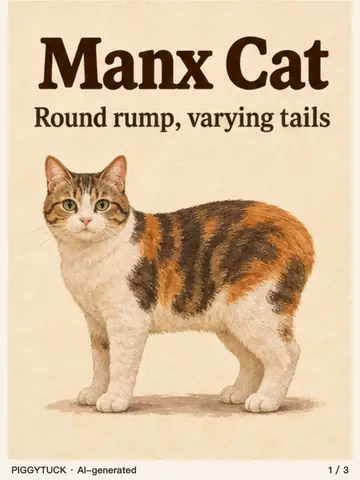
Manx cats are recognisable by a short back, round rump, deep flanks, and tails that range from absent to a short stump. They have compact bodies, broad chests, round paws, and hind legs longer than the forelegs.[1] In the home, a regular brushing routine and comfortable indoor resting spots help with everyday care. Discuss changes in movement or litter-box habits with a veterinarian.[1][2][3]
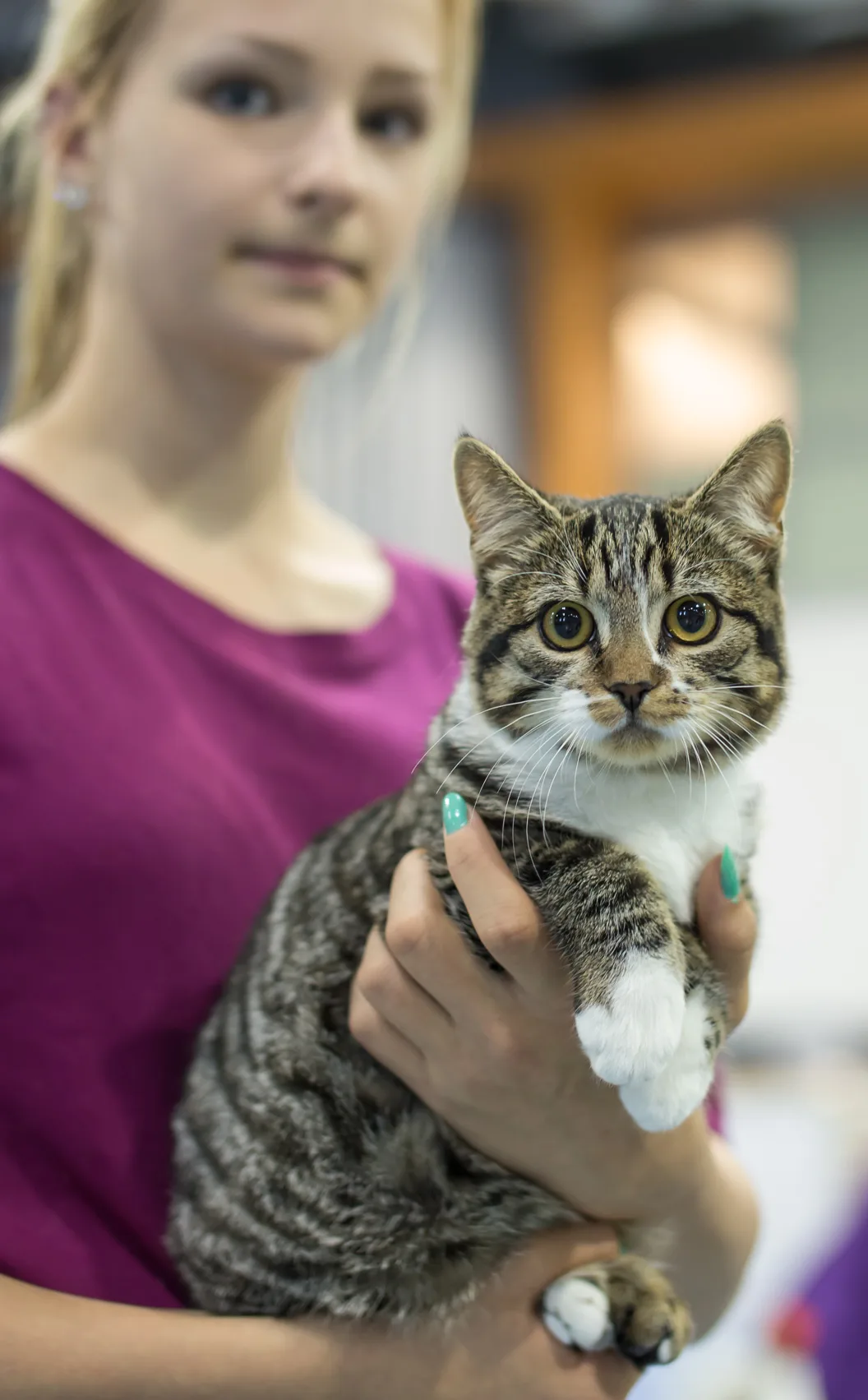
Figure: Brown/grey-and-white Manx Lulu held up; rounded head and white paws visible. Heikki Siltala, catza.net[5]
Appearance and tail varieties in the standard
The head is large and rounded with prominent cheeks; the nose medium and curved without a stop; the chin firm. Ears are medium, open at the base, narrowing to rounded tips and set relatively high; eyes are large and round, any colour permitted if it matches the coat.[1] The coat is short with a dense soft undercoat and a firmer topcoat; all colours and patterns are recognised, any amount of white is allowed, with colour details in the general colour list.[1] Tail varieties: Rumpy—completely absent with a hollow at the spine end; Rumpy riser—a slight upward bow at the base that does not stop a stroking hand; Stumpy—a short tail, no longer than 3–4 cm in the WCF standard.[1] Points: body 25, shortness of back 10, taillessness/Stumpy length 25, head 15, eye shape/colour 5, coat 15, condition 5—the heavy weight on back length and tail grade shows the axis of recognition is short back–round rump–tail type, not taillessness as a standalone gimmick.[1] Deep flanks with the short back and round rump shape the silhouette; longer hind than front legs shape stance, but the standard does not promise athleticism, temperament, or individual health.[1] A photo that hides the tail cannot prove Rumpy, Rumpy riser, or Stumpy.[1]
Short-coat care and the indoor environment
Short-coated Manx often groom themselves well. Brushing at least weekly helps remove dust, dead skin and loose hair and lets you check the skin; daily combing is a longhair schedule, not the short-hair default.[3] Soft brushes, pin brushes or grooming mitts suit shorter coats; mitts help lift dead hair, and heavier sheds may need a seasonal tool.[3] Keep sessions short, pair with praise or treats, and stop at twitching, tail-lashing, growling or hissing; watch for sores, wounds or mats and see a vet if the coat changes markedly.[3] A regular grooming routine gives you a chance to check the skin and coat.[3] Brush gently over the loin and where the hind legs meet the body. Tell the veterinarian about any changes in gait or sensitivity.[1][3]
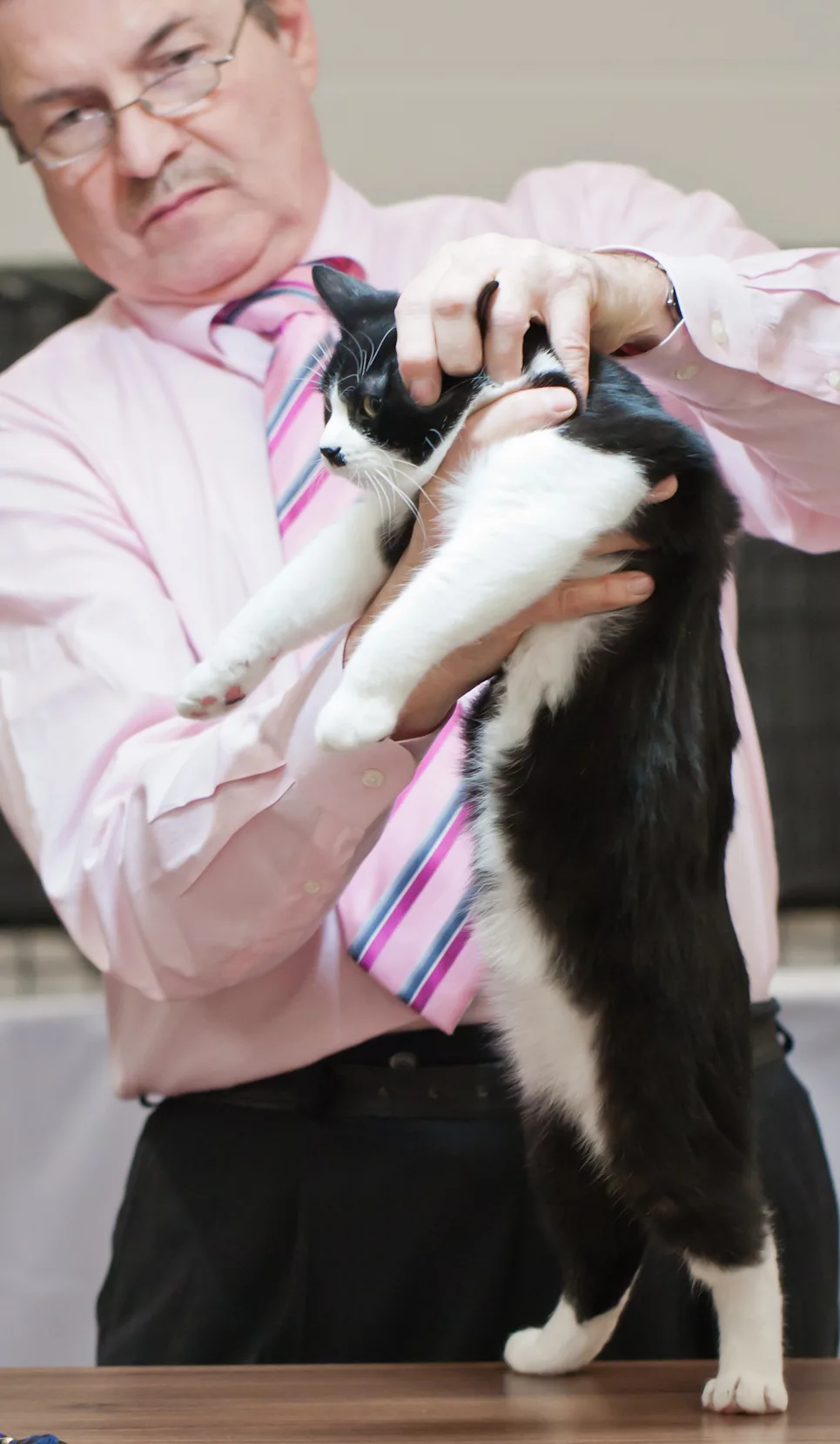
Figure: Black-and-white Manx held above a show table; white chest and legs visible. Heikki Siltala, catza.net[6]
Indoor living lowers some trauma risks, but safety alone is not enough. To help reduce behavioural and stress-related health problems, provide a safe place; separated resources; play and predatory opportunity; predictable social interaction; and respect for smell and other senses.[4] Planning climbing, hiding places, dispersed food/water/litter and scheduled interaction gives the cat options to play, rest, or retreat.[4] In multi-cat homes, separate resources to reduce conflict around bowls or litter; alone-versus-together rhythm follows the individual, not a breed stereotype.[4] For individuals with longer hind legs and a shorter back, jump landings and perch heights still need individual watching—mid-level platforms and non-slip landings often help more than ever-higher towers—but exact heights are home observation, not a standard clause.[1][4]
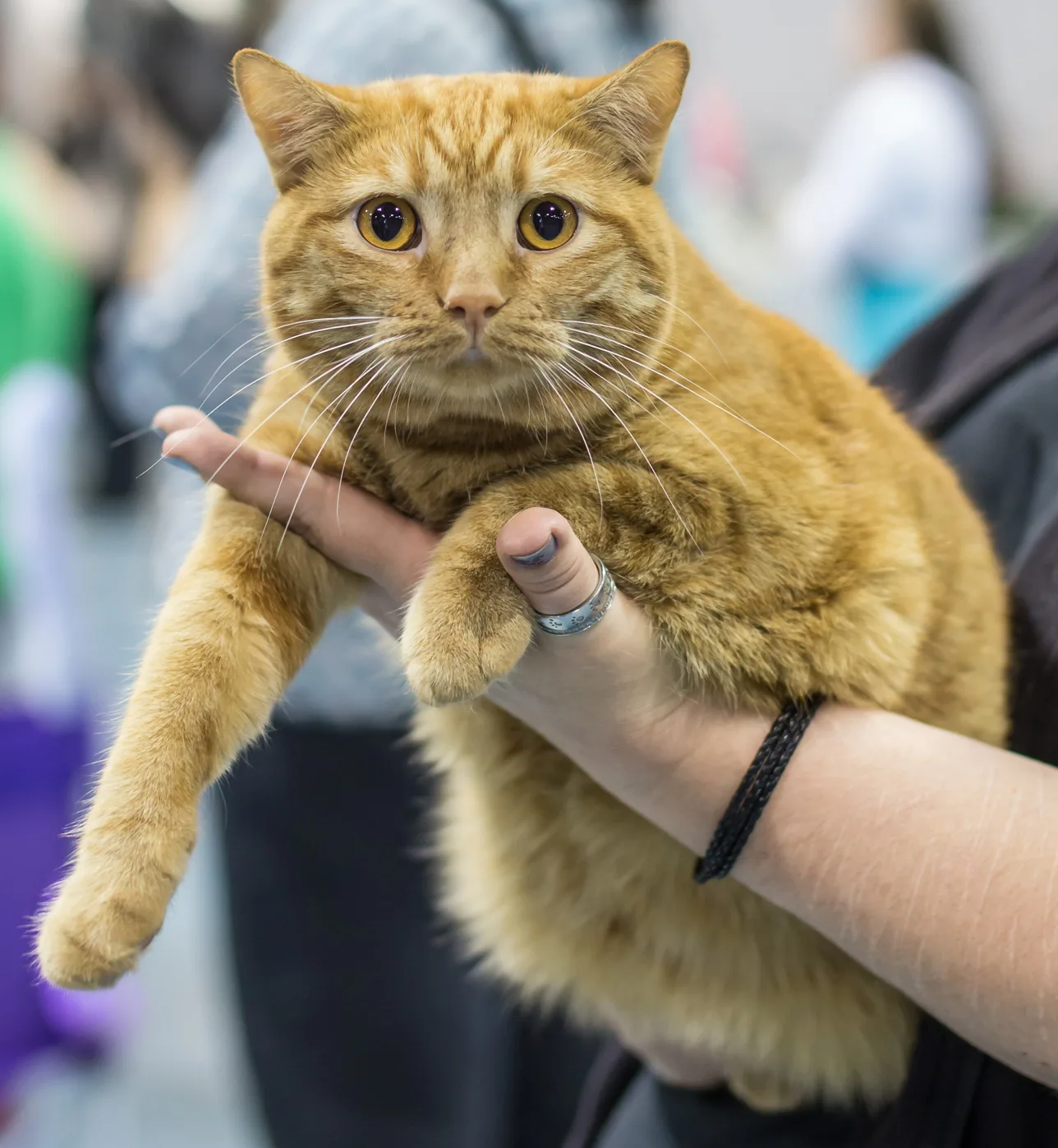
Figure: Ginger Manx Conan Lontrus held in both hands; broad rounded face and forelegs visible. Heikki Siltala, catza.net[7]
Talking about tail-related health
Sacrocaudal dysgenesis in Manx cats can be inherited as an autosomal dominant trait, and spina bifida may occur alongside it. Severe shortening of the spine can affect the spinal cord and nerves involved in movement and elimination.[2][9] Have a veterinarian assess changes in gait, jumping, or elimination. X-rays or CT may help assess vertebral changes; some cases call for CT myelography, MRI, genetic testing, or cerebrospinal fluid analysis.[9]
The risks associated with the Manx gene are still being studied. The GCCF requires a veterinary health check for breeding Manx cats and no longer rewards extreme shortness of the back. The 2010 WCF standard classifies tail appearance as Rumpy, Rumpy riser, or Stumpy. A tail grade does not establish whether an individual cat has spinal or elimination problems.[1][8]
Consider the short back, rounded rump, deep flanks, and tail together when identifying a Manx. If the tail is hidden in a photo, check the cat or its pedigree records.[1] At home, brush weekly and provide separate indoor resources and non-slip landing spots. Ask for parental examination records before choosing a kitten. A veterinarian can assess spinal or elimination concerns and decide whether imaging is needed.[2][4][8][9]
References
-
WCF (2010-01-01). Breed standard: Manx (MAN).
-
GCCF. Manx.
-
RSPCA. Grooming your cat.
-
FelineVMA (2025-08-28). Indoor cats position statement news.
-
Siltala, H. Manx photo 212096.
-
Siltala, H. Manx photo 200135.
-
Siltala, H. Manx photo 212098.
-
GCCF. Welfare — Manx Cats.
-
Parsley, E.; peer-reviewed by Carney, P. (full review Mar 2026; updated Jul 2026). Congenital and Inherited Spinal Cord Disorders in Dogs and Cats. MSD Veterinary Manual.