The Burmese is a short-haired domestic breed. The body is medium in size, but the bone is substantial and the muscle is developed, so the cat often feels heavier than it looks. A round head, a short muzzle, round eyes from yellow to gold, and a short coat with a satin finish are the outward marks. The modern Burmese was bred mainly in the United States and is known for being attached to people and fond of interaction. This account follows the CFA and TICA breed pages and veterinary genetics material. It covers origin, appearance, temperament, health concerns, and day-to-day care.
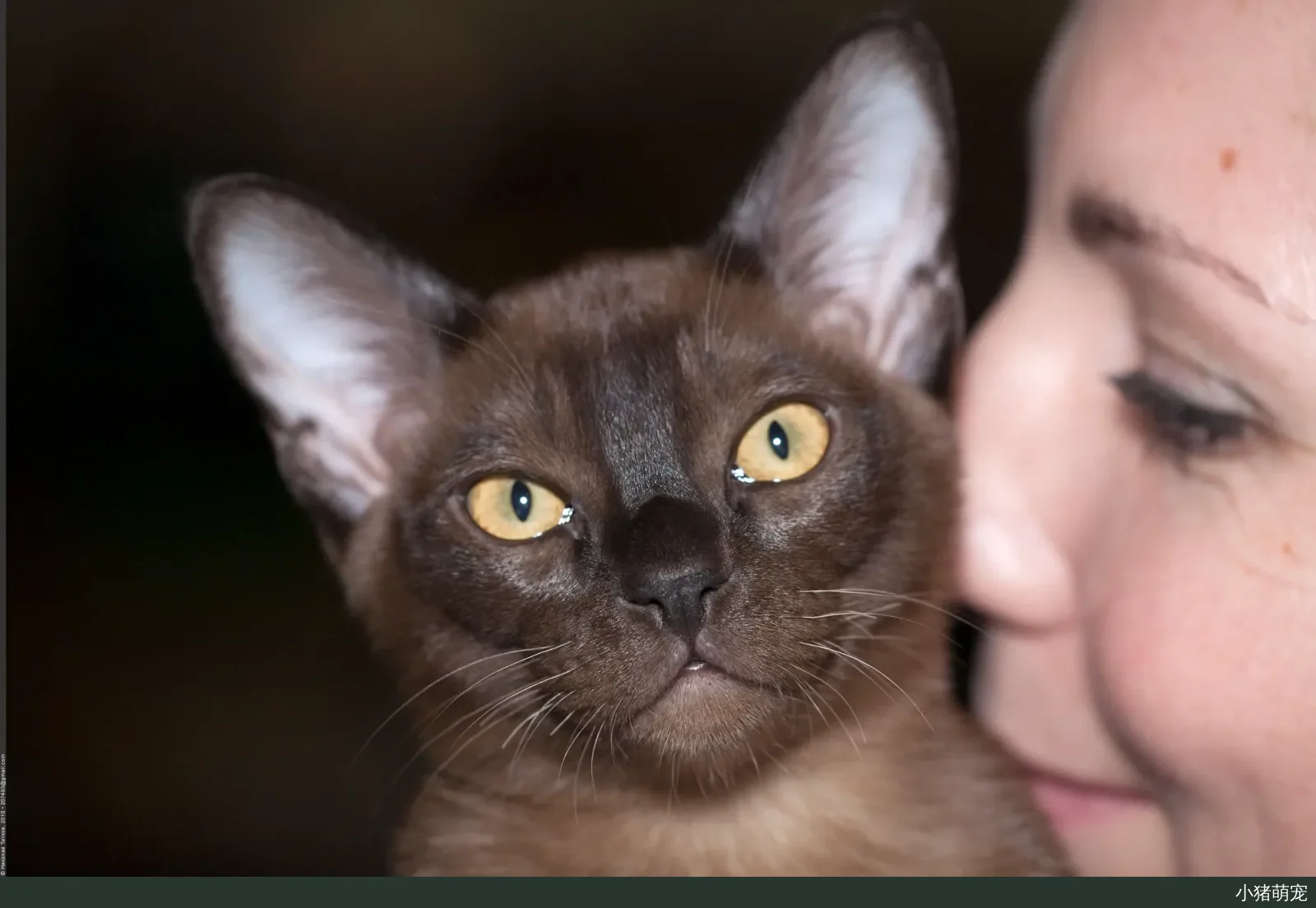
Close-up of the sable Burmese International Champion Antuana Silk Way beside a person. Photograph: Nickolas Titkov, Moscow. Original file: BUR Int.Ch. Antuana Silk Way (4496874981), Wikimedia Commons. License: CC BY-SA 2.0. The Commons file is 4368×2912. The copy shown here is resized in proportion to 1600×1067, and a dark bar reading “小猪萌宠” has been added along the bottom, so this file is 1600×1104.

Origin and recognition
The name points to Southeast Asia. The TICA breed page says the cat originated along what is now the border of Thailand and Myanmar and was later developed in the United States and Britain. The CFA also mentions a natural population on the Malay Peninsula, with a small number imported. Most Burmese cats today, though, can be traced to one female: Wong Mau.
On TICA’s account, a sailor brought Wong Mau from the East to San Francisco in 1930 and gave her to Dr. Joseph G. Thompson. Her frame was fine, but her body was more compact than a Siamese, the tail shorter, the head round, the muzzle short, the eyes set wider, and the coat walnut brown with darker points. Many breeders took her for a dark Siamese. Thompson thought she was clearly different and set out to fix her traits. In 1932 Wong Mau was bred to the seal-point Siamese Tai Mau, and later to her son Yen Yen Mau. Among the offspring were cats that were dark brown all over. Those dark brown kittens passed the color on reliably and became the basis of the breed. Wong Mau herself is now generally treated as a Siamese–Burmese hybrid.
On recognition, the CFA began registering early Burmese cats in 1936, and the breed became eligible for championship competition in 1959. TICA listed the Burmese among its earliest recognized breeds in June 1979. Early breeders mostly kept only the sable. Dilute colors such as blue were accepted later, and the red gene was introduced afterward in Europe.
Appearance and temperament
Under the CFA standard, the ideal Burmese is medium in size, with substantial bone and developed muscle, and a weight that is “surprising” for the size. The cat should not look obese, slack in the belly, or listless. The head is round from the front and from the side, the face full, the eyes wide-set, the muzzle short and broad, with a nose break visible from the side. The ears are medium, broad at the base, rounded at the tip, and tipped slightly forward. The eyes are large and round. The coat is short, fine, close to the body, and satin in sheen. The CFA profile also says a Burmese matures at about 18 months, that an adult male may weigh 12 pounds (about 5.4 kilograms) or more, and that females are usually smaller.
Associations do not accept the same colors. The CFA accepts four: sable, champagne, blue, and platinum, with eye color from yellow to gold, deeper and brighter preferred. TICA’s range is wider. Besides sable, blue, chocolate, lilac, and other solid colors, it includes red, cream, and several tortoiseshell colors. The breed developed separately in the United States and Britain, and associations in different regions also differ on head and body. The two lines are often called American and European. A reference to a “standard Burmese” should follow the breed page of the association being cited. There is no single worldwide standard.
On temperament, the CFA describes the Burmese as curious, intelligent, and friendly, and, because the cat stays so close, as “Velcro kitties.” TICA says they are attached to people and like to curl up on any empty lap. The need for company is strong. Long stretches alone are lonely, and TICA suggests that a household often empty might keep two so they have each other. The voice is generally soft, and the cat will “talk” with the family. They are bright and active, can learn games such as retrieving, and suit a household willing to play and to offer puzzle or interactive toys. Individuals still differ. Time with children or other pets still needs to be introduced gradually and watched.
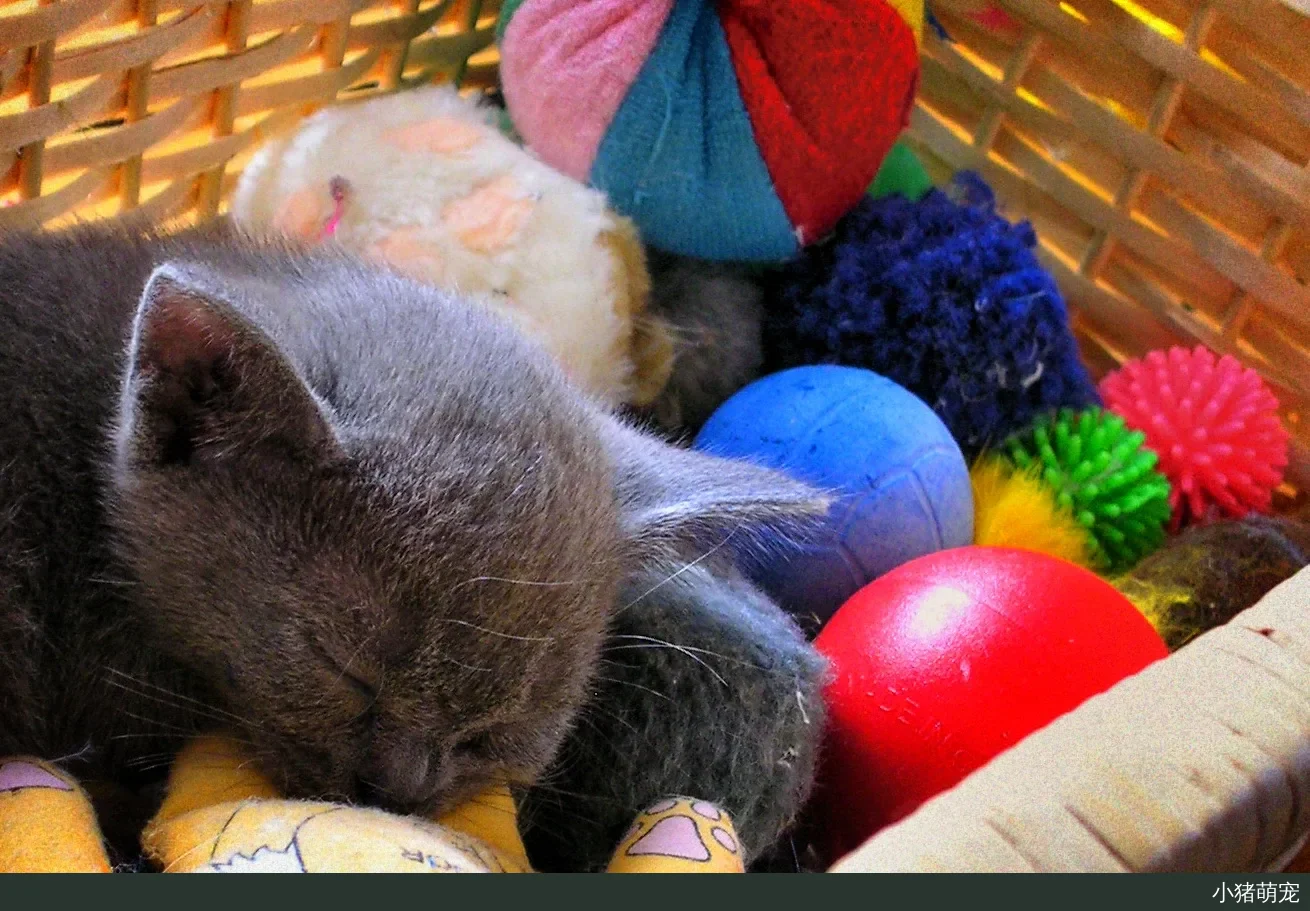
A gray Burmese kitten asleep among toys in a wicker basket. Photograph: Mikael Tigerström, Gothenburg. Original file: The kitten and its toys, Wikimedia Commons. License: CC BY 2.0. The Commons file is 1310×873. The copy shown here keeps that photograph at the same width and adds a dark bar reading “小猪萌宠” along the bottom, so this file is 1310×911.

Health and daily care
Both the CFA and TICA describe the Burmese as a generally healthy breed, but one inherited condition is worth knowing: Burmese hypokalemia, also called familial episodic hypokalemic polymyopathy. The Veterinary Genetics Laboratory (VGL) at UC Davis describes it as an autosomal recessive disorder tied to a nonsense mutation in WNK4. An affected cat has episodes of low blood potassium, seen as weakness of the skeletal muscle, most clearly in the neck. The cat may be unable to lift the head (cervical ventroflexion), may have trouble walking, or may move with a stiff gait. The Merck Veterinary Manual also lists cervical ventroflexion and a stiff gait as typical signs of hypokalemic polymyopathy.
“Recessive” can be read this way. Each cat has two copies of the gene. A cat with one mutated copy is a carrier and does not itself become ill. If two carriers are bred, about a quarter of the kittens are expected to carry two mutated copies and to be affected. VGL offers a cheek-swab genetic test for the Burmese and for related breeds such as the Bombay and the Tonkinese. Breeders can use it to avoid pairing carriers. The condition is usually not fatal, and most affected cats can be managed, but whether to supplement potassium, and how, has to be decided by a licensed veterinarian after an examination.
The TICA breed page also notes that, like all cats, the Burmese is at risk of hypertrophic cardiomyopathy (HCM). It suggests that breeders ask a veterinary cardiologist for an echocardiogram, and that an owner may have periodic checks on a veterinarian’s advice. The CFA notes that some sources suggest older Burmese cats may be prone to diabetes, but the related genetic research is not settled.
Day-to-day keeping is mainly indoors. The short coat is relatively simple to care for. Both the CFA and TICA suggest a rubber brush once a week to remove loose hair, and also regular nail trims, ear cleaning, and brushing the teeth with a pet toothpaste a veterinarian accepts. The home should have cat trees and climbing space that are high enough, and time each day for interactive play. Feed a complete cat food, adjusted for age, body condition, and veterinary advice, watch the weight, and keep fresh water available every day. Vaccination, parasite control, and neutering can be discussed with a veterinarian. If the cat shows muscle weakness, cannot lift its head, walks abnormally, or becomes markedly dull, it should be seen promptly.
This is a general account of the breed. It is not a diagnosis or a treatment plan for an individual cat. Health questions belong with a licensed veterinarian.
References
- The Cat Fanciers' Association. Burmese
- The International Cat Association. Burmese
- UC Davis Veterinary Genetics Laboratory. Burmese Hypokalemia
- Williamson B. Feline Hypokalemic Polymyopathy. Merck Veterinary Manual, updated February 2026.
- Piggy Pets.