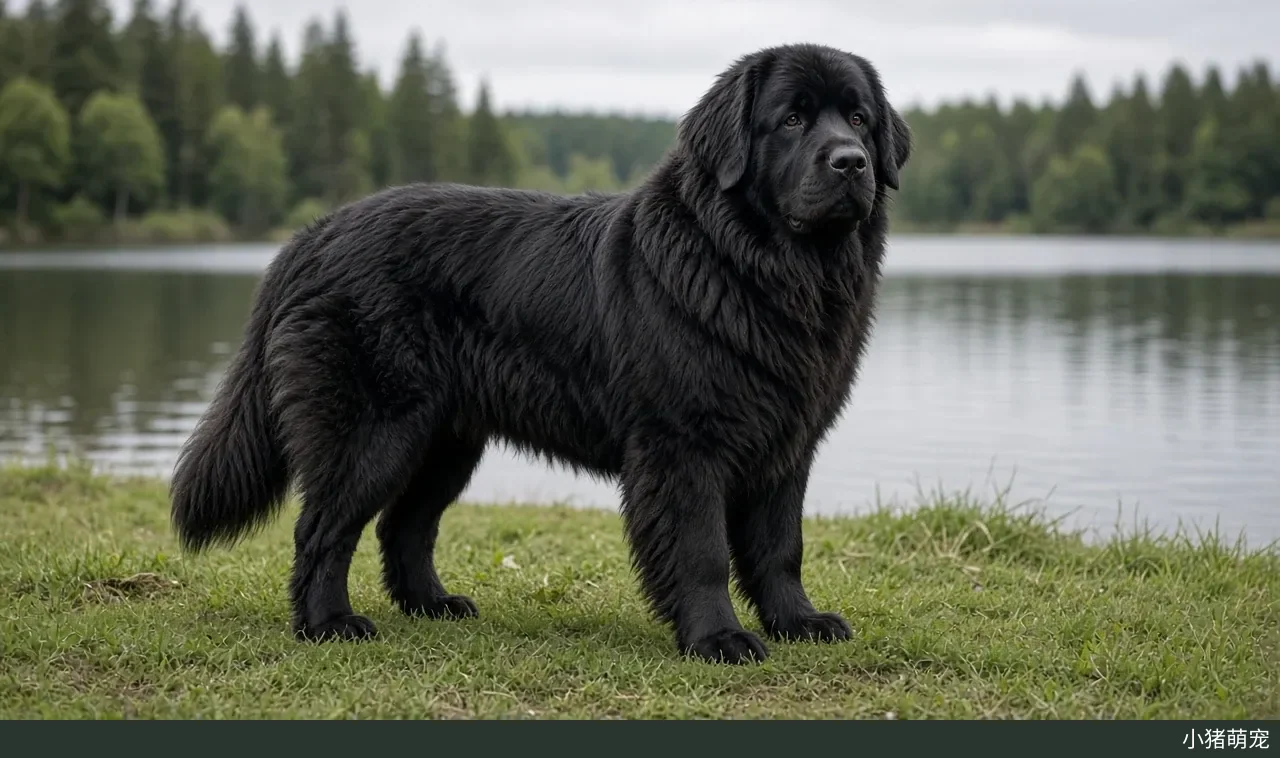
An adult black Newfoundland standing on lakeside grass, showing huge size and a thick double coat. AI-generated illustration.
The Newfoundland is a giant working breed native to Newfoundland, Canada: in fishing harbors it helped haul nets and carts, and it is famous for water rescue. It has a water-resistant double coat and webbed feet; both FCI and AKC breed standards put a gentle temperament at the core. Living with one means planning daily brushing, wiping drool, daily walks, and helping it cool down in hot weather.
Newfoundland Island origins and water rescue
The current FCI standard (No. 50, published 29 October 1996) lists Canada as country of origin and the use as “draught and water dog.” The historical note in the standard says the breed descends from Newfoundland’s indigenous dogs plus large black “bear dogs” brought by Vikings after 1100; later, dogs brought by European fishers further shaped it, and by the start of colonization around 1610 its form and nature were largely set. That early history is the standard’s own account; details are hard to verify independently. The AKC cites Newfoundland Club of America (NCA) historian Maryjane Spackman: Newfoundlands arose from local dogs crossed with dogs brought by European settlers, and in the early nineteenth century on the island they helped fishers haul nets ashore and fish to market. The AKC also notes that several retrieving breeds, including the Labrador, descend from Newfoundlands; Labs were even called “Lesser Newfoundlands” early on.
Water rescue is its best-known skill. Per the AKC, many sailing ships in the eighteenth and nineteenth centuries carried Newfoundlands; when surf was too rough to land, the dog swam ashore with a line; stories of saving drowning people abound, and the AKC itself calls them “legend.” In the United States today Newfoundlands do not hold official water-rescue roles, but the AKC notes they still patrol beaches in France and Italy. To preserve the instinct, enthusiasts drafted a water-test scheme in 1971; two years later the NCA approved the first formal rescue test in Michigan, with tasks such as delivering a rope to a “victim,” towing a boat ashore, and jumping from a boat to save the handler.
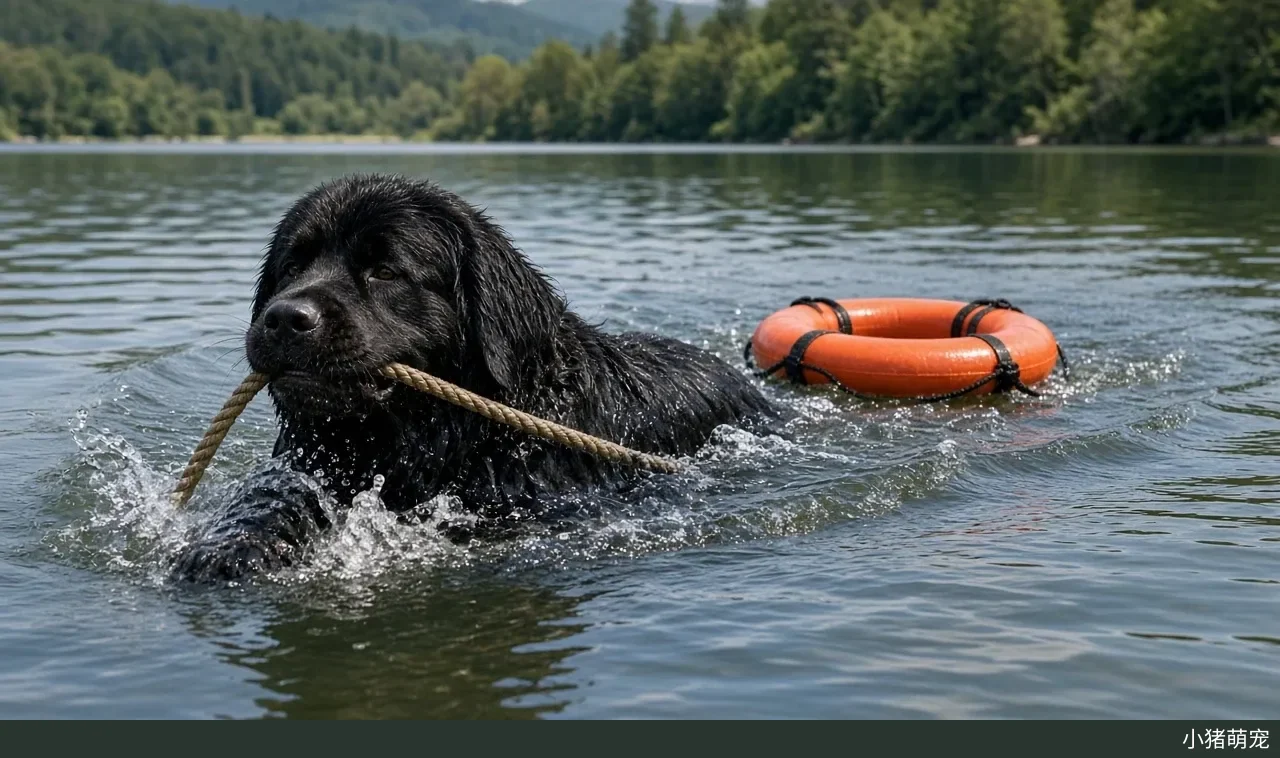
A Newfoundland swimming in a lake with a rope in its mouth and a life ring nearby, illustrating water-rescue training. AI-generated illustration.
Size, waterproof coat, and webbed feet
Newfoundlands are huge. The FCI standard’s average height at the withers is 71 cm for dogs and 66 cm for bitches; average weight about 68 kg for dogs and 54 kg for bitches. The AKC standard gives averages of 28 inches for dogs and 26 inches for bitches, with weight 130–150 lb (about 59–68 kg) for dogs and 100–120 lb (about 45–54 kg) for bitches. Both standards say large size is a plus, but not at the expense of balance, structure, and correct gait. The body is slightly longer than tall, with heavy bone and a wide, deep chest.
The build suits the water. The FCI standard specifies a water-resistant double coat: outer coat of medium length, straight and free of curl (a slight wave allowed), soft dense undercoat thicker in winter than summer; the AKC standard also notes undercoat is often less dense in summer or warmer climates. Feet are large and round with webbing between the toes; the FCI lists “absence of webbing” as a fault; the tail is thick at the root and acts as a “rudder” when swimming. AKC articles describe the stroke not as a dog paddle but as spreading the webbed feet and stroking to the sides. On color, the FCI recognizes black, black-and-white, and brown; the AKC recognizes black, brown, gray, and black-and-white, the last called Landseer after paintings by nineteenth-century artist Edwin Landseer.
Gentle temperament, exercise, and cooling
The FCI standard describes the Newfoundland’s expression as kind and soft, renowned for “outstanding gentleness and serenity”; aggressive or overly shy dogs are disqualified. The AKC standard is blunter: sweet temperament is the breed’s hallmark and its “most important single characteristic”; the AKC breed page also calls it a patient, watchful children’s “nanny dog.” The NCA warns, though: they usually get along with children and other dogs, yet may not realize how large they are—a wagging tail can knock a toddler down, and playful paws can hurt small dogs. They grow slowly: still puppies near age two, and not fully mature until about three.
Gentle does not mean sedentary. The NCA recommends regular daily exercise to keep the dog firm and muscular; walking 2–3 miles (about 3–5 km) a day is a common amount; the “weekend warrior” pattern—idle all week, then sudden hard workouts—raises injury risk. They are also unsuited to life on a chain; many can climb or push through fencing. Summer needs special care: Cornell University College of Veterinary Medicine lists thick or dark coats, overweight, and older dogs among heatstroke high-risk groups, and dogs have sweat glands mainly in the paw pads—they cool mainly by panting. Prevention includes: no hard exercise in hot, humid weather; shade and plenty of water outdoors; walks outside the hottest hours; never leave a dog alone in a car. Newfoundlands drool in ordinary weather and more in heat; watch for heavy panting, vomiting, weakness, unsteadiness, or collapse—if those appear, wet the body with cool water at once and get to a veterinarian quickly.
Everyday care and health screening
The two big daily jobs are brushing and wiping drool. The NCA is frank that Newfoundlands “shed a lot,” with two heavier shed seasons a year; they need daily and weekly grooming and regular baths, plus trimming of ear, chest, and foot hair for hygiene and health, not only looks. Drool is equally unavoidable: the NCA says there is no way to breed a “dry-mouthed” Newfoundland—clothes, walls, and sofas will get wet. Size also means even routine veterinary costs are not small.
On health, several hereditary conditions listed by the NCA Health Center relate directly to breeding screens. Hip dysplasia is abnormal development of the hip socket that can lead to painful arthritis and lameness; it is polygenic and also influenced by environment. Elbow dysplasia stems from disordered elbow growth and may involve cartilage growth defects, trauma, genetics, exercise, and diet. Subaortic stenosis (SAS) is a congenital hereditary heart defect: a ring of fibrous tissue below the aortic valve narrows the outflow, loading the heart, and severe cases can cause sudden death; NCA Health Center veterinary articles recommend that Newfoundlands from one year of age have a veterinary cardiologist auscultation, with echocardiography if a murmur is heard. Mildly affected dogs can have normal lifespans; more severe cases need medication or surgery.
Cystinuria is failure of the kidneys to reabsorb cystine normally, so it builds up in urine and can form bladder or kidney stones. Cornell University College of Veterinary Medicine lists common signs such as straining to urinate, frequent small urinations, house soiling, and blood in the urine; male dogs are anatomically more likely to block, and inability to urinate is an emergency. The Newfoundland type is caused by a recessive SLC3A1 variant—two copies, one from each parent, are needed for disease—and labs such as PennGen at the University of Pennsylvania offer DNA testing for that variant. The NCA participates in the Orthopedic Foundation for Animals (OFA) Canine Health Information Center (CHIC) program; certification for Newfoundlands requires hip (OFA or PennHIP) and elbow radiographs, cardiac specialty exam, and cystinuria DNA testing, with results public; the NCA encourages breeders to certify breeding stock. When choosing a puppy, ask the breeder for these records; for day-to-day abnormalities, follow your veterinarian’s exams and advice.
References
-
FCI: FCI-Standard N° 50 NEWFOUNDLAND (current valid standard published 1996-10-29)
-
FCI: NEWFOUNDLAND (50)
-
AKC: Official Standard of the Newfoundland (approved 1990-05-08, effective 1990-06-28)
-
AKC: Newfoundland Breed History: From Fishermen’s Helpers to Loyal Guardians (updated 2025-03-13)
-
AKC: Newfoundland Dogs Prove Lifesaving Skills in Water Rescue Tests
-
NCA: Newfoundland Club of America: Celebrating Hard Working Working Dogs
-
NCA Puppy Information Center: What to Know Before You Get A Newf
-
NCA Health Center: SubAortic Stenosis in Newfoundlands (Jennifer Zablotny, DVM)
-
NCA Health Center: Canine Disorders Known to Affect Newfoundlands
-
NCA Health Center: Canine Health Information Center (CHIC) Certification
-
Cornell University College of Veterinary Medicine: Cystinuria
-
PennGen Laboratories, University of Pennsylvania: Cystinuria (Type 1) Test Details
-
Cornell University College of Veterinary Medicine: Heatstroke: A medical emergency