The name Aegean cat originally referred to a population of domestic cats that developed naturally in the Cyclades, a group of Greek islands. Europetnet describes cats approaching people for food in local fishing ports. It is easy to picture a cat making its rounds along the waterfront. Does an Aegean cat need the same freedom once it comes to live with you? Its island origins alone give you no reason to let it roam. A more useful question is how it can spend its waking hours at home: where can it explore, what can it do, and can it slip away when it wants to be alone? [1][7]
Where does the name Aegean cat come from?
Europetnet calls the Aegean cat a landrace, a local type that took shape as cats bred on the islands over many generations. Greek breeders began working to establish a formal breed in the early 1990s. That date tells us when the breeding effort began. The island population was already there, and its age is a separate question. The fishing-port account offers a similar glimpse of local history: it tells us where some cats found food, but little about the early life of a cat born in someone’s home. [1]
As of November 2026, the Aegean does not appear on the Fédération Internationale Féline (FIFe) lists of fully or provisionally recognized breeds or in the Cat Fanciers’ Association (CFA) breed directory. Europetnet’s profile gives no association standard against which to judge an individual cat. If an adoption record says “Aegean cat,” the name gives you a starting point for a conversation. Which island did the cat come from? Who cared for it? Has it always lived indoors? A claim about its pedigree or formal registration would need a record for that particular cat from the registry concerned. [1–3]
Three Aegean cats with different markings
Two photographers give names to the Aegean cats in their pictures. Bob, from Santorini, was three years old when photographed. Dark stripes cross his forehead, cheeks and forelegs, and a small patch of pale fur stands out on his chin. His photographer took the picture in late winter, when Bob’s coat looked thicker than in warmer weather. Areta, a young male, has both white front paws hooked over the edge of a table. White fur extends from his chest to his muzzle, while the dark stripes on his head cluster around his forehead and ears. Neither cat’s coloring gives us a rule we could apply to them all. [4][5]


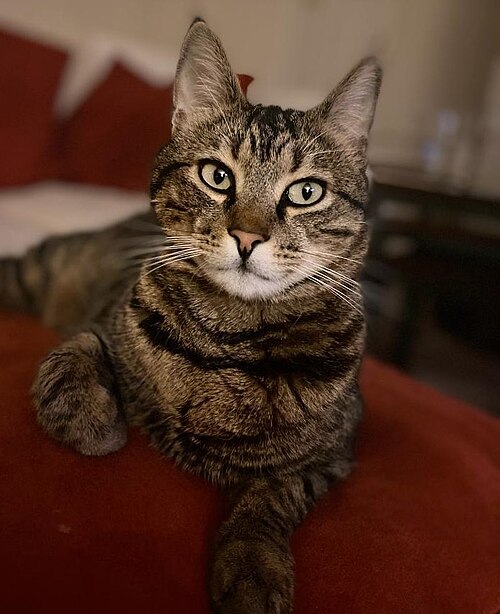
Bob wears his late-winter coat. Sam Holt, Wikimedia Commons[4]

Young Areta has a white chest and a striped forehead. Barc0de, Wikimedia Commons[5]
The third cat was seven months old when photographed. Pale orange fur colors its ears and temples, with light patches scattered along its body and legs. The photographs help us recognize these three individuals. They cannot establish the breed of another island cat whose origins are unknown. A photograph also captures only a moment of behavior. Seeing this young cat in someone’s arms tells us little about when it chooses to come close or how long it enjoys being stroked. Those preferences emerge in everyday encounters. [4–6][8]
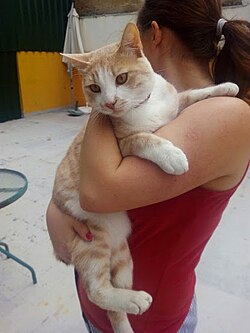
This seven-month-old Aegean cat has pale orange patches. Ursula Valentim, Wikimedia Commons[6]

Giving a cat opportunities to forage at home
If you wonder whether your cat has enough to do indoors, start with one meal. Keep its usual feeding spot and set aside a few pieces of its regular dry food. Put them in a shallow puzzle feeder where the cat can see them and scoop them out with a paw. Does it come over to sniff? Does it reach in? Once it knows the game, try dividing those pieces between two easy-to-find spots. The cat gets to discover food for itself, and you get to see whether it enjoys searching while the rest of dinner is still within easy reach. [7][8]
A toy the cat can catch offers another opportunity. Clear a stretch of floor for a wand toy and draw the lure along the ground, moving it away from the cat. Pause and watch. Does the cat crouch, fix its eyes on the lure, then give chase? Every so often, let it pin the toy with its front paws to finish the catch. If it likes to watch from behind cover first, leave that hiding place available. In a home with several cats, a separate turn gives a slower cat a chance to catch the lure, too. [7][8]
Give just as much thought to how the cat can leave the action. A cardboard box with a side opening, lined with familiar fabric and placed in a quiet spot, gives it cover and a view out. Give water, food, litter trays and resting places separate locations. If several cats share the home, follow the routes each one takes. Suppose one cat lying in a doorway can cut another off from water or a litter tray. Put another bowl or tray somewhere the second cat can reach by a different route. Two water bowls side by side still leave both behind the same doorway. [7][8]
Let the cat set the pace as it gets to know people. Sit where it can approach on its own. If it comes over and rubs against you, gently stroke the side of its head, then pause to see whether it comes back for more. If it heads for its box, let the visit end there. When you tidy its sleeping places, wash the bedding in rotation so some familiar scent remains. With the same gentle responses from day to day, the cat can learn where to find company and where it can rest undisturbed. [7][8]
A health history starts with the individual cat
A Greek study illustrates why the distinction between an island and a breed matters for health. Researchers tested blood samples from 1,554 cats across nine regions of Greece. They found IgG antibodies to Toxoplasma gondii in 339 of those cats, evidence of past exposure to the parasite. One row in the study lists the Aegean Islands. The 153 cats in that row were grouped together because they were sampled there. The researchers did not identify them as members of the Aegean breed, so the figures cannot tell us how often Aegean cats develop the disease. [9]
The researchers also recorded whether cats went outdoors and whether they hunted. When you bring a cat home, these are questions worth asking its previous caregiver, and the answers are worth sharing with your veterinarian. A kitten raised entirely indoors and an adult brought home from a harbor could have the same name on their adoption papers and quite different histories of exposure. Where your cat used to eat and whether it hunted help your veterinarian understand its past. What it likes to chase now, and where it goes when it wants to hide, can guide the home you make for it today. [7–9]
References
-
[1] Europetnet. Aegean cat.
-
[2] Fédération Internationale Féline. Breeds.
-
[3] The Cat Fanciers’ Association. Breeds.
-
[4] Sam Holt. File:Aegean Island Cat.jpg. 2021.
-
[5] Barc0de. File:Aegean cat.jpg. 2009.
-
[6] Ursula Valentim. File:Aegeancat7.jpg. 2015.
-
[7] Feline Veterinary Medical Association. New Feline Veterinary Medical Association Position Statement Reimagines Life for Indoor Cats. August 28, 2025.
-
[8] AAFP and ISFM Feline Environmental Needs Guidelines. Journal of Feline Medicine and Surgery, 2013.
-
[9] Feline Toxoplasmosis in Greece: A Countrywide Seroprevalence Study and Associated Risk Factors. 2022.