The Irish Water Spaniel’s original job was to find downed waterfowl and bring them back to the hunter’s hand. By the late Middle Ages, slender-tailed sporting dogs were already working the waterways of southern Ireland. The breed took on its familiar appearance in the 1830s through Justin McCarthy and his dog Boatswain. That work still shapes daily life with an Irish Water Spaniel. Outdoors, these dogs enjoy having something to find and someone to bring it to. Back home, the curls that serve them so well in the water need someone to comb them through. [1][2]
Look at the dog standing in the grass and follow its outline from nose to tail. The muzzle is smooth, long curls fall forward over the forehead, and looser hair hangs from the ears. Across the shoulders and back, the curls tighten. The same rich liver color extends down the legs. The easiest feature to pick out is the tail. Curls cover a short stretch at the base, then give way to short hair as the tail narrows to a fine point. Both this distinctive “rat tail” and the smooth face grow that way naturally. [1][2]
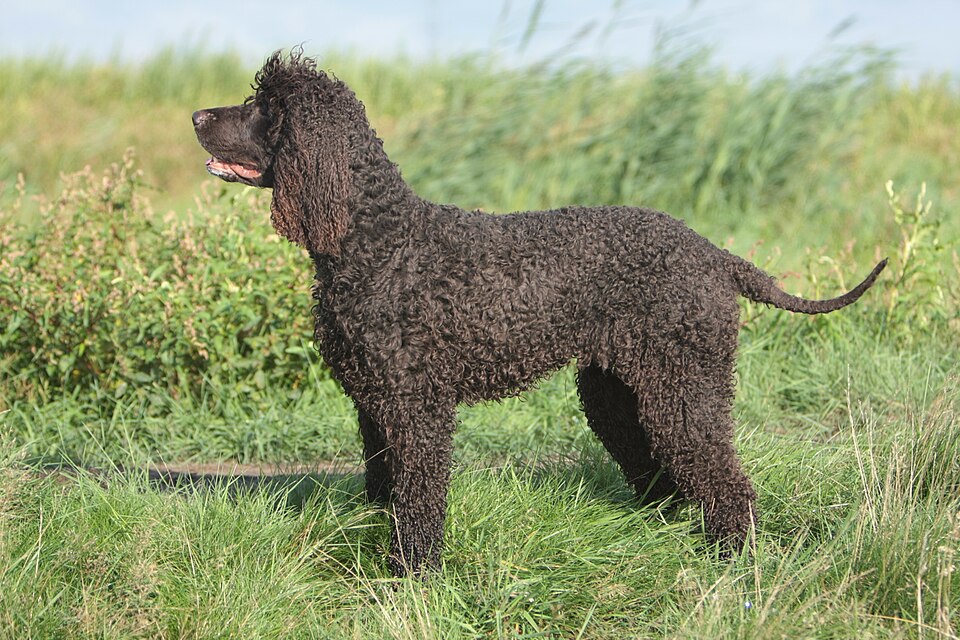
The Irish Water Spaniel’s rat tail tapers to a fine point. Roete002, Wikimedia Commons[5]

The Irish Water Spaniel is the tallest spaniel registered with the American Kennel Club (AKC). Adults stand about 21 to 24 inches (53 to 61 centimeters) at the shoulder. In profile, you can see the deep chest, broad back, and strong hind legs. Webbing between the toes helps propel the dog through water. This is a long-striding dog built to keep working in the field. At home, an Irish Water Spaniel can enjoy a game with the family and settle down afterward. Making room for plenty of outdoor activity each day is part of that routine. [1][2]
A job for an ordinary weekday
Start with your household’s busiest workday. Who has time for a long walk? Is there a safe place nearby where a dog can stretch out and chase a ball? The AKC lists long walks, hikes, and games of fetch as good ways to exercise this breed. A weekend at the lake gives the dog a chance to swim, and there is plenty to do on dry land during the week. If Monday through Friday offers only a few minutes outside for toilet breaks, those five days are the first part of the schedule to rethink. [1]
An ordinary walk can include a small version of the work this spaniel was bred to do. In a quiet, fenced area, let the dog watch you place a familiar toy a short distance away. Give a simple cue to find it. When the dog picks it up, invite it back. Encourage it the moment it turns toward you, then reward it when it reaches you. On the next turn, change only the toy’s hiding place so there is a little more searching to do. Watch which part the dog enjoys. One may linger over the search. Another may hurry straight back with the toy for the pleasure of starting again with you. [1][2]
Irish Water Spaniels are generally willing partners, and it helps to teach one part of a retrieve at a time. If the dog reaches the toy and then runs laps with it, shorten the distance on the next turn. Practice just coming back to you with the toy. Once that part is familiar, put it together with the search. Family members can use the same cue and reward the same action when they take turns. The AKC recommends keeping training enjoyable and positive. Put the toy away while the dog is still keen for another turn, then carry on with your walk. [1]
In a family with young children, an adult needs to be free to give the dog their full attention. The Irish Water Spaniel Club of America emphasizes early socialization for these enthusiastic dogs, especially around small children. A child can start by watching quietly beside an adult while the person handling the dog throws the toy, gives the cue, and takes the toy back. When judging the fit for your family, watch the dog in front of you. Does it approach a newcomer or hang back? Can it settle after a game? Those observations can help you choose how quiet a setting and how short a game to start with. [2]
Leave time for the coat to dry
After a swim in the sea or a scramble up a muddy bank, rinse the salt and mud away with fresh water. Blot the coat with a towel and give the dog a warm place to dry thoroughly. The long ears hang against the cheeks. Once you have toweled the back and legs, gently lift each ear flap and dry its visible surfaces on both sides. If swimming is a regular outing, it helps to keep towels near the door and decide where you can rinse the dog. Whoever takes the dog out needs time for this part after the last retrieve. [3][4]
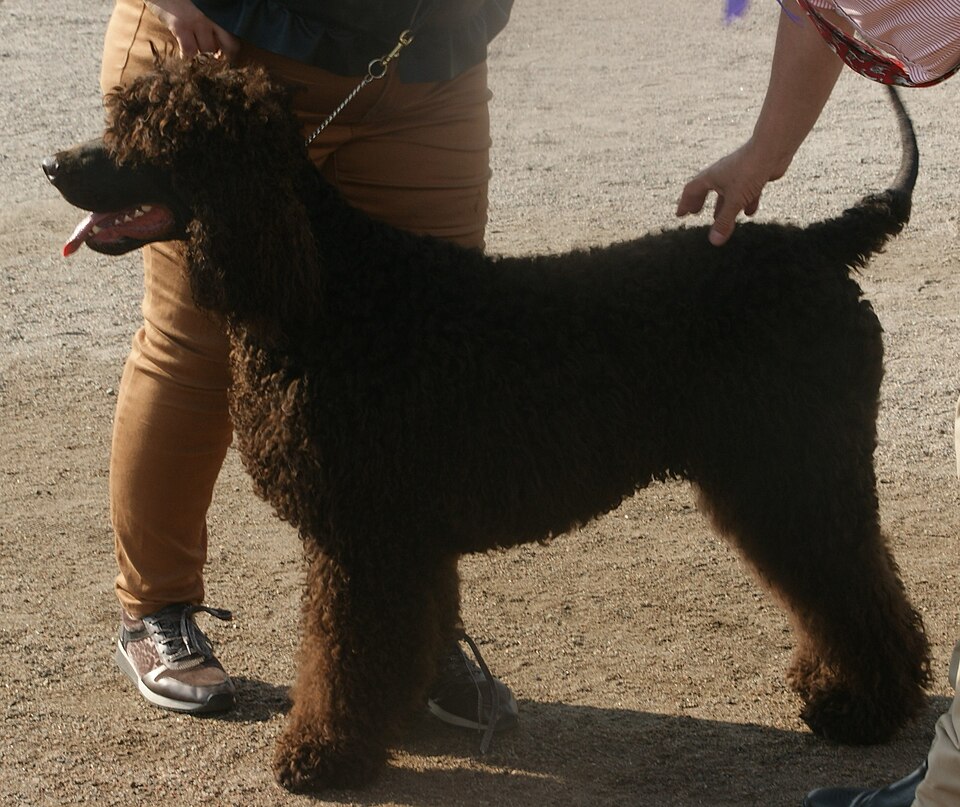
A curly topknot and long ears frame the face. Canarian, Wikimedia Commons[6]

A rinse takes care of the grit. Loose hair is another matter. An Irish Water Spaniel leaves relatively little hair on the floor because some shed hairs stay caught in the curls, where they can tangle with dirt and form mats. The AKC recommends grooming at least weekly. VCA Animal Hospitals suggests a thorough combing two or three times a week. Work through the body, legs, and long ear hair a section at a time with a wide-toothed comb. When you reach a small tangle, pause to tease it apart gently with your fingers, then comb out the loose hair. The coat will look fluffy afterward. A light mist of fresh water helps the curls form again as they dry. [1][3][4]
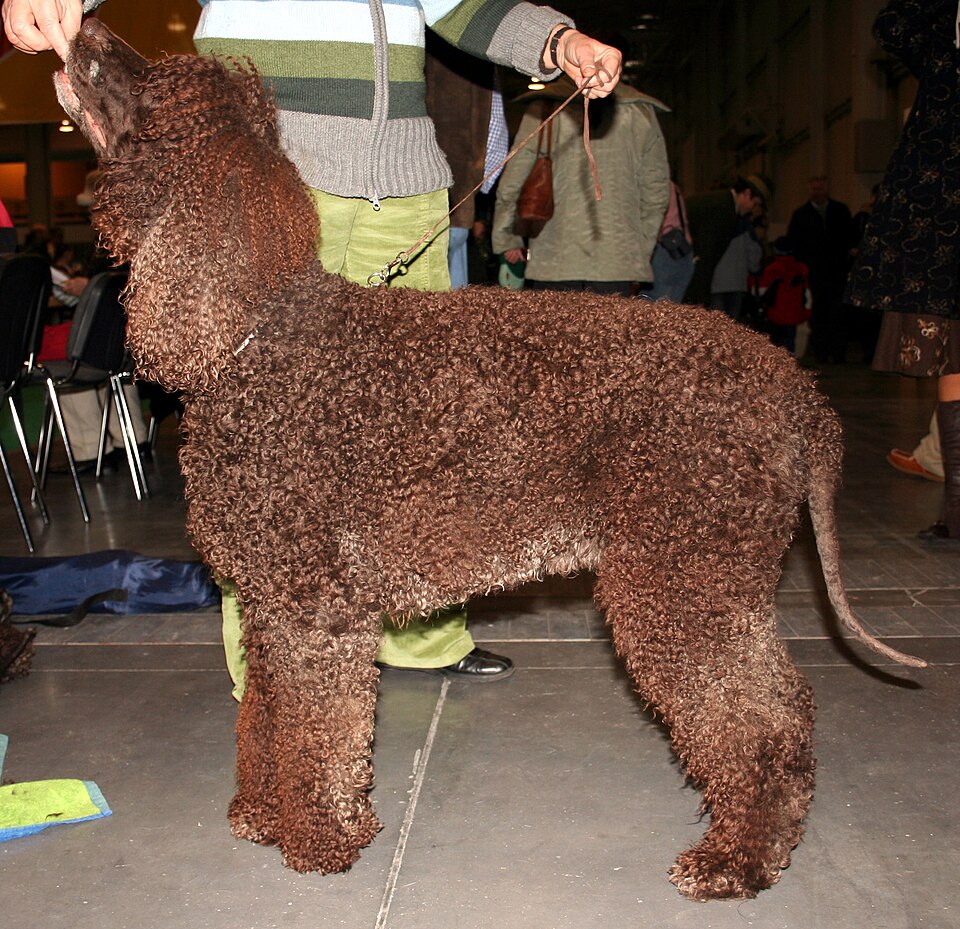
Dense curls cover the body and legs. Pleple2000, Wikimedia Commons[7]

While a puppy still has little coat to manage, let it get used to the feel of a comb, an ear being gently lifted, and a paw resting in your hand. Keep each session short enough for the puppy to stay relaxed, and reward it. These small beginnings make it easier to comb longer hair, inspect the ears, and trim the nails later. An adult’s coat needs trimming roughly every two months. If you want to learn to care for it yourself, ask a groomer who knows the breed to show you how to reach through the layers with a comb. Even with regular grooming appointments, the coat needs combing at home between trims. [1][3]
Which health records should you ask to see?
If you are getting a puppy from a breeder, ask to see the hip, elbow, eye, and thyroid evaluation records for both parents. Check which dog each report belongs to, discuss the results with the breeder, and share the family history with the veterinarian who will care for your puppy. Joint development deserves attention in this breed, and the parents’ records give you some of that background. When deciding how far your own dog can walk and how gradually to increase exercise, take its age, physical condition, and your veterinarian’s assessment into account. [1][4]
Before you decide, pencil an ordinary week into the family calendar. Who can take the dog on long walks and play retrieving games on workdays? Who will rinse and dry it after a swim? Which evenings leave time to sit down and comb through the curls? Picture the dog leaping into the water, then picture it standing beside you afterward while you work through one silky lock of ear hair at a time. If both sound like time you would enjoy spending together, that is a routine you are more likely to keep.
References
-
[1] American Kennel Club. Irish Water Spaniel Dog Breed Information.
-
[2] Irish Water Spaniel Club of America. What is an Irish Water Spaniel?
-
[3] Irish Water Spaniel Club of America. Grooming Your Irish Water Spaniel.
-
[4] VCA Animal Hospitals. Irish Water Spaniel.