The World Cat Federation (WCF) lists the Lykoi under the code LYS. Its name comes from the Greek word for wolf. Seen head-on, the cat has a bare mask extending from the nose, muzzle and chin up around the eyes and toward the ears. The bare eyelid rims look as if someone has traced them with pale eyeliner. The face is slightly longer than it is wide, with softly rounded cheeks and whisker pads. The large, upright ears have broad bases and rounded tips. [1][2] Britain’s Governing Council of the Cat Fancy (GCCF) weighs welfare concerns breed by breed. It granted the Lykoi preliminary recognition in February 2020. [2][3]
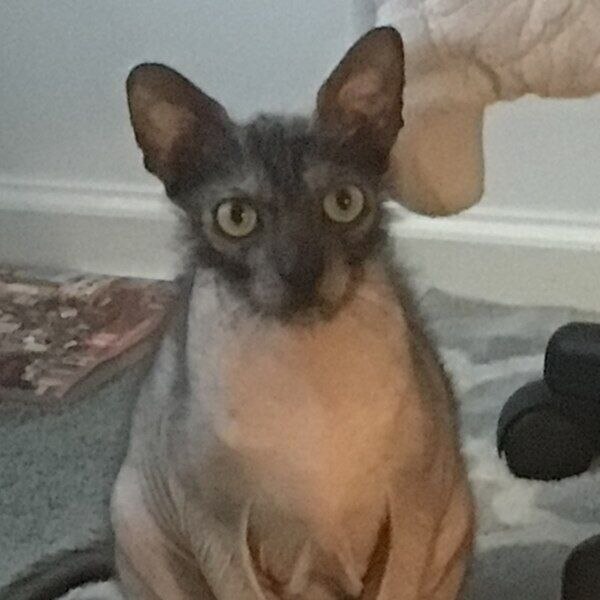
Figure: Coat coverage on the face and chest. Big Slosh, Wikimedia Commons[11]

Across the shoulders and back, a black roan Lykoi can look silver-gray. Up close, each black hair is black from root to tip, and each white hair is white along its whole length. The two grow intermingled. This pattern is called roan, and black roan is the color the WCF accepts for showing. Longer outer hairs, called guard hairs, cover the back and sides over a scant undercoat. The coat feels soft. Hair is sparser on the legs and feet, revealing oval paws and long toes. When the cat stands, you can see its slender body and a tapering tail shorter than its torso. [1]
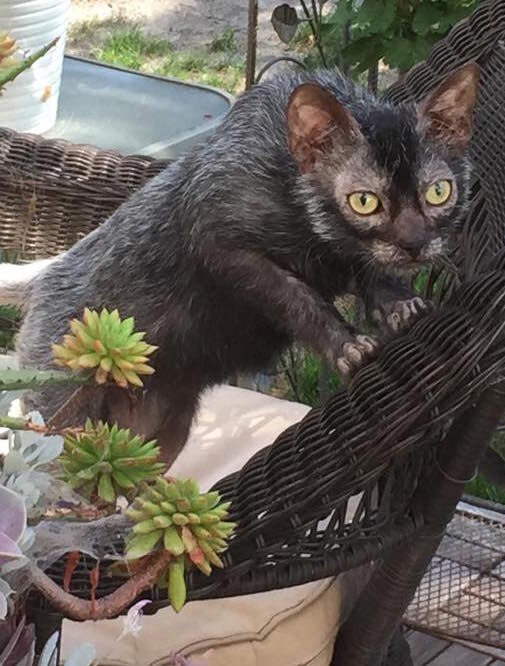
Figure: Sparse hair on the forelegs. steptacular, Wikimedia Commons[12]

Where does your Lykoi usually show bare skin?
A Lykoi’s coat has its own growth cycle. The same cat can look well covered at one stage and lose enough hair in a molt to leave broad areas bare. When you bring one home, ask the previous caregiver for photos from its last molt. Once your cat has settled in, take dated pictures of its face straight on and its shoulders, back and legs from the side. If a patch looks thinner later, compare the same spot in similar light. You’ll be able to tell your vet whether the familiar mask has a clearer outline or a previously furred patch now shows skin. [1][4]
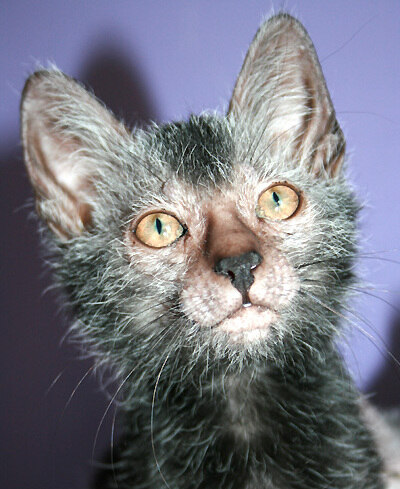
Figure: The Lykoi’s facial mask. Christine Auverdin Boulanger, Wikimedia Commons[13]

Include the paws when you groom your cat. Researchers compared seven Lykoi with seven domestic shorthairs with healthy skin. Under the microscope, they found fewer hair shafts per group of follicles in the Lykoi. All seven Lykoi also had dark material clinging to their claws, and some had a little brown debris on the feet and face. [5] The Cat Fanciers’ Association (CFA) notes that oil can collect around the ears and toes. When your cat rests a paw in your hand, look at where a mark lies. It helps to know whether it’s on a claw, between the toes or on top of the paw. [4][5]
Whether your Lykoi needs a bath depends on how oily or dirty its skin gets and how well it grooms itself. If there are just a few loose hairs, a gentle brushing is enough. When the skin gets greasy enough to need washing, use warm water and an unscented shampoo labeled for cats. Wet the area, gently work in the shampoo and rinse it all away. Your cat will lick itself afterward. If the running tap startles it, pour clean water slowly from a cup. If the buildup keeps returning, tell your veterinarian how quickly it comes back and what product you use so you can agree on a cleaning routine. [4][6]
How can you set up your Lykoi’s indoor space?
Watch where the sun falls before you choose a spot for a bed. The CFA advises limiting prolonged sun exposure because the sparse coat leaves skin exposed. Offer a secure window perch and a cushioned place nearby out of direct sun. A bed in shade at breakfast may be in full sun by afternoon. A partly drawn curtain can give your cat both shade and a view. The GCCF recommends a cozy bed at ordinary household temperatures. If your cat has access to an enclosed balcony, keep the way indoors open so it can choose a sheltered place to rest. [2][4]
Follow the routes your cat takes to food, water and the litter box. The Feline Veterinary Medical Association recommends separate locations for these resources and somewhere each indoor cat can retreat alone. Put water and litter in different quiet spots and a scratching post where the cat passes after a nap. In a home with several cats, two full water bowls behind the same narrow doorway can both be out of reach when one cat sits in the entrance. Bowls in different rooms give each cat another way to water. Give each a sheltered resting spot as well. [7][8]
The CFA describes a Lykoi at play stalking a toy before a sudden pounce. Try trailing a wand toy along the floor and around the corner of a cardboard box. Pause so your cat can watch and choose its moment to spring. Let it pin the toy under its paws, then wait for it to let go before starting again. Let the cat choose how to spend time with you, too. If it comes over and rubs against you, offer a stroke. If it’s still watching the toy, carry on playing. When it walks away, let it rest. [4][8]
Which skin changes call for a veterinary visit?
Pay attention to new bumps even if your cat lets you touch them. In a 2026 study, veterinarians examined ten Lykoi with skin lesions and one whose skin looked normal. Affected cats had small black or white bumps and plugged follicles on the body or legs. Some had only a few scattered spots. In others, bumps merged into larger lumps. Touching the lesions caused no apparent itching or discomfort. Skin biopsies revealed cysts under the microscope. [9] If a bump persists, more appear or the skin over one breaks open, book a veterinary visit and point out where the first one appeared. [9][10]
Contact your veterinarian promptly if your cat keeps licking or chewing one leg or scratching around the eyes or ears, especially with new hair loss, redness, swelling, flakes or scabs. Describe what you noticed first. Was the hair on the leg already thin when the licking began? Have similar patches appeared elsewhere? Parasites, allergies and infections can all affect the skin. Your veterinarian will use that history, the location of the changes and a physical exam to decide what to check next. Bring earlier photos alongside recent ones so the vet can see how your cat’s mask and legs usually look. [10]
References
-
[1] World Cat Federation. November 22, 2020. Lykoi (LYS)
-
[2] The Governing Council of the Cat Fancy. Lykoi
-
[3] The Governing Council of the Cat Fancy. Unrecognised Breeds
-
[4] The Cat Fanciers’ Association. Lykoi
-
[5] Michelle L. LeRoy et al. (2016). The Japanese Journal of Veterinary Dermatology, 22(3), 179–191. Clinical and Histologic Description of Lykoi Cat Hair Coat and Skin
-
[6] Courtney Barnes, Ryan Llera, Tammy Hunter and Cheryl Yuill. VCA Animal Hospitals. Grooming and Coat Care for Your Cat
-
[7] Feline Veterinary Medical Association. August 28, 2025. New Feline Veterinary Medical Association Position Statement Reimagines Life for Indoor Cats
-
[8] Feline Veterinary Medical Association and iCatCare (2026). Your Cat’s Environmental Needs
-
[9] Thibault Burnouf et al. (2026). Journal of Feline Medicine and Surgery. Clinical, histopathological and genetic features of a cutaneous adnexal polycystic syndrome in Lykoi cats: a prospective study of 10 cases
-
[10] Cornell Feline Health Center, Cornell University College of Veterinary Medicine. Feline Skin Diseases