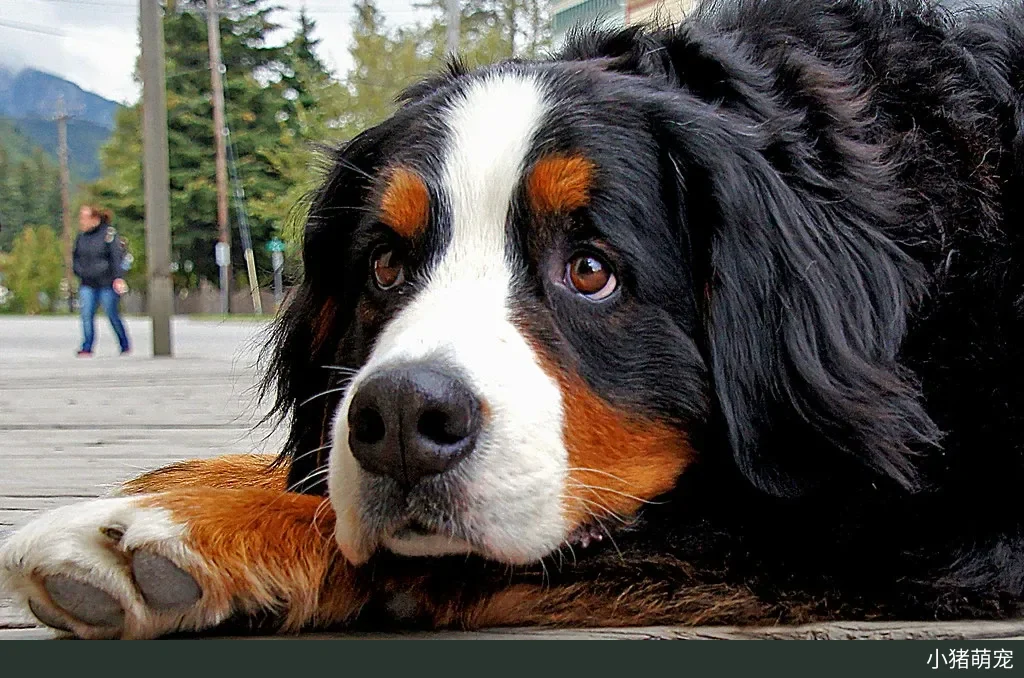
A Bernese Mountain Dog lying flat on a wooden floor, with a clear white blaze, rust brow spots, and white front paws (photographed 4 September 2012). Photo: Bernard Spragg; source: Flickr; license: Public Domain Mark 1.0.
The Bernese Mountain Dog comes from the canton of Bern in Switzerland, where it once guarded farms, pulled carts, and drove cattle. It wears a long black, rust, and white coat; large yet gentle, loyal to family and steady with strangers. Living with one means daily moderate walks and patient positive training—and knowing up front that the breed’s lifespan is short and cancer risk is high.
Origins: a farm dog of Bern
Per the FCI (Fédération Cynologique Internationale) breed standard published in 2003, the Bernese Mountain Dog is a long-established farm dog that guarded homes, pulled carts, and drove cattle in the pre-Alpine and central regions around Bern. It was first called “Dürrbächler,” after the small village and inn Dürrbach near Riggisberg in the canton of Bern—where such long-coated tricolor farm dogs were especially common.
Dogs of this type appeared at shows in 1902, 1904, and 1907. In 1907, breeders around Burgdorf founded the Schweizerischer Dürrbach-Klub to promote pure breeding and fix the type; by a 1910 Burgdorf show, 107 dogs were entered. It was later renamed Bernese Mountain Dog along the lines of other Swiss mountain dogs and quickly became popular in Switzerland and neighboring parts of Germany. FCI formally recognized the breed on 26 July 1954, placing it in Group 2 among Swiss Mountain and Cattle Dogs.
Earlier history is unwritten. Both AKC and VCA Animal Hospitals mention a popular story that mastiff-type dogs brought over the Alps by Roman armies mixed with local dogs to form the ancestors; VCA is clear that this origin “is not documented.” With farm mechanization, numbers once fell sharply; Swiss enthusiasts began searching and rebuilding the breed only late in the nineteenth century. Per VCA and AKC, the first Bernese Mountain Dogs reached the United States in 1926, and AKC recognized the breed in 1937.
Appearance and temperament
The FCI standard describes the Bernese Mountain Dog as a “long-haired, tricoloured, strong yet agile” working dog: medium-large, with sturdy bone, slightly longer than tall (height at withers to body length about 9:10). The coat is long and glossy, straight or slightly wavy; the ground color is jet black, with rich rust markings on the cheeks, above the eyes, on the legs, and on the chest, a symmetrical white blaze on the head, and a continuous white patch from throat to chest. White feet and a white tip of the tail are ideal.
On size, the FCI standard sets dogs at 64–70 cm and bitches at 58–66 cm at the withers. The AKC standard is similar: dogs 25–27.5 inches, bitches 23–26 inches; weight about 80–115 lb (about 36–52 kg) for dogs and 70–95 lb (about 32–43 kg) for bitches.
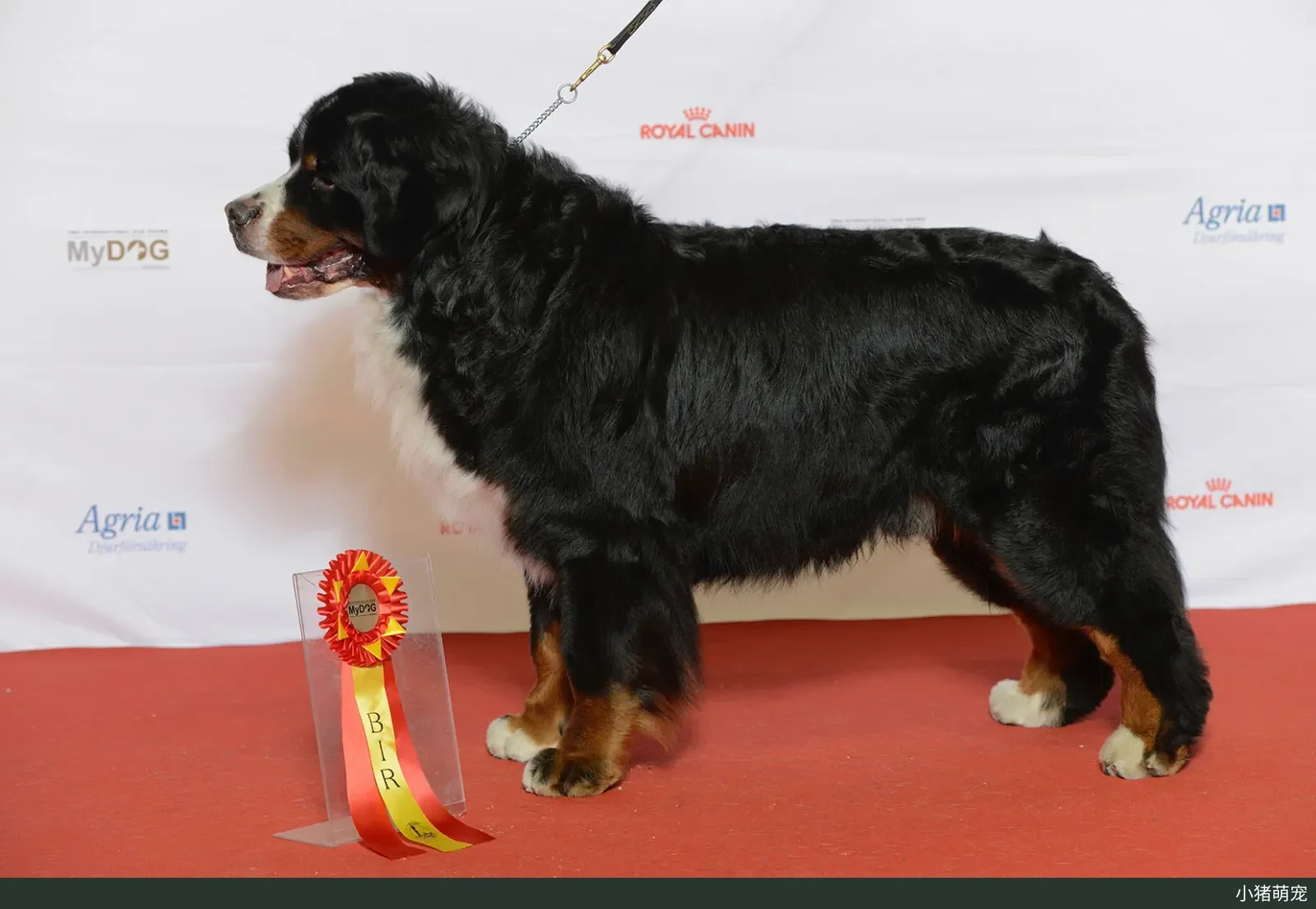
A Bernese Mountain Dog standing in profile at the MyDOG show in Gothenburg, Sweden, on 8 January 2016—Finnish and Swedish champion Berntiers On Demand. Photo: Johan Frick-Meijer (Svenska Mässan); source: Wikimedia Commons; license: CC BY 2.0.

On temperament, the FCI standard says: self-confident, attentive, and watchful; fearless in everyday situations; good-natured and devoted to family; self-assured and placid with strangers; even-tempered and obedient. VCA adds that they are easygoing companions, usually fine with other pets, and may be a bit reserved with strangers; they are generally gentle with children, but large dogs and children always need adult supervision. The price of that beautiful long coat is above-average shedding—brush once or twice a week normally, more often during coat change.
Exercise and training needs
Bernese Mountain Dogs do not need high-intensity exercise. VCA recommends one moderate daily walk or a short jog; they are usually quiet and polite indoors, very cold-tolerant, but not heat-tolerant—watch them carefully in hot weather. The Bernese Mountain Dog Club of America (BMDCA) president, quoted in an AKC article, also says they enjoy long walks in cool weather and are content with a short morning outing in summer.
On training, VCA finds Bernese Mountain Dogs quick learners but sensitive—best suited to food-reward positive methods. Obedience training is not only about control of a large dog; it is also important mental work.
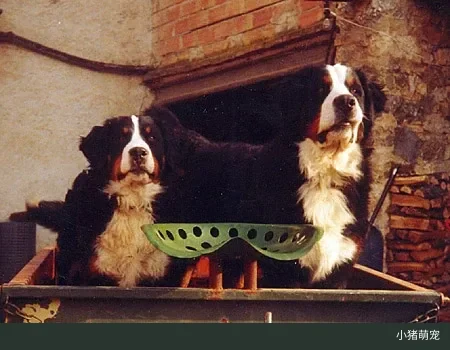
Bernese Mountain Dogs Gaby v. Waldgruss (left) and Enzo de Jamani-Jueli (right) sitting in a large garden cart, ready for a “ride” (photographed about 1992). Photo: J. Jeffrey Bragg; source: Wikimedia Commons; license: CC BY-SA 3.0.

If you want them to revisit their old job, drafting/carting fits well, and BMDCA runs dedicated draft tests. An AKC article warns, though, that growth plates close around age 2—cart work before then is risky: about 6 months is fine for harness familiarization, but put no weight in the cart before age 2.
Common health issues
What most worries owners is lifespan. BMDCA is frank that while some Bernese live into their teens, too many do not, and 7–8 years is short for a large breed; VCA cites an expected lifespan of 6–9 years.
Cancer is a major concern. A 2009 Journal of Heredity study by Abadie et al. reported that histiocytic sarcoma—an aggressive malignancy that often spreads systemically—occurs at about 25% frequency in Bernese Mountain Dogs. In 89 cases analyzed in depth, mean age at onset was 6.5 years, dogs and bitches were similarly affected, and estimated survival after diagnosis was only about 49 days; the authors conclude multiple genes are involved. These figures come from research case series and do not state any one dog’s individual risk.
For dogs that may be bred, BMDCA’s minimum recommended health testing covers hips, elbows, eyes, heart, and degenerative myelopathy (DM), plus one of three: von Willebrand disease (vWD), thyroid, or histiocytic sarcoma risk testing. The club stresses that clearing CHIC or similar programs only means tests were done and published—not that every result was normal. On feeding, VCA recommends large-breed puppy food to slow growth (without changing final size), which may reduce the incidence or severity of adult hip dysplasia; adults tend to pack on weight, so watch calories as weight rises.
When choosing a puppy, ask the breeder for test results and health records for parents, littermates, and relatives. After you bring a Bernese home, beyond routine vet visits BMDCA cites American Veterinary Medical Association (AVMA) advice to watch for steadily growing lumps, unexplained weight loss, reluctance to exercise, or declining stamina—and seek care promptly if something seems wrong.
References
-
American Kennel Club. Elaine Waldorf Gewirtz. Bernese Mountain Dog History: From Working Dogs to Devoted Pets. Updated 2026-08-19, accessed 2026-10-17.
-
Fédération Cynologique Internationale. FCI-Standard N° 45 Berner Sennenhund, Dürrbächler (Bernese Mountain Dog). Official standard published 2003-03-25, accessed 2026-10-17.
-
Fédération Cynologique Internationale. BERNER SENNENHUND (45). Accessed 2026-10-17.
-
VCA Animal Hospitals. Bernese Mountain Dog. Undated page, accessed 2026-10-17.
-
Bernese Mountain Dog Club of America. Health. Undated page, accessed 2026-10-17.
-
Bernese Mountain Dog Club of America. Recommended Testing. Page dated 2024-03-23, accessed 2026-10-17.
-
Bernese Mountain Dog Club of America. Cancer. Undated page, accessed 2026-10-17.
-
Abadie J, Hédan B, Cadieu E, et al. Epidemiology, Pathology, and Genetics of Histiocytic Sarcoma in the Bernese Mountain Dog Breed. Journal of Heredity, 2009, 100(Suppl 1): S19–S27.