
A Labrador Retriever on England’s Quantock Hills. Photo: IDS.photos (Tiverton, UK); source: Wikimedia Commons; license: CC BY-SA 2.0.

The Labrador Retriever’s name includes “Labrador,” but its ancestors were water dogs of Newfoundland’s fishing harbors in Canada; in the nineteenth century in Britain they were developed into duck-retrieving gun dogs. Friendly, eager to learn, and fond of water, they are also energetic and unusually keen on food. Drawing on AKC and FCI breed materials and British veterinary research, this article covers origins, appearance, temperament, exercise and training needs, and common health issues.
Origins and appearance
Labrador Retrievers do not come from Canada’s Labrador region; they come from Newfoundland. Per the AKC’s breed-history article, dogs brought by fishermen from various European countries mixed on the island and formed the “St. John’s Dog,” named for the capital. The larger branch later became the Newfoundland; the smaller, short-coated branch was the Labrador’s ancestor. They helped haul nets and dive for fish that slipped the hook; fishers preferred short-coated dogs because ice was less likely to cling to their water-resistant coats. After ships carrying salt cod reached Poole on England’s south coast, the Earl of Malmesbury took these dogs to his estate and bred them as duck retrievers; the name “Labrador” also spread from that family. In the nineteenth century Newfoundland taxed dogs not used for herding heavily, and Britain imposed quarantine on imported dogs in 1885, nearly cutting off the transatlantic dog trade; the breed’s continuation rested mainly on British breeders.
Accounts of when they entered Britain do not fully agree: the AKC says British nobility took notice in the early nineteenth century, while the historical summary in the current FCI standard says Col. Peter Hawker and the Earl of Malmesbury introduced them in the later nineteenth century. The FCI standard also notes that a breed club was founded in 1916 and a Yellow Labrador club in 1925. The AKC recognized the breed in 1917; the FCI gave formal recognition in 1954, placing it in Group 8 (retrievers). Per the AKC, Labs topped AKC registrations for 31 straight years from 1991 through 2022.
In appearance, the FCI standard describes the Labrador as strongly built, short in the loin, and very active, with a broad skull and a wide, deep chest, and notes expressly that that substance must not come from excess weight. Two signature traits stand out: the coat—short, dense, free of wave and feathering, rather hard to the touch, with a weather-resistant undercoat—and the “otter tail,” thick at the root and tapering to the tip, covered in short dense hair so it looks round. Color is limited to solid black, yellow (from light cream to fox red), and liver/chocolate; a small white spot on the chest is allowed. For size, the FCI ideal height at the withers is 56–57 cm for dogs and 54–56 cm for bitches; the AKC standard allows a wider range—about 57–62 cm and 29–36 kg for dogs, about 55–60 cm and 25–32 kg for bitches.
Compared with the Golden Retriever, another retrieving breed, the clearest difference is the coat: per the FCI standard, Goldens have a flat or wavy coat with abundant feathering in shades of gold or cream; Labs are short-coated without feathering, in black, yellow, or chocolate.
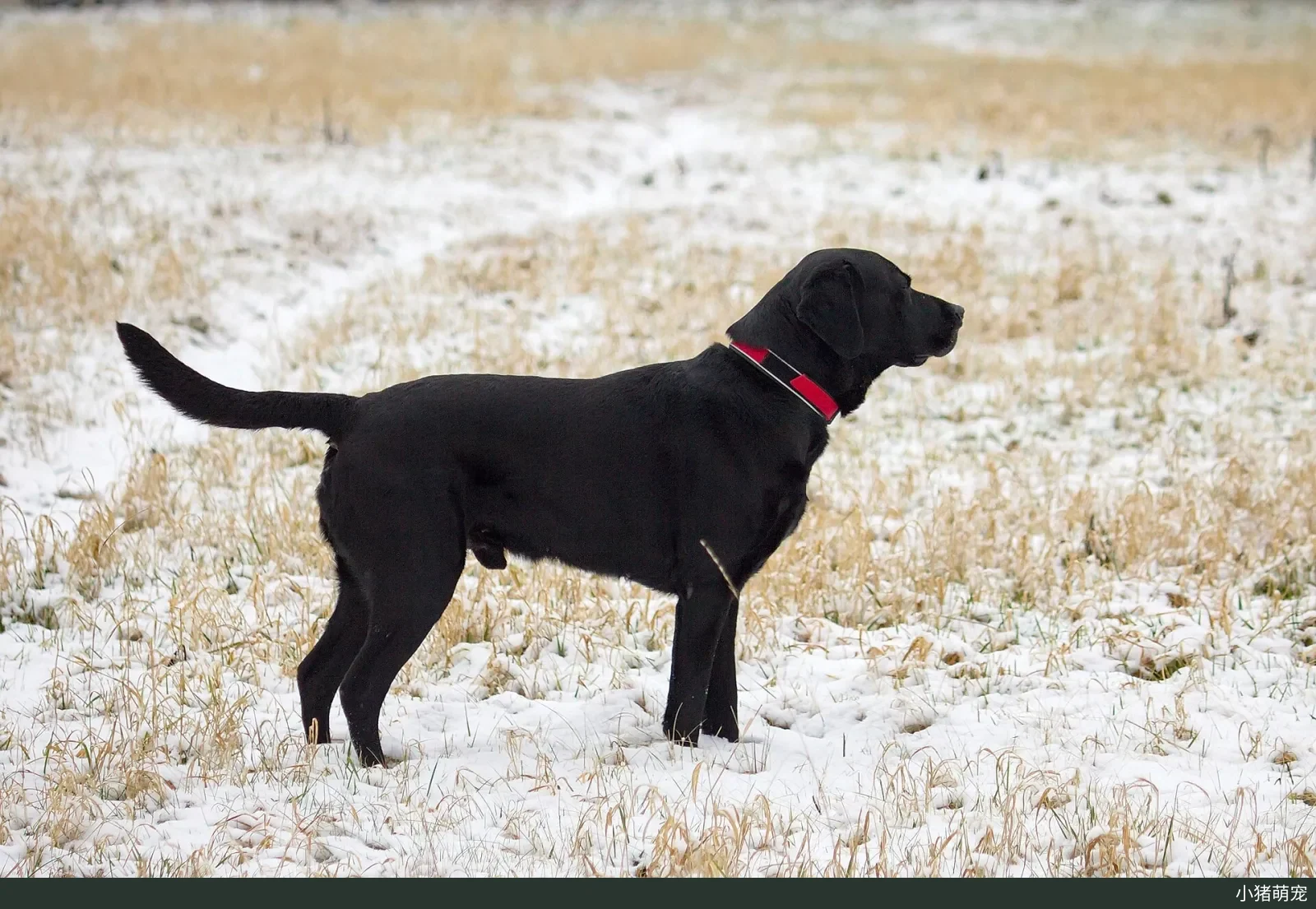
Black Labrador Retriever male. Photo: Losch; source: Wikimedia Commons; license: CC BY-SA 3.0.

Temperament, exercise, and training
The FCI standard describes Labrador temperament as good-natured, very agile, with an excellent nose, a “soft mouth” (retrieving game without damaging it), and a love of water; adaptable and loyal to people; intelligent, keen, and obedient, with a strong desire to please; kindly disposed and free of aggression or undue shyness. The AKC also says Labs bond closely with the whole family and get along readily with neighbors’ dogs and with strangers. Those are breed-standard and kennel-club generalizations; any one dog still depends on breeding, socialization, and how it is raised.
Friendly does not mean quiet. The AKC lists Labs among very high-energy breeds that need substantial daily exercise; without enough of it, they may burn off energy through overexcitement or destructive behavior. Their favorite activities are retrieving and swimming; they also suit agility, obedience, tracking, dock diving, and other dog sports. The AKC notes that many Labs work in search and rescue, drug and explosives detection, or as service and assistance dogs.
Adult Labs are strong and energetic, so the AKC stresses early socialization and puppy classes: between about seven weeks and four months of age, gradually expose the puppy to people, places, and situations, and start obedience training early. Their food drive is often useful as training motivation. A 2016 study in Cell Metabolism found that some Labs carry a deletion in the POMC gene linked to higher body weight, body fat, and stronger food motivation; among 81 assistance-dog breeding stock dogs, about 76% carried the deletion—far higher than in ordinary Labs. The researchers speculated that dogs more sensitive to treat rewards may be more often selected as assistance dogs, but that remains a hypothesis.
Common health issues
The AKC regards Labs as generally healthy, but responsible breeders should screen breeding stock for elbow and hip dysplasia, heart disease, hereditary myopathy (muscle weakness), and eye diseases such as progressive retinal atrophy. Some young Labs may show exercise-induced collapse (EIC); DNA testing can identify carriers and help breeders avoid producing affected puppies. Like other deep-chested large breeds, Labs can develop life-threatening gastric dilatation–volvulus (“bloat”); owners should learn the signs and how to respond. The AKC’s expected lifespan is 11–13 years.
Primary-care clinic records fill in a more everyday picture. A 2018 study analyzed 33,320 Labs seen in 2013 in the UK VetCompass database and randomly extracted disease records for 2,074 of them. The most recorded problems were otitis externa (10.4%), overweight or obesity (8.8%), and degenerative joint disease (5.5%); overall median lifespan was 12.0 years. Chocolate Labs had a median lifespan of 10.7 years, below 12.1 years for other colors, and otitis externa and pyotraumatic dermatitis (“hot spots”) were also more common. Note that the study used records from the UK only; only 176 dogs had death records; and links between color and disease are statistical associations, not proof that color causes disease.
Weight management is especially important for Labs; the FCI standard twice stresses that solid build must not come from excess weight. The 2016 study found that among 383 British Labs, about 22% carried at least one copy of the POMC deletion (20% one copy, 2% two); in an analysis of 310 dogs, each extra copy was associated with about 1.9 kg higher average weight. In other words, some Labs that “never feel full” may have a genetic reason; owners need to watch portions and body condition rather than add meals whenever the dog begs.

Chocolate Labrador Retriever. Photo: The Random Editor; source: Wikimedia Commons; license: public domain.

References
-
American Kennel Club. Labrador Retriever Dog Breed Information. Page undated; accessed 2026-10-17.
-
Flaim D. Labrador Retriever History: From Water Dogs to Beloved Companions. American Kennel Club, updated 2024-03-22.
-
Green R. Why Labs Are One of America’s Most Popular Dogs. American Kennel Club, updated 2024-03-18.
-
Fédération Cynologique Internationale. FCI-Standard N° 122 Labrador Retriever. Current standard published 2026-09-08.
-
Fédération Cynologique Internationale. Labrador Retriever (122). Breed nomenclature page; accessed 2026-10-17.
-
Fédération Cynologique Internationale. FCI-Standard N° 111 Golden Retriever. Current standard published 2026-09-08.
-
McGreevy PD, Wilson BJ, Mansfield CS, et al. Labrador retrievers under primary veterinary care in the UK: demography, mortality and disorders. Canine Genetics and Epidemiology, 2018, 5: 8.
-
Raffan E, Dennis RJ, O’Donovan CJ, et al. A Deletion in the Canine POMC Gene Is Associated with Weight and Appetite in Obesity-Prone Labrador Retriever Dogs. Cell Metabolism, 2016 (published online 2016-05-03).