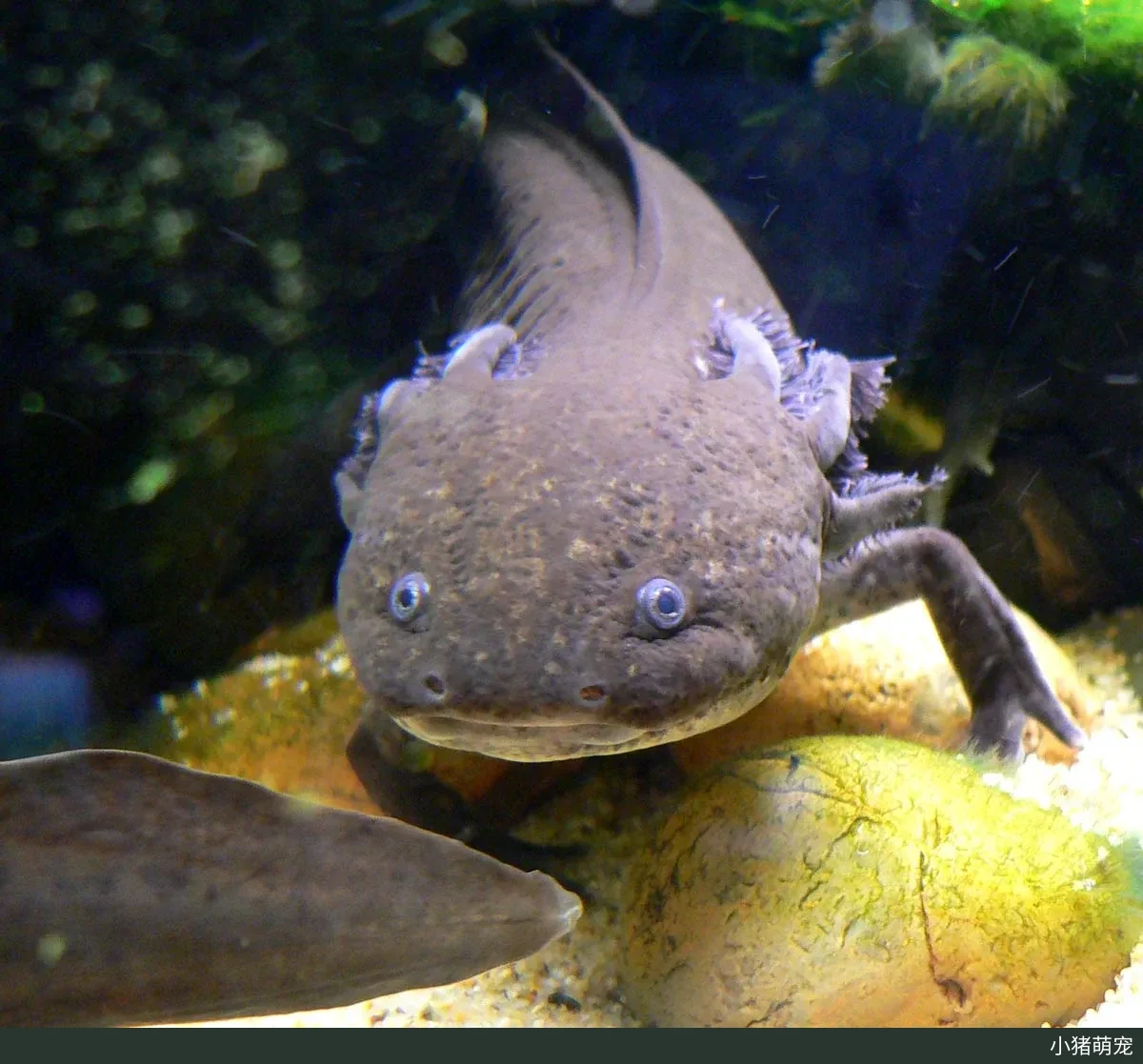
A wild-type Mexican axolotl, photographed June 2005 at the Steinhart Aquarium in San Francisco, USA. Image: Stan Shebs, from Wikimedia Commons, license CC BY-SA 3.0.
The Mexican axolotl, whose Chinese nickname means “six-horned dinosaur,” is a caudate amphibian that keeps its external gills for life and lives entirely in water. It is abundant in pet tanks and laboratories, yet in the wild it survives only in a few waters south of Mexico City and is listed as Critically Endangered by the IUCN. Drawing on veterinary, zoo, and official sources, this article covers its habits, water-quality and diet basics, common diseases, and CITES plus domestic management rules.
Natural habits and body traits
The Mexican axolotl is native to Lake Xochimilco and its canals in Mexico City, and to the Chalco lake area. Today the wild population is confined to three isolated sites in southern Mexico City, in deeper lakes, wetlands, and canals—Xochimilco still receives cold spring water. Its best-known trait is neoteny: as adults they keep the larval feather-like external gills and a fin that runs along the back to the tip of the tail, and almost never metamorphose onto land. The three pairs of external gills on either side of the head are why the folk name “six-gilled” stuck.
Most individuals are 23–25 cm total length; some reach 30–40 cm, and females are usually larger than males. Wild animals are black to mottled brown; white, golden, albino, and other colors on the market come from captive selection. In captivity, average lifespan is about 10–15 years, with reports of animals living to 20; males mature at about 10 months and females at 12–18 months. Vision is poor; they spend most of their time on the bottom, mainly crawling, and swim with eel-like body undulations only when needed. They can regenerate limbs, the tail, and even parts of the heart and central nervous system, which is why they have long been a model animal for regeneration research.
In the wild, adults and juveniles eat small fish plus invertebrates such as insects, worms, and crustaceans; newly hatched larvae eat zooplankton and small worms. Before tilapia and carp were introduced, they had almost no serious predators besides humans.
Husbandry and diet
Axolotls are cold-water animals: keeping one is really about keeping a tank of good water. Veterinary sources give reference values of water temperature 15.6–17.8°C (Royal Veterinary College materials say 16–18°C), and in any case not above 24°C; pH 7.4–7.6; ammonia and nitrite at 0, nitrate below 10 ppm; chlorine and chloramine in tap water must be removed. LafeberVet suggests changing about 30% of the water weekly; the Royal Veterinary College suggests 10–20% weekly, adjusted for filtration. For households in warmer climates, the 24°C line is easy to breach in summer—plan cooling before you buy.
For tank size, juveniles need at least 38 L and adults 78 L or more; larger tanks hold more stable water. Filtration must be solid, but flow must be gentle—use a spray bar to spread outflow; strong current stresses them and can damage the external gills. Lighting should be dim, with caves, tubes, or similar hides. Substrate should be fine sand, rocks larger than the animal’s head, or a bare bottom; never use small gravel—axolotls gulp food whole, and pebbles are easily swallowed, which can cause potentially fatal intestinal blockage. Best not to mix species: juveniles may cannibalize each other, small fish get eaten, and larger fish may nip the gills.
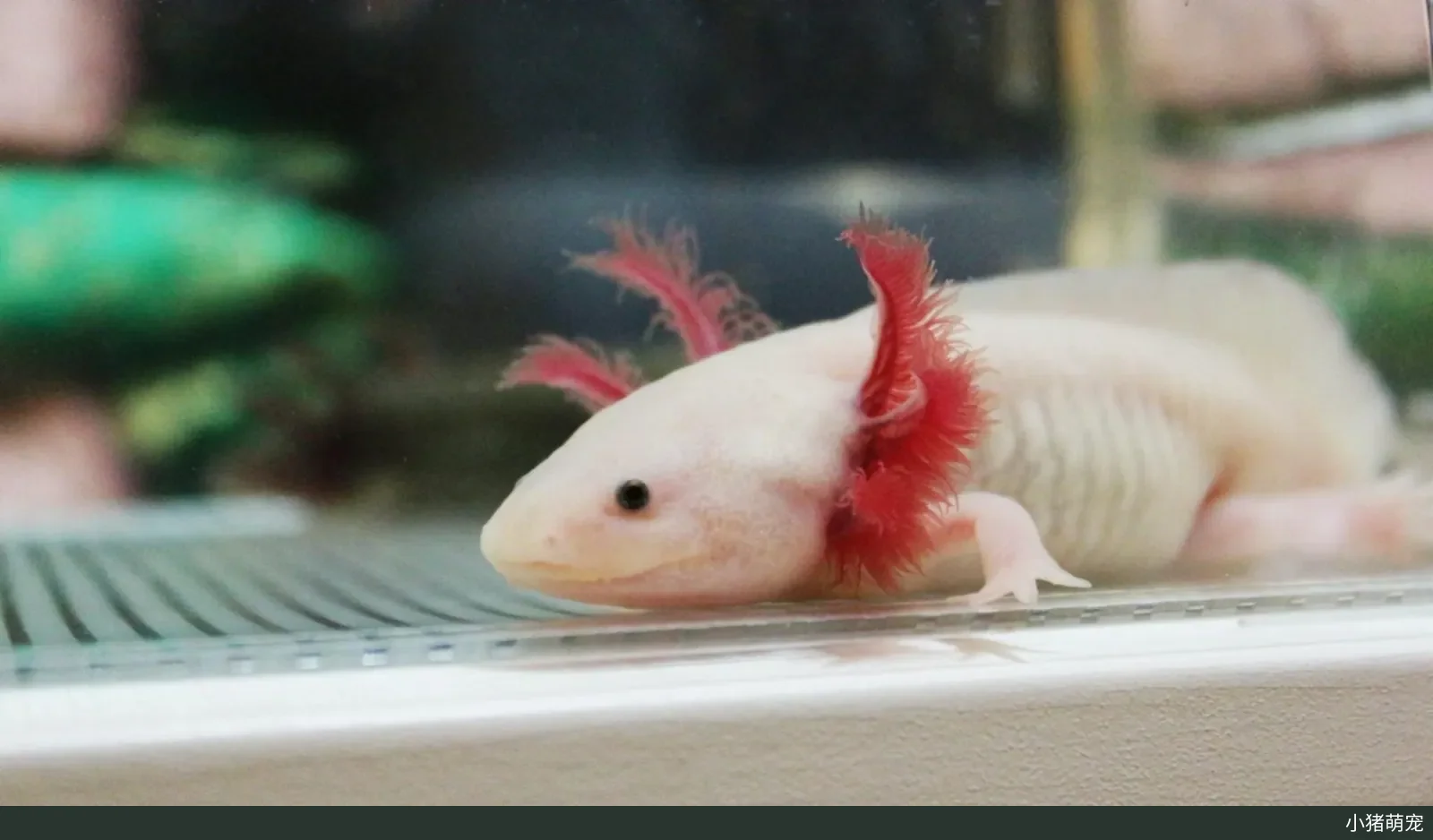
Leucistic is a common captive color morph; the animal in the photo is resting on the tank floor. Image: Hannah Kao, from WordPress Photo Directory, license CC0 1.0.
Diet-wise, axolotls are carnivores. Common foods include frozen bloodworms, blackworms, chopped earthworms, brine shrimp, salmon pellets, and small feeder fish. Earthworms should be chopped before feeding: there are reports of a related tiger salamander perforating its stomach after swallowing a whole large worm. The Royal Veterinary College also notes that aquatic feeders are best taken from waters without fish, to avoid introducing pathogens. Juveniles are fed daily; adults every 2–3 days; offer only what they finish in 2–5 minutes and remove leftovers promptly. Metabolism is slow, so overfeeding easily leads to obesity, which is quite common in captive animals.
Common health problems
LafeberVet’s veterinary materials state plainly that many diseases in captive animals stem from poor husbandry. These issues deserve the most attention:
- Foreign-body ingestion and intestinal blockage: Swallowing gravel or small ornaments can be life-threatening; smaller objects are sometimes regurgitated, while deeper blockages may need surgery.
- High water temperature: Above 24°C they lose appetite, develop abdominal fluid, float uncontrollably, and are prone to secondary bacterial infections such as Aeromonas and Pseudomonas.
- Water-quality problems: Poor water, overfeeding, and stress can all trigger bacterial infection; fungal (Saprolegnia) infection produces white cotton-like growth on the skin. Chronically high nitrate may cause bulging eyes and cloudy cornea; VCA also notes that high nitrite can make the eyes protrude.
- Obesity: Too much food plus a slow metabolism.
- Parasites: May enter via food or tankmates.
- Trauma: Bites from tankmates; rough handling can cause limb loss.
- Drug risks: Tetracyclines are contraindicated; malachite green and copper-containing drugs are also considered unsafe—do not casually apply ornamental-fish medications.
Veterinarians recommend a check by a clinician familiar with amphibians for new arrivals, plus fecal parasite testing, then an annual exam thereafter. Skin and external gills are delicate; even during vet exams, direct handling is minimized—usually the animal is observed in a clear container with its water. So do not handle them for play; “they can regenerate” is no excuse for casual touching.
Conservation status, rules in China, and ethics
Internationally: the IUCN Red List assessment published in October 2019 lists the species as Critically Endangered (CR); the population is still declining, with an estimated 50–1,000 wild adults and a 2014 survey density of about 36 per square kilometer. Main threats are urban expansion, drying and polluted canals, and introduced tilapia and carp. The Mexican axolotl has been on CITES Appendix II since 1 July 1975; international trade needs the corresponding permits. Mexico has permanently banned capture of wild individuals since 1975 and listed it on its national endangered-species list. Per IUCN assessment inference, today’s international trade uses captive-bred animals.
In China: Ministry of Agriculture and Rural Affairs Announcement No. 69 of 2018 approved the Mexican axolotl as a Category II national key protected wild animal, noting “wild populations only”; Announcement No. 491 of 2021 issued an updated list, and a 2023 Shenzhen official notice still states that “wild populations are approved as Category II national key protected wild animals.” Management of captive-bred animals has several layers: a 2018 notice from the General Office of the Ministry of Agriculture and Rural Affairs says captive-bred populations of such species are no longer treated as national key protected wild animals, but captive breeding, sale, purchase, and use still require permits or approvals under law; a July 2026 reply from the Shanghai Municipal Agriculture and Rural Committee explains that aquatic wildlife and products marked “wild populations only” on the list are subject to special labeling management. Local details may differ; before buying, confirm lawful origin and relevant labels with the seller, and consult the local fisheries authority if unsure. For import and export, approval from the Ministry of Agriculture and Rural Affairs and the Endangered Species Import and Export Management Office is required, with an import/export permit. In 2023, Shenzhen Bay Customs seized a live Mexican axolotl suspected of undeclared entry, later transferred to Shenzhen Wildlife Zoo for rescue.
Ethics: an axolotl in a pet tank and the wild population in Lake Xochimilco are almost two different worlds. Keeping one more at home does not create one more in the wild; hope for wild populations rests on habitat restoration—for example, UNAM cooperating with local farmers to create canal refuges and promote traditional farming without chemical fertilizer and pesticides. Before deciding to keep one, think through three things: it may stay with you 10–15 years; it needs stable cold water all summer; it is for watching, not for handling. Sources also note that exogenous thyroxine can induce metamorphosis onto land—that is not a “trick” normal husbandry should pursue. And never release any pet individual into natural waters.
References
-
IUCN SSC Amphibian Specialist Group. Ambystoma mexicanum. The IUCN Red List of Threatened Species, published 23 October 2019. https://doi.org/10.2305/IUCN.UK.2020-3.RLTS.T1095A53947343.en
-
San Diego Zoo Wildlife Alliance Library. Axolotl (Ambystoma mexicanum) Fact Sheet (publication date not marked). https://ielc.libguides.com/sdzg/factsheets/axolotl
-
O’Shea R (reviewed by Horton S, Talbot B). Basic Information Sheet: Axolotl. LafeberVet, 18 March 2021 (updated 8 April). https://lafeber.com/vet/basic-information-sheet-axolotl/
-
O’Shea R. Care of the Axolotl. LafeberVet, 18 March 2021 (updated 8 April). https://lafeber.com/vet/care-of-the-axolotl/
-
Royal Veterinary College, Beaumont Sainsbury Animal Hospital. Axolotl – Ambystoma mexicanum Care (December 2022, per filename). https://www.rvc.ac.uk/Media/Default/Beaumont%20Sainsbury%20Animal%20Hospital/EXOTICS/Animal%20Care%20Factsheets/Axolotl-care-and-advice-Dec-2022-jh.pdf
-
Rich G. Axolotls: Owning. VCA Animal Hospitals (publication date not marked). https://vcahospitals.com/know-your-pet/axolotls-as-pets
-
CITES Animals Committee. AC21 Doc. 11.2. https://cites.org/sites/default/files/eng/com/ac/21/E21-11-2.pdf
-
CITES. Appendices I, II and III valid from 5 March 2026. https://cites.org/sites/default/files/eng/app/2026/E-Appendices-2026-03-05.pdf
-
Ministry of Agriculture and Rural Affairs. Announcement No. 69 of the Ministry of Agriculture and Rural Affairs of the People’s Republic of China, 9 October 2018. https://www.moa.gov.cn/nybgb/2018/201811/201901/t20190102_6165921.htm
-
Ministry of Agriculture and Rural Affairs. Announcement No. 491 of the Ministry of Agriculture and Rural Affairs, 16 November 2021. https://yyj.moa.gov.cn/gzdt/202112/t20211206_6383860.htm
-
General Office of the Ministry of Agriculture and Rural Affairs. Notice on standardizing approval management for aquatic animal species in the CITES Appendices (collected on the Chinese government website). https://www.gov.cn/zhengce/zhengceku/2018-12/31/content_5441763.htm
-
Shenzhen Municipal Planning and Natural Resources Bureau. Building a shared front line for aquatic wildlife rescue and a harmonious, beautiful ecological home—Nanshan Administration of the Municipal Planning and Natural Resources Bureau joins the rescue of a Mexican axolotl, 10 May 2023. https://www.sz.gov.cn/szzt2010/wgkzl/glgk/jgxxgk/gtzy/content/mpost_10583833.html
-
Shanghai Municipal Agriculture and Rural Committee. Which species can apply for special aquatic wildlife labels?, 15 July 2026. http://nyncw.sh.gov.cn/bwbdqt/20260721/2fa13bd0a34e43e18ee06b05cff78195.html
-
Wildlife Protection Law of the People’s Republic of China (reposted on the Beijing Municipal People’s Government website). https://www.beijing.gov.cn/zhengce/zhengcefagui/qtwj/202307/t20230707_3157872.html