Scrappy the dog was adopted as a youngster, then returned to the shelter two months later. For nearly a year afterward he had ongoing diarrhea and weight loss; the organization tried medication, special diets, and food trials. Volunteer Connie noticed he was getting thinner and suspected the shelter environment might be tied to his condition, so she offered to foster him at home. In an October 2026 report, Animal League America said Scrappy’s gastrointestinal problems eased after he arrived home and his weight began to rebound; with Connie’s patient company he also gradually met new people and new settings.[1]
When the report was published, Scrappy was still waiting at Connie’s for a suitable adoptive home. His story shows where fostering sits in the rescue chain: an animal may already be in shelter care yet not be ready for a permanent home. Foster homes provide a stretch of temporary housing and care while the organization keeps coordinating medical care, finding adopters, and completing adoptions.[1][2]
Some animals need time before they are ready to be adopted
Animals Animal League America lists for fostering include cats and dogs too young to adopt yet, animals recovering from surgery, illness, or injury, and animals that struggle in a shelter setting or have special medical or behavioral needs. Nursing mothers and litters, and older animals waiting for a home, may also need this kind of placement.[2]
The care these animals need is not the same. Litters need age-stage care; recovering animals may need revisits and medication on the organization’s schedule; animals afraid of people or new places need everyday contact that slowly builds a sense of safety. What a foster home does depends on the animal’s condition and the organization’s plan.[1][2]
Another foster volunteer in the report, Marilyn, first took in a litter born at the shelter and still too young to adopt. Over the next 16 years she and her husband cared for more than 80 foster animals—puppies that needed to grow up, and dogs rescued from commercial breeding facilities that feared human contact. For the latter, her work included giving them a chance to adapt slowly to people’s company.[1]
What happens when an animal leaves the shelter for a while?
A 2019 study followed 207 dogs at five U.S. shelters. Researchers collected urine before short-term foster care, during it, and after return to the shelter, and used monitors to record activity and rest. When dogs stayed one to two nights in a foster home, the urinary cortisol-to-creatinine ratio fell, and the longest continuous rest period also occurred during fostering; after return to the shelter, cortisol-related measures went back to pre-foster levels.[3]
That study looked at brief overnight fostering and also reminded organizations to watch the shelter environment itself: differences between shelters in the metrics sometimes exceeded the changes during short-term fostering.[3] Scrappy’s story is an organizational case record; improvement after fostering alone cannot pin down why he had diarrhea and weight loss before. Together, the two kinds of material point to a practical issue: living environment and individual needs deserve careful attention while animals wait for adoption.
Behind temporary care, organizations stay in the relay
Fostering does not mean the organization drops out once an animal enters a home. In Animal League America’s program, for example, the organization supplies basic supplies, food, medication, veterinary care, and foster-team support; foster caregivers handle daily feeding, safety, and appropriate training, and communicate changes, coordinate vet appointments, or meet potential adopters with the organization.[2][4]
The program matches a first animal to new fosters based on experience and application criteria. If behavior problems arise, fosters can contact program staff and the behavior team; if they truly cannot continue, they can arrange with a coordinator to return the animal. That setup gives foster homes channels for help and handoff so care can continue.[4]
For shelters, foster homes also add places where animals can be cared for. Animal League America says that when a household takes on temporary care of one animal, shelter space opens up so the organization can take in others who need help.[1][2] That capacity still depends on food, medical care, staff coordination, and follow-on adoption work.
From household observation to adoption introductions
Foster homes also do something a shelter cannot fully replace: get to know an animal in home life, then hand those observations to the next caregiver. Marilyn tells adopters what the animal likes, what makes it tense, and what helps it feel safe.[1] That information shows adopters more than a brief shelter meet-and-greet—it includes what the animal needs in everyday company.
So animals living in foster homes can still be seen, Animal League America lists them on pet-search sites and social media and asks fosters for photos and video from home. When someone wants to adopt, the foster passes contact details to the program lead and the organization continues with applications and matching.[4] Foster observations thus enter the adoption pitch; photos, meetings, and applications connect the animal to a potential new household.
Organizations differ in how they arrange meetings. Best Friends Animal Society’s Utah dog foster manual requires medically and behaviorally cleared, adoptable foster dogs to visit the adoption center at least two days a week to meet the public; foster homes may also give coordinators the dog’s preferences, habits, and photos to update online listings.[5] Home care and public display run in parallel there.
Temporary care also means saying goodbye. Marilyn recalls that letting go of that first litter was hard; later, seeing them enter new homes, she felt she had met the goal of fostering. The report says some adoptive families still send her photos and updates.[1] After one handoff ends, a foster home can take in the next animal that needs care.
How fostering changes the handoff shows up as a chain of concrete work: give the animal a temporary home, meet its present needs, pass household observations to the organization, then let potential adopters get to know it. For animals like Scrappy still waiting for a family, that stretch of time is itself part of rescue.[1][4]
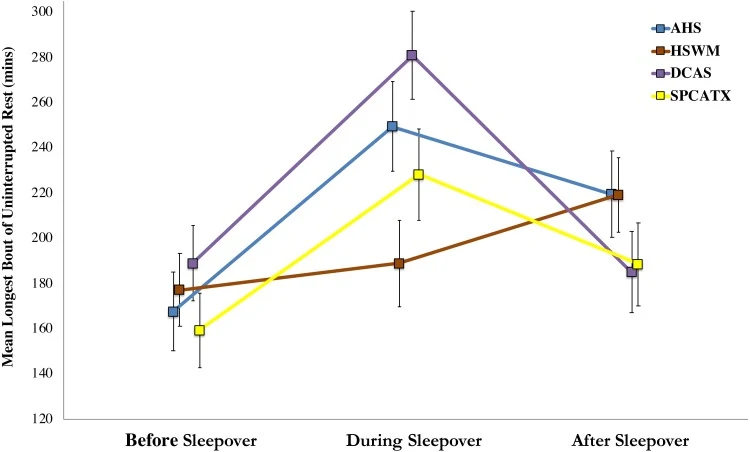
Figure 1|In the 2019 study, longest continuous rest time (minutes) for dogs from four shelters before, during, and after short-term fostering; error bars are standard errors. From an independent study—not measurements from this case. Source: Gunter et al., Evaluating the effects of a temporary fostering program on shelter dog welfare, PeerJ 7:e6620, original paper Figure 2, CC BY 4.0. Original figure retained; compressed only.
References
-
Animal League America. When a Foster Home Changes Everything. 2026-10-14.
-
North Shore Animal League America. Foster Care Program. 2026-09-02.
-
Gunter LM, Feuerbacher EN, Gilchrist RJ, Wynne CDL. Evaluating the effects of a temporary fostering program on shelter dog welfare. 2019-03-27.
-
North Shore Animal League America. Foster Program FAQs. 2019-03-20; some entries updated 2023-10-04.
-
Best Friends Animal Society. Dog Foster Care Manual. Undated.
-
Piggy Pets · Welcome to my pet planet