The Bengal has a wildcat-like spotted coat: Asian leopard cats are among its ancestors, but today Bengals are bred only to other Bengals. Muscular, energetic, and highly curious, the breed is recognized by TICA, CFA, and FIFe. To keep one, prepare enough play and climbing space, and ask breeders for cardiac screening and genetic test results for PRA-b and PK deficiency.
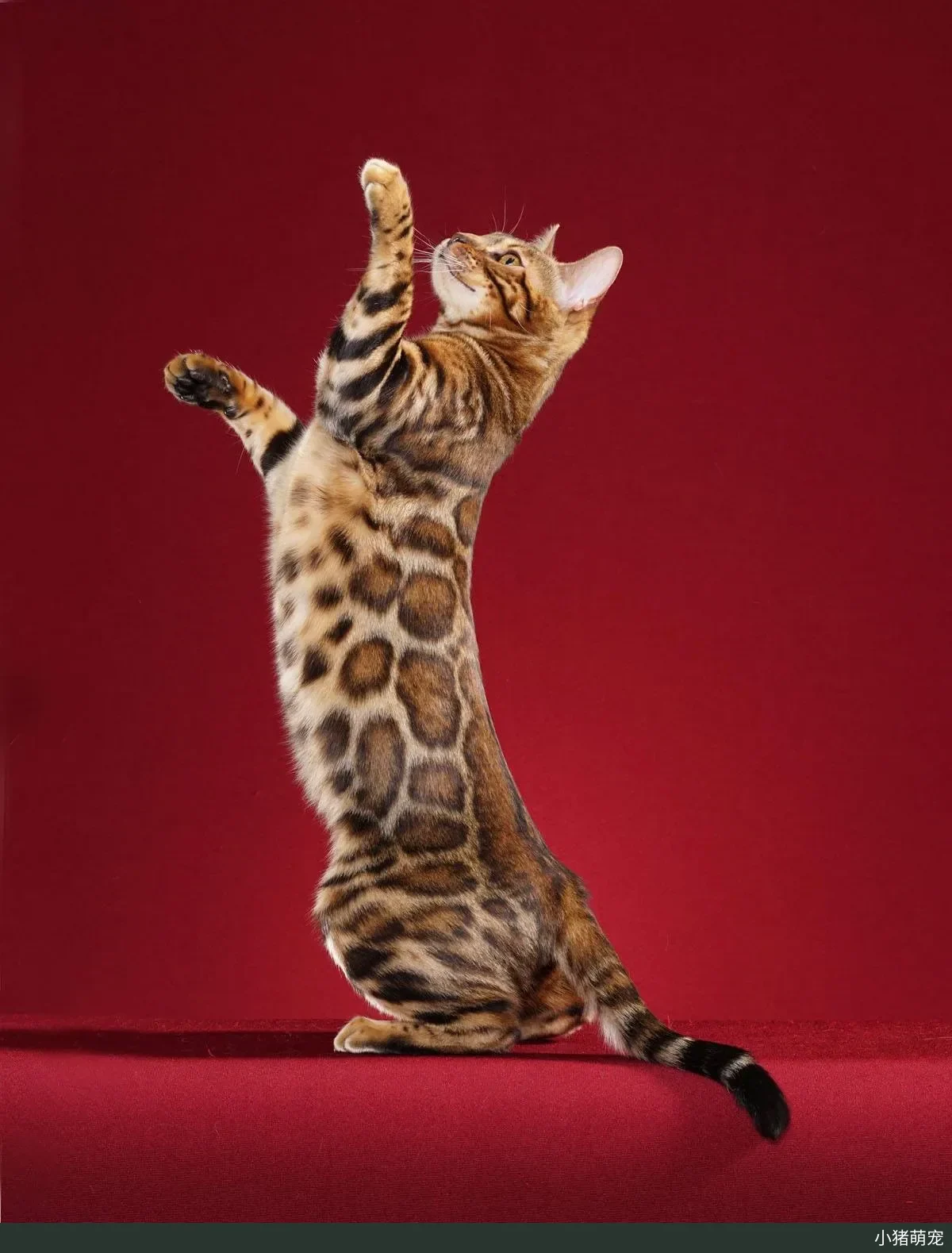
A standing female Bengal covered in rosettes. Image author: Lightburst, source: Wikimedia Commons, license: CC BY-SA 4.0.
Origin and breed recognition
The Bengal story begins with a cross-species hybrid. Per TICA and CFA breed materials, in 1963 Jean Mill (then Jean Sugden) bred an Asian leopard cat (Prionailurus bengalensis) to a domestic cat, producing first-generation hybrids; the name “Bengal” comes from the leopard cat’s scientific name. Another thread comes from Dr. Willard Centerwall: TICA’s timeline says he began leopard-cat × domestic breeding in 1971 to study disease-resistance genetics and domestication; CFA says he hoped to produce domestic cats carrying the leopard cat’s natural immunity to feline leukemia. In 1980, Mill obtained hybrid females from Centerwall’s project and restarted breeding with spotted domestic cats; modern Bengals trace to the cats she bred in the early 1980s.
Major associations recognized the breed at different times: TICA accepted Bengals as a new breed in 1986 and granted championship in 1991; FIFe’s standard notes recognition in 1999; CFA opened registration in 2016 requiring five generations of pure domestic ancestry, and elevated the breed to championship in 2018. Early hybrid generations are registered in TICA as Foundation (F1, 2G, 3G), cannot compete, and only females among them are used for breeding; FIFe’s current breeding rules forbid breeding F1–F4 Bengals. TICA’s breed page stresses that modern Bengals are bred only Bengal to Bengal.
Appearance and color
Bengals are medium to large, muscular and solidly boned, with the hindquarters slightly higher than the shoulders, a thick tail with a rounded tip, and the bearing of a small athlete. The head is relatively small for the body, the nose broad, whisker pads prominent, eyes large and round, ears medium-small with a broad base and rounded tips; CFA’s standard says this combination gives a “nocturnal animal” expression. TICA’s adult weight references are about 6–12 lb (about 2.7–5.4 kg) for females and about 9–15 lb (about 4.1–6.8 kg) for males, mature around age two; expected lifespan is 12–20 years, depending on environment, nutrition, and other factors.
What people notice first is the coat. TICA calls the Bengal the only domestic breed that can show “rosettes”—two-toned spots with a dark outline and lighter center, shaped like doughnuts, paw prints, or arrows. The other pattern is marble, evolved from classic tabby but freer in direction and stronger in contrast. The most common color is brown spotted or rosette tabby; there are also silver and what breeders call “snow” colors—seal lynx point, mink, sepia, and others. Some Bengals’ hair tips glitter gold in sunlight—“glitter.” Shorthair Bengals have a close, silky coat; CFA and TICA now also register longhaired Bengals.
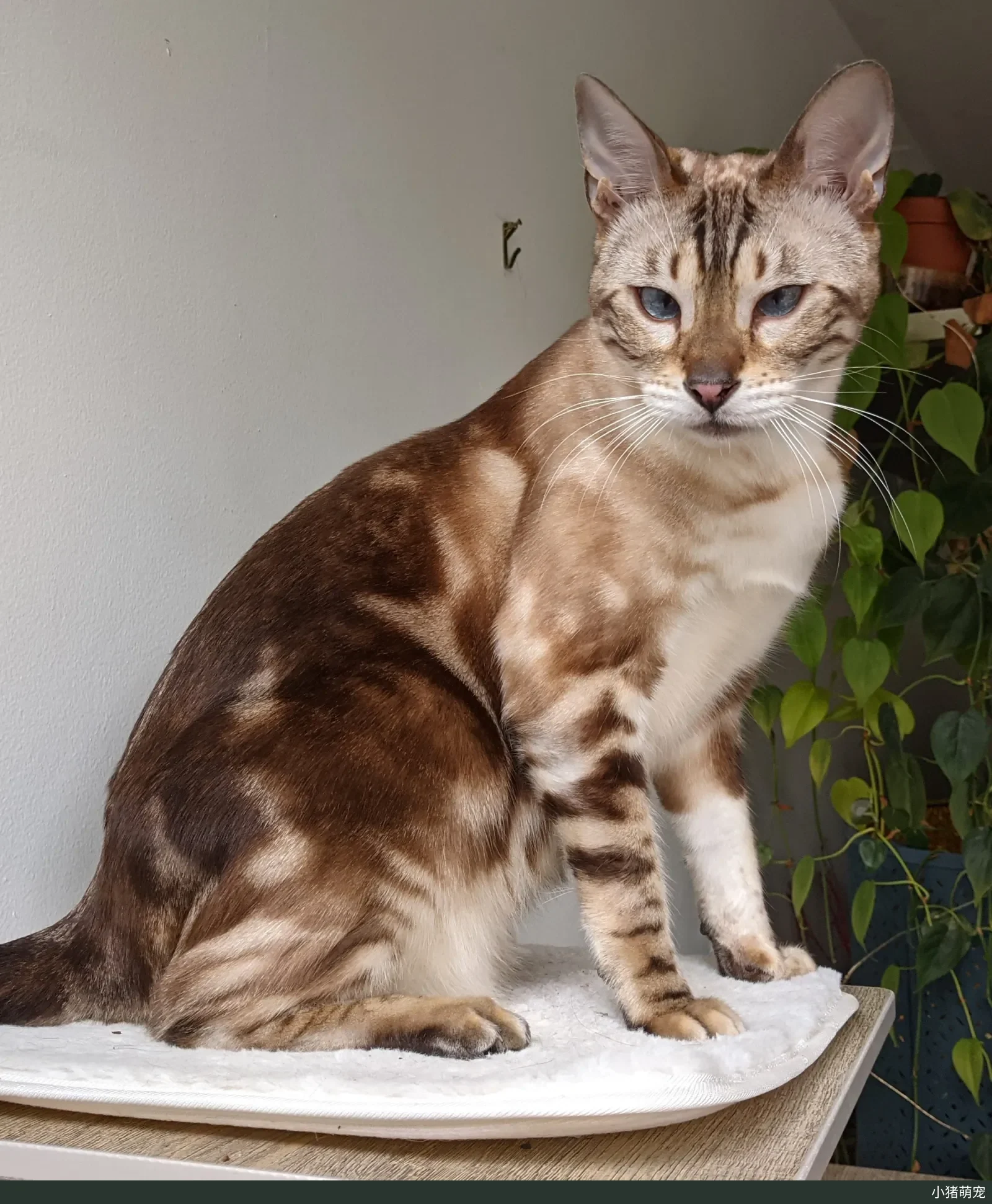
An 18-month-old snow marble Bengal male with blue eyes. Image author: Hadal, source: Wikimedia Commons, license: CC BY-SA 4.0.
Temperament and daily care
Per CFA and TICA, Bengals are confident, curious, and athletic, often keeping kitten-like energy into old age. They are smart, can learn sit, fetch, and other tricks, and many accept a harness for walks. Many are fascinated by water—they may watch you brush your teeth or follow you into the shower. They want to be where the action is and love heights—TICA says bluntly that if you dislike cats leaving the floor, a Bengal may not suit you. Vocalization varies; some “chat,” others are quiet; with proper introductions they usually get along with other pets.
UK welfare assessments are more cautious. A September 2024 Animal Welfare Committee (AWC) report cites an owner-questionnaire study: among F2 and later Bengals, 33.2% still showed destructive behavior, 89.5% climbing behavior, and 78.9% strong hunting behavior. The report also holds that hybrid-origin cats including Bengals have complex environmental needs, are unsuited to small indoor spaces, and that many are territorial and poorly tolerant of other cats. These data are owner-reported and do not describe every cat, but they make clear that space and time for companionship must be settled before getting a Bengal.
- Exercise and play: Schedule interactive play daily; provide cat trees, high platforms, puzzle toys, or a cat wheel; TICA also recommends treat or clicker training to burn energy.
- Grooming: Shorthair Bengals need about one soft-brush session a week and rarely need baths; longhaired Bengals need daily combing. TICA suggests monthly nail trims.
- Diet: Choose a balanced, high-quality cat food. Neutered adults gain weight easily; TICA’s breed page notes most breeders do not recommend free-feeding adults—watch both quality and quantity; refresh water daily and place bowls away from food.
- Multi-cat homes and outdoor access: Introduce new members gradually before cohabitation. The AWC report generally advises against free roaming for hybrid-origin cats, while long confinement indoors can cause frustration, so indoor-focused homes should compensate with play and enrichment.
Common health issues and the hybrid debate
To be clear: Bengals are not among breeds defined by structural mutations such as folded ears, short legs, or short faces. TICA’s 2016 breed seminar materials cite registration rules requiring that domestic cats used in breeding carry no structural mutations; CFA’s standard says head proportions are “not extreme,” and TICA requires that no feature look exaggerated. What Bengals need watching for are mainly the following genetic or possibly genetic issues:
- Hypertrophic cardiomyopathy (HCM): the most common heart disease in cats. CFA notes it is detected by cardiac ultrasound; most breeders have a cardiologist ultrasound breeding cats before first breeding and recheck periodically; TICA also requires HCM testing of its breeders’ cats.
- Bengal progressive retinal atrophy (PRA-b): autosomal recessive. Per the UC Davis Veterinary Genetics Laboratory, photoreceptors begin to be lost around 7 weeks of age, with severe vision impairment by about age two; progression varies; affected cats often have enlarged pupils and forward-pointing whiskers, and struggle more at night. Carriers have normal vision and can only be found by genetic testing.
- Erythrocyte pyruvate kinase deficiency (PK deficiency): autosomal recessive hemolytic anemia with intermittent episodes; age of onset and severity vary, possibly showing severe lethargy, weakness, weight loss, jaundice, and abdominal enlargement. In a UC Davis survey of 38 breeds, Bengals were among those with higher frequency of this mutation.
- Other reported issues: The UK AWC report lists hereditary cataracts, polyneuropathy, and higher rates of chest-wall deformity in related individuals among Bengals, and notes secondary nutritional hyperparathyroidism (metabolic bone disease); it also acknowledges that research on disease frequencies in hybrid-origin cats remains limited.
PRA-b and PK deficiency both require a mutation from each parent to cause disease: two carriers mated are expected to produce about 25% affected kittens. Genetic testing mainly helps breeders avoid carrier-to-carrier pairings. When choosing a kitten, ask for the parents’ PRA-b and PK deficiency reports and cardiac ultrasound records.
The real controversy around Bengals is hybridization itself. A Cat Group position statement published by International Cat Care (first issued March 2025, updated September) states that it does not support breeding wildcat hybrids or keeping them as pets; welfare risks are highest for hybrids fewer than five generations from a wildcat. It also notes that most UK Bengals are already five or more generations from the original cross, but early-generation Bengals remain a concern, and no commercial genetic test can prove a hybrid’s generation—only breeding records can. In England, Scotland, and Wales, Asian leopard cats and first-generation hybrids fall under the Dangerous Wild Animals Act 1976. If you want a Bengal, a registered cat with multi-generation pedigree records matters more than chasing a “wilder” look.
References
-
The Cat Fanciers' Association (CFA). Bengal (breed profile and standard)
-
The International Cat Association (TICA). Bengal
-
TICA. Bengal Breed History (compiled by Anthony Hutcherson, 2021-06-16)
-
Fédération Internationale Féline (FIFe). Bengal (BEN) breed standard
-
FIFe. Breeding & Registration Rules (2026-07-01 edition)
-
UC Davis Veterinary Genetics Laboratory. Progressive Retinal Atrophy (PRA-b) (Bengal)
-
UC Davis Veterinary Genetics Laboratory. Erythrocyte Pyruvate Kinase Deficiency (PK Deficiency)
-
Animal Welfare Committee (UK). Opinion on the welfare implications of current and emergent feline breeding practices (September 2024)
-
International Cat Care. The Cat Group Position Statement on Hybrid Cats (first issued 2025-03-18, updated 2025-09-26)