The Gordon Setter’s ancestors worked alongside hunters to find game birds in the Scottish Highlands. By the early nineteenth century, the fourth Duke of Gordon’s kennels were producing dogs a Gordon owner today would recognize. One word in the breed standard helps explain how those dogs worked: stamina. They needed enough bone and muscle to keep going over rough ground. For a family today, part of the pleasure is keeping that working partnership alive. A Gordon can range ahead, and you can teach it to come back to your side when you call. [1]
Look at a Gordon from the side. The back is relatively short, and straight forelegs support a substantial body. The chest reaches down to the elbows. The ears are set roughly level with the eyes and hang close to the head. Against the glossy black coat, a small tan spot sits above each eye. The same tan appears along the sides of the muzzle and on the lower legs. In the photograph, long hair partly obscures the outline of the chest and belly. Find the elbow on the near foreleg and you can still see how deep the chest is. [1]
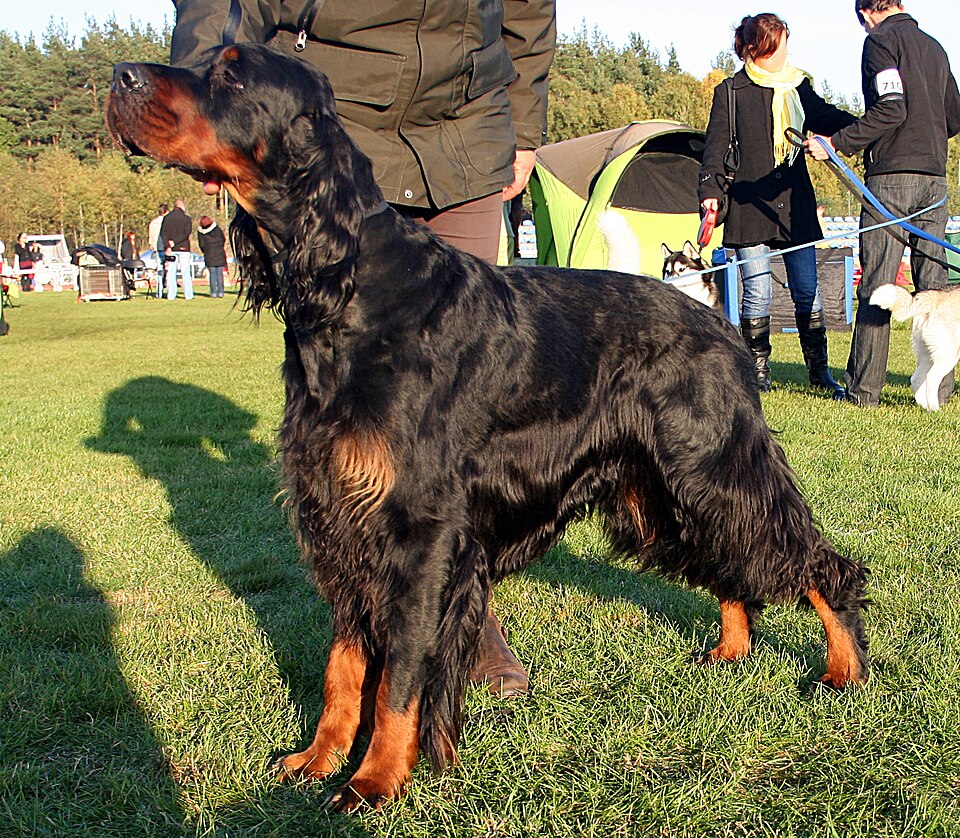
The Gordon’s chest reaches its elbows. Pleple2000, Wikimedia Commons[4]

Make room for exercise on a workday
The American Kennel Club (AKC) describes a dog that enjoys running across a field and settling down beside its person afterward. To judge how that would fit into your life, picture an ordinary workday. Who can take the dog for a walk before work? When everyone is home in the evening, who will pick up the leash and head somewhere the dog can stretch out into a stride? If the outing that comes most readily to mind is a weekend hike, the part of the plan that still needs attention is Monday through Friday. [1]
An apartment household can make this work. Start with a walking route you can reach from your front door every day. Then find a place with a secure fence and a gate that closes, where the dog has room to run. If you have a yard, take part of the day’s exercise outside together. Give the dog time to sniff around. When it looks up at you, start a game. That little stretch of time in the yard gives the Gordon a chance to move and both of you a chance to practice paying attention to each other. [1][2]
Make coming back part of the game
Choose a quiet moment at home for the first lesson. Say the dog’s name and watch for it to turn toward you. Show it a favorite toy or a small treat. As it starts walking toward you, praise it, then give the reward when it reaches you. After a few repetitions, say “come” just as the dog is already on its way. There are two responses you can see and practice separately. The dog looks up at its name and comes all the way to you on the recall cue. Everyone who walks the dog can use the same word and give the reward in the same place, right beside them. [1][2]
Once the word is familiar, keep the reward in your pocket until the dog comes to you. Two people can stand a few steps apart in the same room and take turns calling, with only one person speaking at a time. Gradually move farther apart, then take the game into a fenced yard. When you move to an open space with more people and interesting smells, use a long training line and start close together again. If the dog has its nose in the grass and your call goes unanswered, move closer and find a quieter spot. Save the next cue for a moment when the dog can respond. [2]
One recall worth planning happens halfway through play. In a securely fenced area, call the dog over, reward it when it reaches you, and let it go back to playing. If you call only at the end of an outing, the sequence is always the same. The leash goes on, the gate closes, and everyone goes home. A dog can soon learn that “come” means the fun is over. For a bird dog eager to range ahead, another chance to explore makes coming back worthwhile. That is one reason to choose an exercise area where you feel comfortable letting the dog run again. [1][2]
Thinking through who will do this practice also helps you judge whether a Gordon fits your household. Whoever takes the weekday walks needs to be able to handle a strongly built adult on a leash and have time to stop for a few recalls. With a puppy, start indoors with its name and a few steps toward you, and plan for early socialization and puppy classes. With an adult, see what the dog can already do in a quiet place before deciding how far apart to stand next time. Once everyone knows where to start, the routine is familiar whoever picks up the leash. [1][2]
Follow the feathering when you brush
A side view of a Gordon makes a handy grooming map. The coat lies along the back, while longer fringes of hair, called feathering, hang below the ears, down the chest, under the belly, behind the legs, and beneath the tail. Look at a foreleg from the front and the tan on the lower leg catches your eye. From the side, you can see the fringe running down the back of that same leg. At least once a week, brush thoroughly from beneath the ears along the chest and belly, down the legs, and out to the tail. It is easy to run a brush over the glossy back and miss the places most likely to tangle. [1]
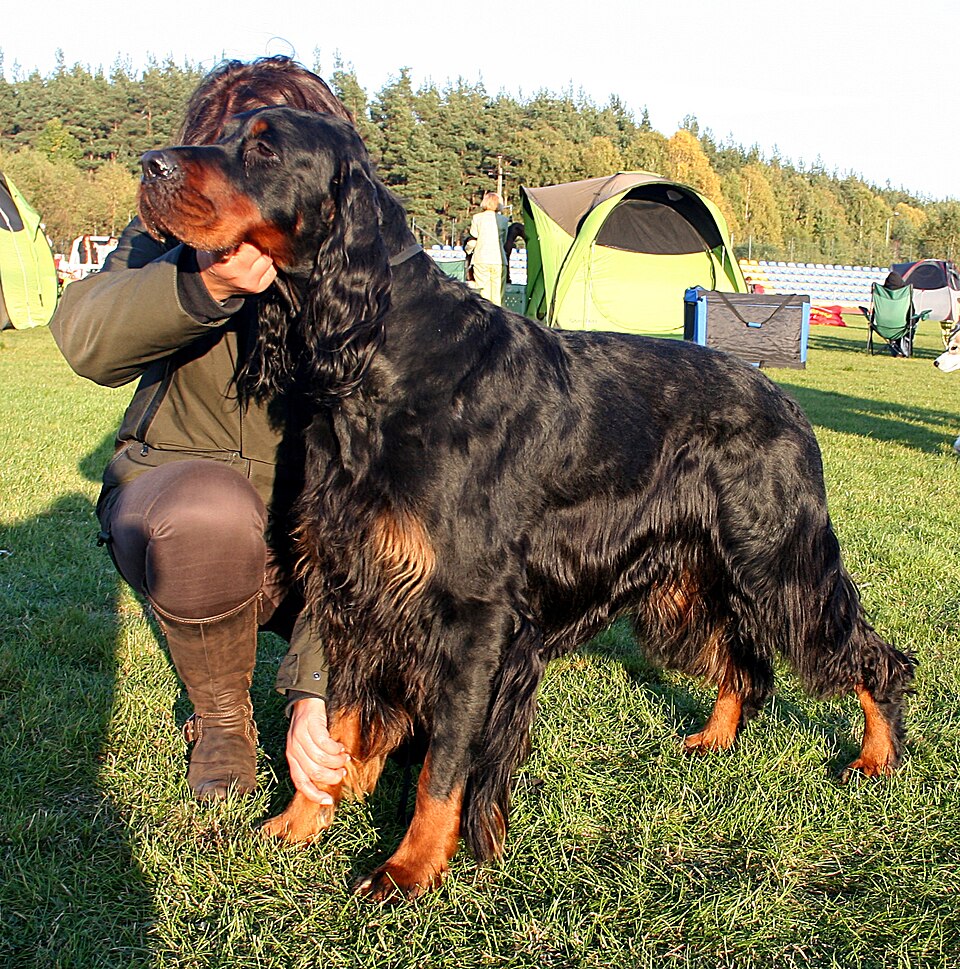
Drop ears frame the Gordon’s tan markings. Pleple2000, Wikimedia Commons[5]

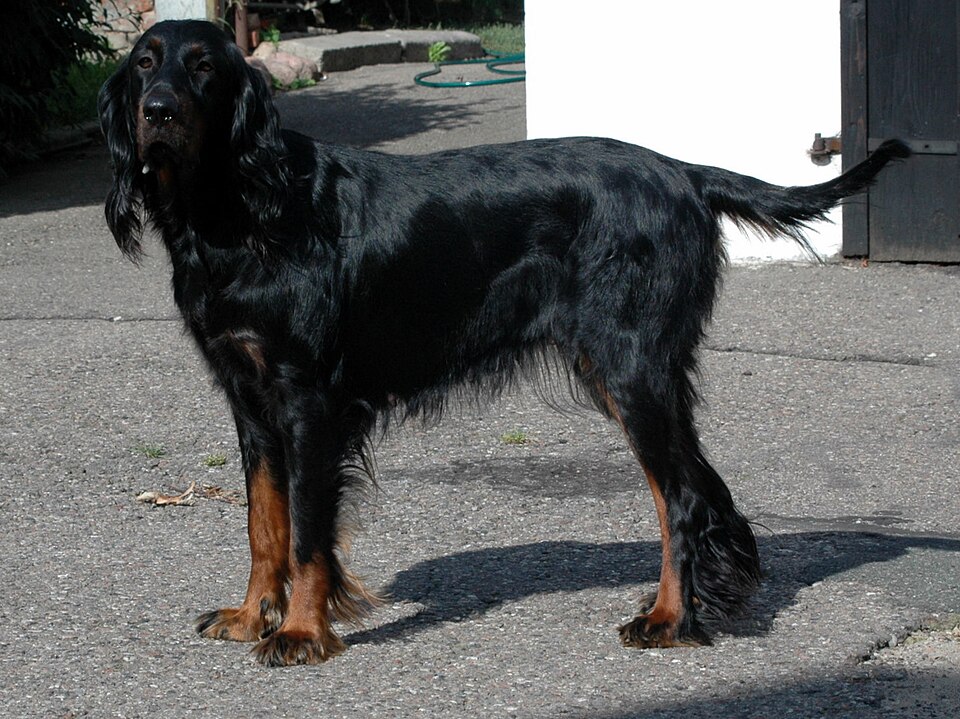
Feathering hangs below the belly and behind the legs. Radosław Drożdżewski (Zwiadowca21), Wikimedia Commons[6]

When you put the leash away after a walk, take a moment to feel for bits of grass caught behind the legs or around the feet. The monthly routine is more thorough. The AKC recommends trimming the hair on the feet, around the ears, and near the base of the tail, clipping the nails, checking the teeth for plaque, and giving the dog a bath. If a groomer does the trimming, someone at home still needs to sit down with the dog between visits and work a brush through each fringe. [1]
Health questions to ask before bringing a Gordon home
When you ask a breeder about a litter, request the records for both parents. Look for hip and elbow evaluations, an eye examination by a veterinary ophthalmologist, and a DNA test for a form of progressive retinal atrophy called PRA-rcd4. The eye examination and the DNA test answer different questions. If the breeder shows you a genetic test result, ask to see the eye examination record as well. Together, the parents’ results tell you about the breeding behind the litter. Your puppy’s veterinary visits are where you and your vet can follow its own joint health, eyesight, and growth. [1]
Before the first hike, save the phone number and route to an emergency veterinary hospital that can see your dog. Make sure everyone who takes the dog out has those details. The deep-chested Gordon Setter is among the breeds at risk for gastric dilatation-volvulus (GDV), often called bloat. If the dog suddenly keeps trying to vomit and nothing comes up, call the emergency hospital and take the dog in immediately. Pacing, drooling, or a swollen abdomen may accompany the retching. Agreeing ahead of time on who will drive and where to go saves time when the dog needs treatment. [1][3]
References
-
[1] American Kennel Club. Gordon Setter.
-
[2] Sassafras Patterdale. How to Train a Reliable Recall for Your Dog. American Kennel Club.
-
[3] Cornell University College of Veterinary Medicine. Gastric dilatation volvulus (GDV) or “bloat”.