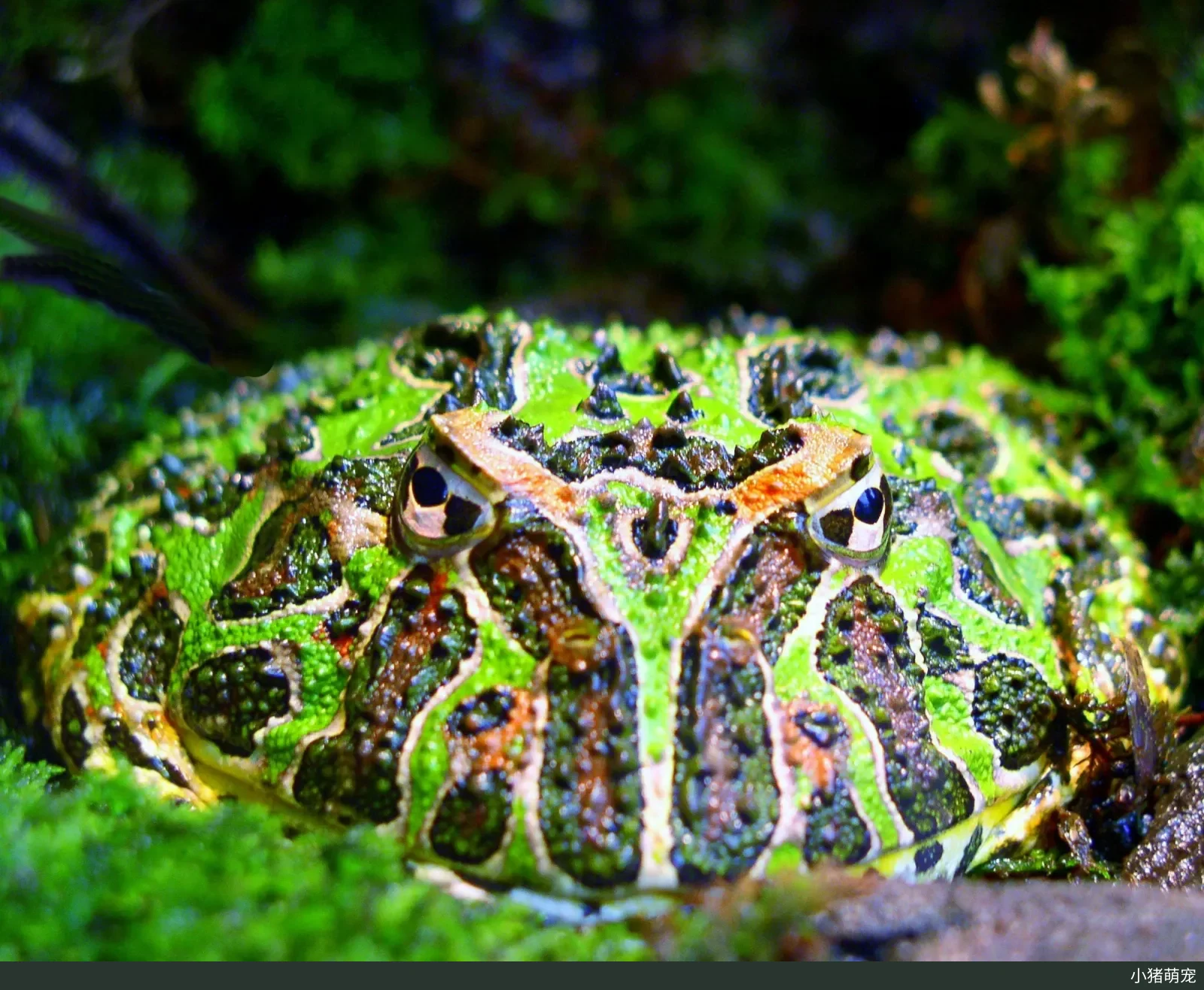
An Argentine horned frog (Ceratophrys ornata) kept at the National Aquarium in Baltimore, USA. Photo: Flickr user avmaier; source: Wikimedia Commons; license: CC BY 2.0.
Horned frogs are a group of large-mouthed South American frogs often called “pacman frogs.” They spend much of their time half-buried in soil, waiting for prey. The Argentine horned frog and Cranwell’s horned frog common in the pet trade are not on the CITES Appendices, but the Argentine horned frog’s wild populations were uplisted by IUCN in 2024 from Near Threatened to Vulnerable. Drawing on veterinary and conservation sources, this article outlines natural habits, housing and diet, common health problems, and the boundaries of legal, responsible keeping in China.
Natural habits and native range
“Horned frog” refers to frogs in the genus Ceratophrys, named for the horn-like projections above the eyelids. Two species are most common in the pet trade: the Argentine horned frog (C. ornata, also called the ornate horned frog) and Cranwell’s horned frog (C. cranwelli, also called the Chacoan horned frog). They were once treated as one species; today they can be told apart by the supraorbital projections, skull proportions, and markings: Cranwell’s has more pronounced triangular projections, often a trident-like dorsal pattern, and darker colors; the Argentine form is brighter and sometimes reddish. AmphibiaWeb records adult Argentine horned frogs at about 11 cm snout–vent length on average; Cranwell’s can open its mouth wider than half its snout–vent length—the reason it can swallow large prey.
Their homeland is not the “tropical rainforest” many care sheets claim. The Argentine horned frog occurs in Argentina’s Pampas (Buenos Aires, Córdoba, Entre Ríos, La Pampa, Mendoza, Santa Fe, and other provinces); historically it was also recorded on the Uruguayan coast and in southern Brazil, from 0–500 m elevation, in grassland near temporary water bodies and also in irrigated farmland and ditches. It is a burrowing frog that prefers loose sandy soil; after heavy rain, shallow flooded ground around permanent water is its breeding habitat. Cranwell’s horned frog lives in the Gran Chaco of Argentina, Bolivia, Paraguay, and Brazil—dry thorny scrub, palm savanna, and seasonal wetlands. The Smithsonian’s National Zoo notes that it is active at night near temporary ponds in the rainy season; when ponds dry in the dry season it may aestivate underground for months until rains return.
Horned frogs are classic sit-and-wait hunters: they bury themselves in substrate with only eyes and “horns” showing, then gulp prey that passes by, mainly at night. They are not clingy pets; when threatened they may inflate their bodies in a threat display. In the wild, both species have been killed by people who wrongly believed them poisonous.

An Argentine horned frog (Ceratophrys ornata) recorded in the wild in Buenos Aires Province, Argentina, February 2024; the observation is research-grade on iNaturalist. Photo: Abril Bastons (ArgentiNat); source: iNaturalist; license: CC BY 4.0.
Housing and diet
Horned frogs are inactive and do not need a huge tank, but the details matter. In PetMD’s care guide (April 2024), veterinarian Maria Zayas recommends:
- House alone: Horned frogs are territorial; cohabitation can lead to cannibalism. Do not share a tank with other amphibians or reptiles.
- Enclosure: At least 10–20 gallons (about 38–76 L), wider than tall, with a secure, ventilated mesh lid.
- Substrate: Adults need about 8–10 cm of coconut fiber or sphagnum, moist but not waterlogged; avoid gravel, pebbles, or artificial turf—they injure skin and, if swallowed, can cause fatal gut blockage.
- Temperature and humidity: About 24–28 °C by day and 21–24 °C at night, humidity 70%–80%; heat pads or lamps must use a thermostat—no hot rocks. WWF’s ranges are slightly wider: about 24–29 °C by day, 18–24 °C at night, humidity 50%–80%.
- Light and water: Keep a day–night cycle; PetMD suggests 10–12 hours of low-intensity UVB daily. Provide a shallow water dish large enough for full soaking, filled with dechlorinated water and cleaned and changed daily.
- Cleaning: Remove leftover food and feces daily; disinfect thoroughly at least once a month.
Horned frog skin is delicate and can absorb oils from hands and chemicals from soap or lotion; the bite is also strong—so they are better watched than cuddled. When you must move one, wear powder-free gloves dampened with dechlorinated water; feed with tongs so fingers are not mistaken for food. Amphibians may carry Salmonella—wash hands before and after touching the frog or tank items.
Diet: horned frogs are carnivores. The staple should be a varied mix of gut-loaded insects and worms—crickets, dubia roaches, earthworms; mealworms and waxworms are high-fat and only occasional. PetMD suggests daily feeding for juveniles and 1–2 times a week for adults; adults may get a thawed frozen rodent every two weeks, but never feed rodents to juveniles, and never feed live rodents—live prey can bite the frog badly. How often to dust with calcium (with vitamin D) and multivitamins varies across veterinary sources: PetMD suggests calcium daily and multivitamins weekly; LafeberVet suggests dusting juveniles 2–3 times a week and adults once a week. Follow your amphibian veterinarian and track weight.
Common health problems
Illness in horned frogs is often subtle, so daily observation matters. PetMD’s veterinary red flags include dry skin, eye discharge or bulging, skin wounds, reddened limbs or belly, lethargy, reduced appetite, oral discharge or bleeding, bent or fractured toes or limbs, nasal discharge, and weight loss. The issues that appear most often in veterinary sources include:
- Metabolic bone disease: The Merck Veterinary Manual (reviewed February 2026) notes that imbalance of calcium, phosphorus, and vitamin D3 in the diet, or inadequate UVB, can cause metabolic bone disease; except for earthworms, most invertebrates are low in calcium, and an all-cricket diet is especially risky. Common signs are a soft, deformed jaw, fractures, and scoliosis; severe cases may include tremors.
- Obesity: The same manual treats obesity as disease—mainly from overfeeding. Many amphibians will keep eating whenever food is offered, and horned frogs are famously greedy.
- Foreign-body ingestion and obstruction: The UK veterinary journal Vet Times reported an Argentine horned frog that, after prolonged inappropriate temperature and humidity under a previous owner, swallowed bark fragments and soil, obstructing stomach and duodenum; they were removed by laparotomy. Anorexia, lethargy, and prolonged absence of feces are reasons to seek care quickly.
- “Red-leg” disease: The Merck Veterinary Manual (reviewed October 2021) describes bacterial skin infection progressing to systemic infection, with reddened ventral skin; newly purchased, malnourished, or poor-water animals are especially at risk. Ventral redness can also come from toxicity, ranavirus, or chytrid—veterinary diagnosis is needed.
- Chytridiomycosis: Caused by frog chytrid (Bd) and salamander chytrid (Bsal), it has driven large declines in wild and captive amphibians and is notifiable to the World Organisation for Animal Health (WOAH); signs include brown or reddened skin, excess shedding and mucus, incoordination, or sudden death.
PetMD suggests a yearly veterinary visit: transport in a ventilated small box lined with damp paper towel, and bring photos of the enclosure plus food and substrate packaging so husbandry problems can be spotted. Confirm a nearby amphibian-capable clinic before you buy.
Legality, conservation status, and ethics
International trade: As of 17 October 2026, a search of the Species+ database maintained by UNEP-WCMC and the CITES Secretariat found no Ceratophrys species listed on the CITES Appendices.
Wild conservation status: The two species fare differently. A 2024 paper by the Argentine horned frog research team compiled about 1,000 records and ran wide field searches, still finding no recent records in Brazil or Uruguay (last records 1992 and 1982 respectively); analysis linked native grassland fragmentation and plantation expansion to its disappearance. On that work, IUCN in 2024 uplisted it from Near Threatened to Vulnerable; remnant populations are confirmed only in Argentina. Habitat loss, pollution, human persecution, and illegal pet trade are listed as main threats. Cranwell’s horned frog was Least Concern in IUCN’s 2004 assessment, though declines were already noted and pet-trade collection was a potential threat. Note that WWF’s pet guide page still lists the Argentine horned frog as Near Threatened—information from before the reassessment.
Chinese rules: Horned frogs are alien species in China. Article 40 of the Wildlife Protection Law, revised in 2022 and effective 1 May 2023, requires State Council wildlife-protection authority approval to introduce wildlife species from abroad; only species on international-convention restricted-trade lists (Article 37) also need import/export permits—horned frogs are not currently on CITES Appendices. The same article requires preventing introduced species from entering the wild and bans unlawful release or discard; violators may be ordered to recapture within a deadline and fined 10,000 to 100,000 yuan (Article 59). Article 60 of the Biosafety Law effective 15 April 2021 also provides that no unit or individual may, without approval, introduce, release, or discard alien species; unauthorized release or discard may bring a fine of 10,000 to 50,000 yuan (Article 81). These are national rules; whether localities add further requirements was not checked case by case—ask local forestry and grassland authorities before purchase.
Ethical reminders:
- Choose captive-bred animals with a traceable source. WWF notes that Argentine horned frog wild populations are declining and that illegal wild collection for the pet trade occurs.
- It may be with you for many years. Lifespan figures differ: WWF says about 6 years; PetMD says 10–15 with good care; LafeberVet says 16 or more. Plan for a long commitment.
- It is a display pet, not a toy. Do not handle for fun, and do not feed live rodents “to watch the hunt.”
- Never release or discard. If you stop keeping one, contact the original seller, a rescue, or the authorities—not a neighborhood green space, park, or riverside.
References
-
Deutsch C. et al. Habitat loss and distribution of the Ornate Horned Frog (Ceratophrys ornata): implications for its conservation in South American temperate grasslands. Perspectives in Ecology and Conservation, 2024 (online 2023-11-28). doi:10.1016/j.pecon.2023.11.002
-
The Rufford Foundation. Camila Deutsch – Time to Take Action: Implementing In-Situ/Ex-Situ Approaches to Conserve the Last Populations of Ceratophrys ornata (2025-04-14). rufford.org
-
Deutsch C. Actualización clave: el Escuerzo Pampeano pasa a la categoría Vulnerable. COANA (2025-12-20). coana.com.ar
-
Deutsch C. & Agostini G. Ceratophrys ornata. The IUCN Red List of Threatened Species 2025. doi:10.2305/IUCN.UK.2025-2.RLTS.T56340A263201909.en
-
UNEP-WCMC & CITES Secretariat. Species+ database (retrieved 2026-10-17). speciesplus.net
-
AmphibiaWeb. Ceratophrys ornata. amphibiaweb.org
-
AmphibiaWeb. Ceratophrys cranwelli. amphibiaweb.org
-
Frost D. R. Amphibian Species of the World: Ceratophrys ornata (Bell, 1843). American Museum of Natural History. amphibiansoftheworld.amnh.org
-
Smithsonian's National Zoo and Conservation Biology Institute. Cranwell's horned frog. nationalzoo.si.edu
-
Zayas M. (DVM). Pacman Frog Care Sheet. PetMD (2024-04-29). petmd.com
-
Pollock C. (DVM). Basic Information Sheet: Ornate Horned Frog. LafeberVet (2011-02-25, updated 2012-07-12). lafeber.com
-
World Wildlife Fund. Pacman frog/South American horned frog (undated page, accessed 2026-10-17). worldwildlife.org
-
Antinoff N. (DVM). Nutritional Diseases of Amphibians. MSD/Merck Veterinary Manual (reviewed February 2026). merckvetmanual.com
-
Whitaker B. R. & Yaw T. J. Infectious Diseases of Amphibians. MSD/Merck Veterinary Manual (reviewed October 2021). merckvetmanual.com
-
Miles S. Treating GI obstruction in an Argentine horned frog. Vet Times. vettimes.co.uk (PDF)
-
Wildlife Protection Law of the People’s Republic of China (revised 2022-12-30, effective 2023-05-01). npc.gov.cn
-
Biosafety Law of the People’s Republic of China (adopted 2020-10-17, effective 2021-04-15). npc.gov.cn