The word “Shepherd” in the Central Asian Shepherd Dog’s name makes more sense when you consider what the dog guarded. Across a region stretching from the Caspian Sea to China and from the southern Urals to Afghanistan, these dogs watched over herders’ camps, livestock and the horses that traveled with them. A dog working at a distance from its people had to notice movement and decide for itself whether to investigate. That history has a practical bearing on a walk today. When a stranger comes into view, the person holding the leash needs time to choose where to go. [1][2]
The American Kennel Club (AKC) has recorded the Central Asian Shepherd Dog in its Foundation Stock Service (FSS) since 1996. To recognize the breed, start with a side view. The Fédération Cynologique Internationale (FCI) standard describes a dog whose body is slightly longer than its height at the shoulder, with a substantial head in proportion to its body. On the white-and-brown male standing beside his handler below, you can trace the outline from shoulders to rump and see how sturdy the legs are. [1][2]
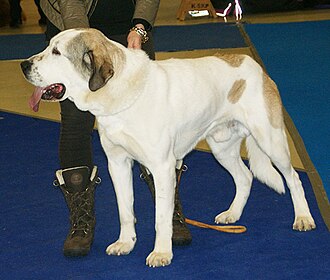
A male Central Asian Shepherd Dog stands in profile. Canarian, Wikimedia Commons[4]

A view from the front shows a different part of the dog’s build. On the light-colored female below, the chest, forelegs and broad paws are all visible. The FCI gives a minimum height at the shoulder of 65 cm and a minimum weight of 40 kg for females. For males, the minimums are 70 cm and 50 kg. To put that size in household terms, think about who will usually hold the leash. Can that person guide an adult dog of this size through the hallway, around a street corner and into a calm change of direction when another dog approaches? [2]
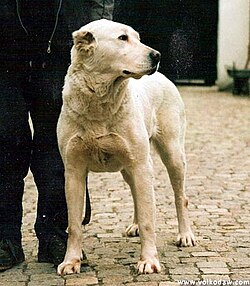
A female Central Asian Shepherd Dog shows her stance. AslanKralice, Wikimedia Commons[5]

The close-up offers another clue. Follow the muzzle from just below the eyes along the bridge of the nose. It keeps its depth almost to the tip, tapering only slightly, which gives it a blunt, squarish profile. Seen together with the broad skull, strong neck and overall proportions, that outline is a more useful guide to recognizing the breed than memorizing a particular coat color. [2]
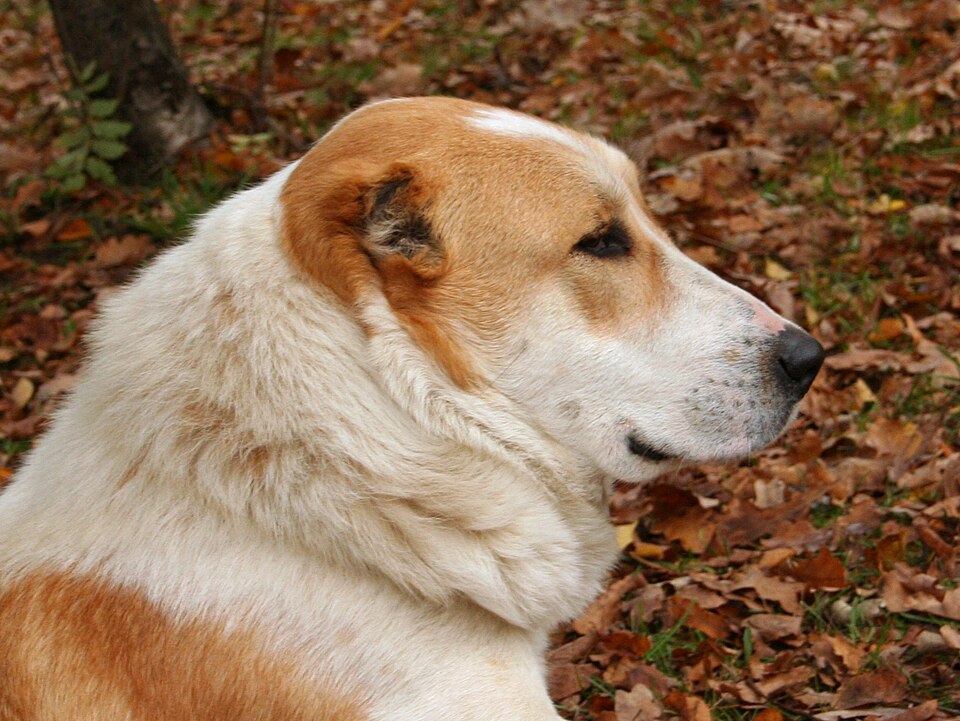
The muzzle tapers slightly toward the nose. Pleple2000, Wikimedia Commons[6]

Choose a walking route with room to pass
Central Asian Shepherd Dogs are often quiet at home and have considerable stamina outdoors. The AKC suggests daily walks with the family and notes that these dogs can accompany their owners on hikes. An easy pace gives you and the dog time to look ahead, pause or turn aside. Start with a short, familiar route. Notice the dog’s stride, how readily it heads home and how it seems afterward. Those observations can guide the length of the next walk. Even in a family that loves weekend hikes, someone still needs to take the leash on weekdays. [1]
Try walking the route yourself at the hour you would usually take the dog out. On a narrow street lined with parked cars, you might only see someone coming when you round a corner. The next street over might give you enough room to walk around them. If a neighbor stops to chat, look for a place where you can step aside with the dog and leave the way clear. Details like these tell you more about whether a route will work day after day than a fixed mileage target does. For this independent breed, the AKC advises using a fenced area for outdoor exercise and keeping the dog on leash for walks. [1]
Practice turning together
A Central Asian Shepherd Dog is inclined to make its own decisions, so teaching it to follow a cue takes patience. One skill that pays off on walks is turning with you when you change direction. Begin on leash in a quiet, fenced yard. Walk a few steps, give a cue everyone in the household has agreed on, then turn and walk the other way. Reward the dog as soon as it follows. Once the turn is familiar, practice on a quiet stretch of street. When you later spot someone approaching with a stroller or another dog, you can cue the turn while the leash is still slack and give everyone room. [1]
A spacious, securely fenced yard makes exercise easier to arrange. Whether the household suits the dog also depends on who comes through the door. Central Asian Shepherd Dogs tend to guard their people and their home, and the AKC points out that inviting guests inside can be difficult. If friends visit often, choose a room where the dog already settles comfortably and where you can close the door. Before guests arrive, someone the dog knows can take it there while another family member welcomes the visitors. The arrangement also needs to work when one person is home alone and has to settle the dog before answering the door. [1]
Before bringing a dog home, think through your household’s busiest day. Who has time for the morning walk? If the usual walker gets home late, who else knows the same cues and can bring the dog home safely? A family that likes to open its door to visitors on the spur of the moment or let its dog run up to greet others on walks would have to change those habits for the long term. The AKC describes this guardian as a dog that requires an attentive owner and advises against choosing the breed as a first dog. [1]
What to check after a walk
When you take off the leash, part the thick hair at the side of the neck with your fingers and feel for clumps of loose undercoat. Central Asian Shepherd Dogs have a dense undercoat that generally needs occasional brushing and a bath as needed. During the heavy annual shed, a surprising amount of hair can come away in one brushing, so allow extra time then. Their strong nails grow quickly and need regular trimming throughout the year. Getting the dog comfortable with having its paws handled, its ears checked for wax or debris and its teeth brushed makes routine care easier with a dog this size. [1]
If you are considering a puppy, ask the breeder for the hip screening results for each parent. The AKC specifically mentions hip dysplasia in its health information for this breed. Heredity is an important risk factor, and rapid weight gain while a puppy is growing can place extra strain on its joints. A record of how much the puppy eats and how its weight changes gives you and your veterinarian a starting point for discussing feeding. The parents’ screening results tell you about the puppy’s breeding background. Daily walks let you get to know your own dog’s gait. [1][3]
Taking the same route regularly has another benefit. You learn how your dog usually gets to its feet and how far it walks with an easy stride. If a dog that once got up readily for a walk begins to struggle, or if it limps repeatedly on walks, note when the change started and which leg seems affected. Arrange a veterinary examination and put the planned long hike on hold. With a dog capable of covering so much ground, knowing its usual stride helps you recognize the day to head home early. [3]
References
-
[1] American Kennel Club. Central Asian Shepherd Dog.
-
[2] Fédération Cynologique Internationale. FCI-Standard N° 335: SREDNEASIATSKAYA OVTCHARKA (Central Asia Shepherd Dog). English edition, 9 February 2011.
-
[3] American College of Veterinary Surgeons. Canine Hip Dysplasia.