The Scottish Terrier—affectionately known as the Scottie—is regarded as one of the oldest native Highland terriers, bred to hunt rats, foxes, and badgers across rugged Scottish farms; even in the seventeenth century, Scotland-born King James I knew the breed well and gave Scotties as gifts.[1][2] Known early on as the Aberdeen terrier, it received the name Scottish Terrier in 1879 from Captain Gordon Murray, whose breeding program helped establish consistent type; the first standard was written in 1881, the first club formed in 1882, the first imports reached America in 1883, the American Kennel Club (AKC) recognized the breed in 1885, and the Fédération Cynologique Internationale (FCI) lists it in Group 3, Section 2 as Standard No. 73.[1][2][3] Popularity peaked during the 1930s and early 1940s, immortalized by President Franklin D. Roosevelt's constant wartime companion, a black Scottie named Fala.[1]
Few silhouettes are more unmistakable. The Royal Kennel Club describes the Scottie as 'multum in parvo'—a great deal in a small package.[2] Under AKC standards, the breed stands about 10 inches at the shoulder and weighs 19 to 22 pounds for males and 18 to 21 pounds for females, while FCI Standard No. 73 cites 25 to 28 cm and 8.5 to 10.5 kg—short-legged yet remarkably heavy-boned and substantial, with forefeet slightly larger than the hind feet for digging and sturdy ground traction.[1][3] The head appears long for the dog's size, with skull and muzzle of equal length, strong level jaws, dark almond eyes set beneath expressive eyebrows, crisp pointed erect ears, and an upright tail.[1][3] A weather-resistant double coat—harsh wiry outer hair over a soft dense undercoat—blends into distinctive beard, leg, and lower-body furnishings in black, wheaten, or brindle.[1][2][3]

A wheaten Scottish Terrier showing its long head, erect ears, and sturdy build. Pleple2000, Wikimedia Commons[5]

Working With an Independent Thinker in Short Sessions
Terrier persistence earned the Scottie its nickname 'the Diehard,' and The Royal Kennel Club notes the breed can be independent to the point of stubbornness—yet that streak comes from intelligence rather than obstinacy alone.[1][2] As the AKC reminds owners, Highland farmers kept the dogs that could figure problems out underground on their own, not dogs waiting to be told every move.[1] Because a Scottie is a genuine thinker that will occasionally test boundaries, the AKC recommends keeping training sessions to no more than 15 minutes at a time and staying creative instead of drilling the exact same exercise over and over; once bored, a Scottie simply stops responding.[1] Progress comes fastest when you make cooperation feel like the dog's own idea through varied games and rewards, paired with steady persistence and clear vocal tone—Scotties read approval and displeasure in a handler's voice acutely, responding far better to calm consistency than to harshness.[1]
Pairing brisk walks with short bursts of lively play keeps both attitude and fitness sharp. While The Royal Kennel Club lists up to an hour of daily exercise as a baseline, the AKC notes that Scotties need bursts of chasing a ball or playing tug—a game that quickly reveals the breed's tenacious hold—making them well suited to apartments or smaller homes when daily play is consistent.[1][2] Outside the home, two classic traits deserve thoughtful management: dignified aloofness toward strangers makes Scotties vigilant watchdogs, while strong hunting instincts can complicate life around neighborhood cats and the AKC cautions that Scotties are known to be cantankerous around other dogs—so leashing and early socialization remain vital, recognizing that individual temperaments vary.[1][3]

Three Scottish Terriers showing brindle, wheaten, and black coats. Walescot, Wikimedia Commons[6]

Balancing Hand Stripping and Clipping for the Double Coat
Maintaining that signature outline takes regular grooming. Although Scottish Terriers shed lightly, their double coat—wiry topcoat plus dense soft undercoat—requires scheduled upkeep.[1] Ideally, the coat is hand stripped, introduced early in puppyhood and maintained monthly (or touched up weekly) to preserve its harsh, weather-resistant texture.[1] Because finding a groomer who hand strips pet dogs can be difficult, the AKC notes that clipping on a six-to-eight-week schedule is completely acceptable for companion Scotties, with the known trade-off that clipping gradually lets the softer undercoat dominate and softens the harsh outer texture.[1] Either way, a thorough weekly brush and comb-out—and frequent checks of long beard and leg furnishings, which The Royal Kennel Club flags as daily upkeep—prevents tangles and supports skin health, paired with periodic baths using a moisturizing dog shampoo.[1][2] On nutrition, AKC notes that an even, healthy coat, bright eyes, and skin free of dry flaking or itching are practical signs that a dog's food fits well, and some experienced breeders favor a moderate-protein diet (mid-20-percent range) with veterinary guidance.[1]
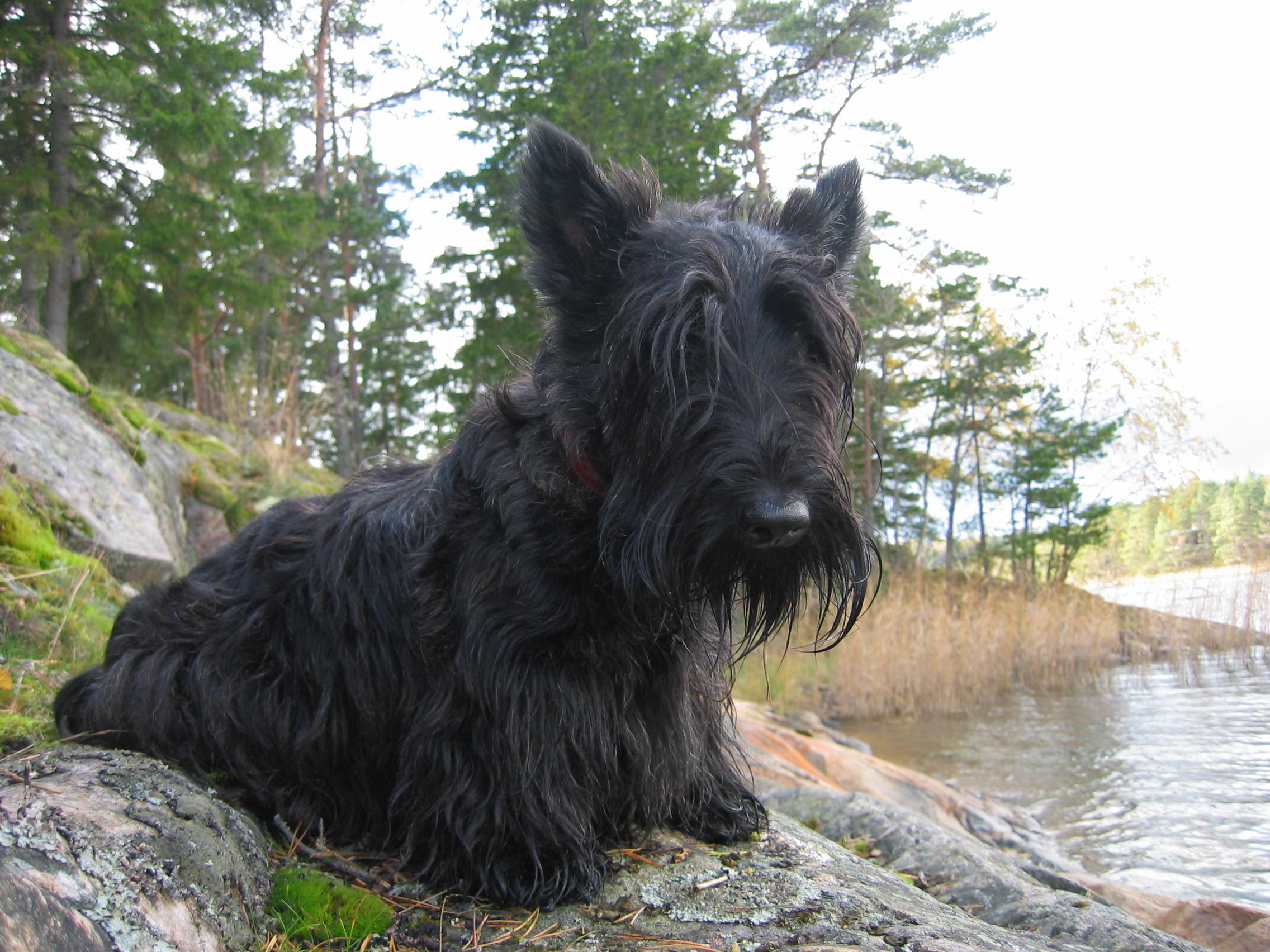
A black Scottish Terrier resting alertly on lakeside rock showing its harsh coat. narujen, Wikimedia Commons[7]

Recommended Health Screenings and Household Fit
Scottish Terriers have an average life expectancy of around 12 years.[1] Under the Scottish Terrier Club of America (STCA) CHIC requirements effective January 2025, three breeding screenings are mandatory: a DNA test for Von Willebrand Disease Type III (Scottish Terrier Type), an OFA Patellar Luxation veterinary evaluation, and a DNA test for Craniomandibular Osteopathy (CMO).[1][4] Breeders must also complete at least one elective test from five options: Autoimmune Thyroiditis evaluation, ACVO eye examination, OFA radiographic evaluation for Legg-Calvé-Perthes disease, OFA serum bile acids evaluation, or OFA kidney UP/UC ratio screening.[4] Before choosing a puppy, ask the breeder for parents' CHIC numbers and an open discussion of health history in their lines.[1][4] Overall, the Scottie suits apartment or small-home households that appreciate a dignified, spirited companion, enjoy brief creative training sessions, and commit to regular coat grooming—while homes with resident cats, multiple assertive dogs, or expectations of an instantly eager-to-please extrovert should weigh the breed's independent nature carefully.[1][2]
References
- American Kennel Club. Scottish Terrier Dog Breed Information.
- The Royal Kennel Club. Scottish Terrier Breed Information.
- Fédération Cynologique Internationale. FCI-Standard N° 73: Scottish Terrier.
- Scottish Terrier Club of America. Health Statement and CHIC Requirements.
- Pleple2000. File:Terier szkocki pszenica 980.jpg, Wikimedia Commons.
- Walescot. File:3scottish terriers.jpg, Wikimedia Commons.
- narujen. File:Black Scottish Terrier.jpg, Wikimedia Commons.