Most people first notice the Common Hill Myna (Gracula religiosa) through a short clip of a glossy black bird greeting someone in an uncannily clear human voice. Among starlings and songbirds, few species match its vocal precision in captivity. Yet bringing one home is nothing like keeping a seed-eating cage bird. Heavy trapping driven by that vocal fame triggered strict national and international trade regulations, its fruit-heavy softbill diet creates demanding daily sanitation, and its physiology leaves it dangerously vulnerable to fatal iron storage disease. Understanding why this bird is ill-suited to casual ownership starts with how it lives in the wild.
An Arboreal Canopy Starling of Humid Asian Forests
Native to eastern and northeastern India, southern China, Indochina, Thailand, Malaysia, the Greater Sundas of Indonesia, and Palawan in the Philippines, Gracula religiosa has also established introduced populations in places such as Puerto Rico, Hong Kong, Florida, Hawaii, and Japan. It favors high-rainfall, humid habitats from sea level up to 300 to 2,000 meters, inhabiting evergreen, semi-evergreen, and wet deciduous forests as well as forest edges, clearings, and shaded plantations. Averaging 27 to 30 centimeters long, the bird wears iridescent black plumage glossed with purple on the crown, nape, and breast and greenish turquoise along the back and tail. Bright yellow fleshy wattles wrap from beneath the eye to the middle of the nape, paired with a sturdy red-orange bill tipped in yellow and crisp white patches across the primary wing feathers.

Figure: A Common Hill Myna displaying glossy black plumage, bright yellow nape wattles, an orange-yellow bill, and white wing patches. Shiv's fotografia, Wikimedia Commons

Unlike ground-walking starlings, the Common Hill Myna is almost entirely arboreal, perching high on exposed dead branches and hopping sideways along limbs. Pairs are monogamous and remain distinct even when gathering into large non-breeding flocks. During the main breeding season around April through July, both parents line a tree cavity at the forest edge with twigs, leaves, and feathers, raise roughly two spotted blue eggs per clutch, fledge young in about a month, and often raise two to three broods a year. Ecologically it functions as an arboreal frugivore, feeding heavily on figs, berries, and tree seeds alongside nectar, canopy insects, winged termites caught on the wing, and occasional small lizards—playing a meaningful role in forest pollination and seed dispersal.

Figure: In the wild, this arboreal starling favors exposed high dead branches above the forest canopy. Micluna, Wikimedia Commons

How Vocal Mimicry Drove Trade Pressure and Legal Controls
In the wild, field research has shown that hill mynas direct their vocal learning mainly toward imitating conspecific calls within their social group rather than mimicking other species. In captivity, especially when nestlings are hand-reared around people, that same vocal flexibility locks onto human speech, whistles, and household noises with startling clarity. That reputation made Gracula religiosa one of the most sought-after cage birds in Asia and beyond, fueling organized nest harvesting for decades.
Although the 2024 IUCN Red List assessment by BirdLife International still classifies Gracula religiosa globally as Least Concern across its roughly 12.5 million square kilometer range, the population trend is decreasing. Tree cover across its mapped range dropped by an estimated 14 percent over three generations, and heavy capture for both domestic and international pet markets—with more than 170,000 wild-caught birds recorded as exported between 1994 and 2003 alone—has caused steep regional declines in China, Indonesia, Peninsular Malaysia, Thailand, the Philippines, and parts of India and Laos. International trade controls tightened accordingly: after Thailand requested its listing on CITES Appendix III in 1992, the species was elevated to CITES Appendix II in 1997.
National laws add an even sharper legal boundary. Under China's current List of Key Protected Wild Animals (2021 Adjustment, Announcement No. 3 of the National Forestry and Grassland Administration and the Ministry of Agriculture and Rural Affairs, effective February 1, 2021), Gracula religiosa is designated a National Class II Key Protected Wild Animal. Capturing wild birds, or breeding, trading, purchasing, or keeping individuals without lawful permits and documented legal provenance violates wildlife protection law. Prospective keepers in any country must verify current national and local wildlife regulations with the relevant authorities rather than assuming availability in a market or online video implies legality.
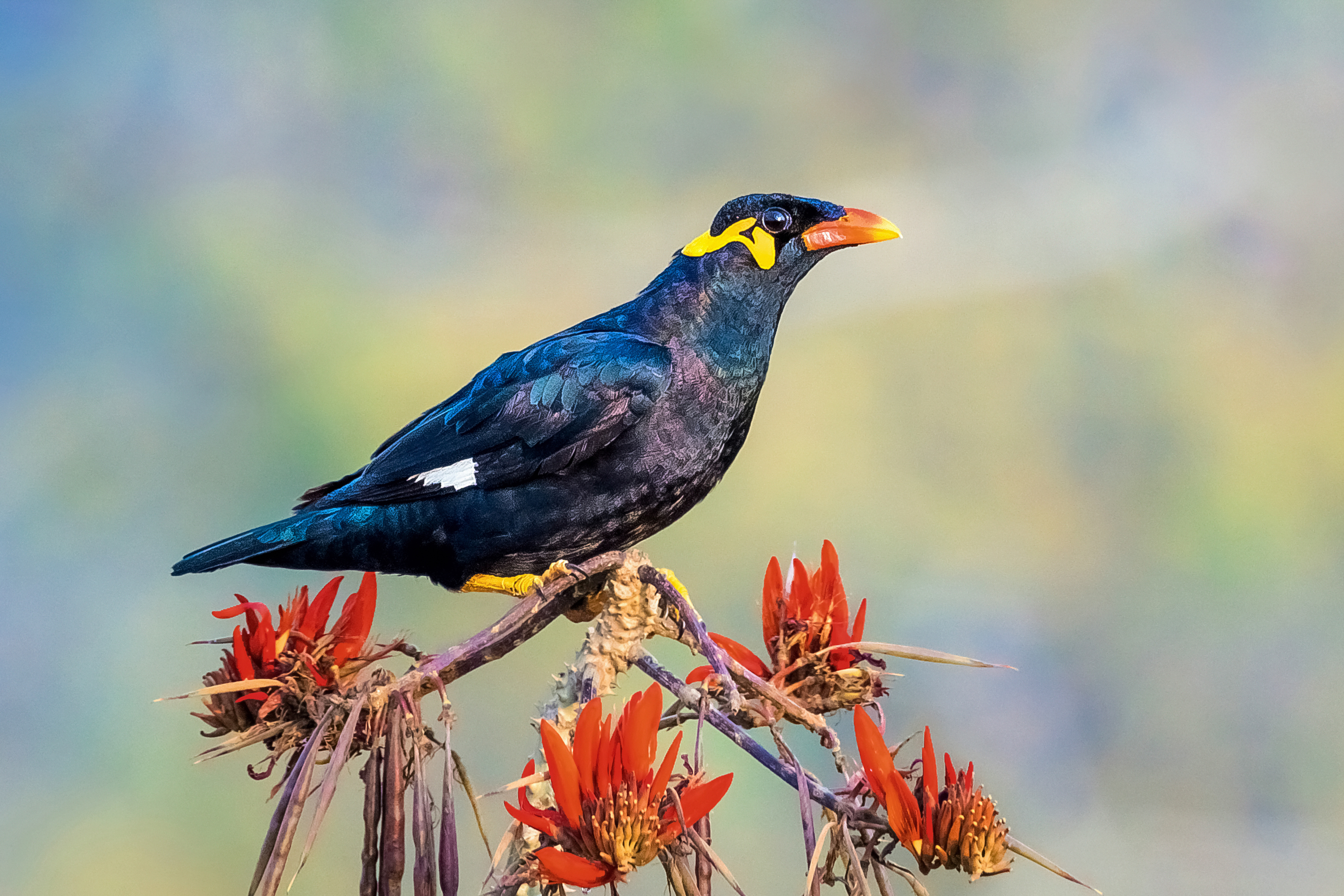
Figure: Wild hill mynas forage on fruit and nectar along humid forest edges where trapping and habitat loss have reduced local numbers. Nafis Ameen, Wikimedia Commons

Softbill Diets and Fatal Iron Storage Disease
Even where keeping a captive-bred bird is lawful, softbill husbandry is far messier and less forgiving than feeding a seed-eating parrot or finch. Hill mynas eat high-moisture soft pellets and diced fruit quickly and pass frequent, watery, fruit-stained droppings, meaning enclosure trays, perches, and nearby walls need daily washing. Feeding convenient household substitutes such as ordinary pet food, meat scraps, or iron-fortified human foods creates a major medical hazard: iron storage disease, termed hemochromatosis once tissue pathology develops.
According to the Merck Veterinary Manual and comparative pathology studies catalogued in OMIA, Gracula religiosa—like toucans and birds of paradise—over-expresses intestinal iron transporters and absorbs dietary iron too efficiently, resembling human hereditary hemochromatosis. Excess iron accumulates in the liver, spleen, and heart, damaging hepatic lysosomes and triggering oxidative injury, with genetics and stress acting as additional contributors. Merck veterinary guidelines recommend keeping total dietary iron below 50 to 100 ppm using dedicated low-iron commercial softbill formulas paired with low-iron fruits such as peaches, plums, honeydew melon, and peeled apples (with bananas, mangoes, and papaya in moderation). Citrus fruits and other high-vitamin-C foods must be avoided because vitamin C markedly increases intestinal iron absorption, along with iron-enriched baby foods, animal products, primate biscuits, and excess vitamin A.
What makes iron storage disease especially dangerous is how silently it progresses. Affected birds often hide subtle discomfort until organ damage is advanced or die suddenly without clear warning. Recognized clinical signs include anorexia, weight loss, lethargy, a fluid-distended abdomen (ascites), labored breathing (dyspnea), green-stained urates (biliverdinuria), and circulatory failure. Definitive diagnosis requires avian veterinary evaluation—ultimately via liver biopsy—and management involves periodic phlebotomy, iron-chelating medications, and strict diet revision under veterinary supervision. Any myna showing labored breathing, abdominal swelling, or persistent appetite loss needs urgent avian veterinary assessment.
Husbandry Standards and Clear Boundaries Against Keeping One
Meeting the welfare and legal needs of a Common Hill Myna requires a rare combination of conditions. First comes verified legal compliance: lawful local ownership rules, documented captive-bred provenance, and any required wildlife permits—never wild-caught birds. Second is space and daily labor: a large horizontal flight cage or secure aviary that accommodates an active canopy hopper, varied natural perches, daily bathing water, splash-resistant washable surfaces, dependable access to verified low-iron softbill pellets and fresh low-iron produce, and an avian veterinarian familiar with softbill metabolic diseases.
By contrast, this species is a poor match for anyone living under wildlife protection bans without permits, apartment dwellers sensitive to loud piercing whistles and calls, households without time for daily wet cleanup and strict low-iron meal prep, or beginners looking for an easy, novelty talking pet. Nor should an unwanted captive bird ever be released outdoors, where it risks poor survival or ecological disruption as an introduced species. For most people, appreciating Gracula religiosa through accredited zoos, documentaries, or wild forest observation is the most responsible choice.
References
- Animal Diversity Web: Gracula religiosa (hill myna)
- BirdLife International (2024), IUCN Red List Assessment: Gracula religiosa
- Merck Veterinary Manual: Nutritional Diseases of Pet Birds
- Merck Veterinary Manual (Bird Owners): Nutritional Disorders of Pet Birds
- List of Key Protected Wild Animals in China (2021 Adjustment, NFGA & MARA Announcement No. 3)
- OMIA 000428-116992: Haemochromatosis in Gracula religiosa