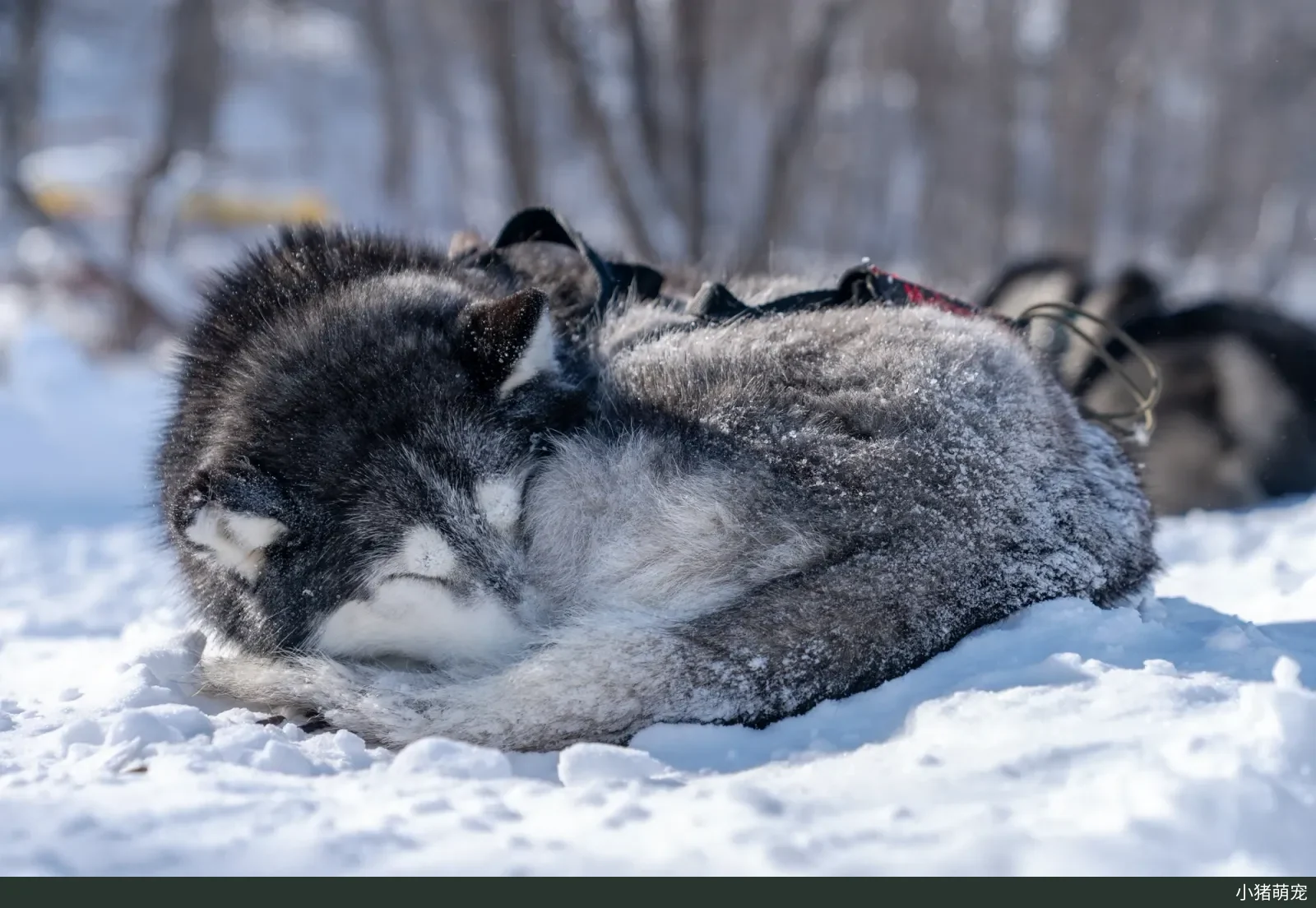
A Siberian Husky curled up resting in the snow, photographed February 2019 at Birches on the Lake, Long Lake, Minnesota, USA. Photo: Lorie Shaull; source: Wikimedia Commons; license: CC BY 2.0.
The Siberian Husky (often just “Husky”) is a medium-sized working dog first developed by the Chukchi people of northeastern Asia to pull light sleds in packs over long distances. They are friendly, outgoing, and energetic—but not watchdogs—and they carry a strong drive to run and to hunt. Drawing on kennel-club standards and veterinary sources, this article covers where they come from, what they look like, and what companionship they need.
Origins and history
The Siberian Husky’s homeland is the far northeast of Asia. Per the Siberian Husky Club of America (SHCA, the AKC parent club), the breed was first developed by the Chukchi as an endurance sled dog: covering long miles with light loads in cold weather on as little food as possible. The Chukchi prized these dogs, housed them with the family, and encouraged children to play with them. SHCA suggests that may be one reason for today’s gentle, friendly temperament.
Their arrival in North America is relatively recent. Per SHCA’s brief breed history, in autumn 1908 Russian fur trader William Goosak brought a team of Siberian dogs to Nome, Alaska, for the 1909 All Alaska Sweepstakes—408 miles. At only 40 to 52 pounds, far smaller than their rivals, they were mocked as “Siberian rats,” yet finished third. The next year, young Scot Fox Maule Ramsay imported about 60 dogs from Siberia; the team driven by John “Iron Man” Johnson won in 74 hours, 14 minutes, 37 seconds—still the race’s best time.
What made them household names was the 1925 “Serum Run.” In January that year diphtheria broke out in Nome; the nearest serum was more than 600 miles away, so sled teams relayed it. Leonhard Seppala and lead dog Togo crossed Norton Sound in a blizzard on a hard stretch; Gunnar Kaasen’s team, led by Balto, ran the final leg. The Balto statue in New York’s Central Park honors all the sled dogs in that relay. Seppala later toured and raced in the contiguous United States, and New England fanciers obtained foundation stock. SHCA notes that every registered Siberian Husky today traces to the kennels of Seppala with Elizabeth Ricker, or to Harry Wheeler’s kennel.
AKC formally recognized the breed in April 1930; SHCA was founded in 1938 and AKC-recognized in 1946. One detail is telling: the FCI standard lists the country of origin as the United States. That does not contradict the history above—ancestors came from Siberia, but the first breed standard appeared in the AKC Gazette in 1932, and the modern breed’s foundation kennels were in North America.
Appearance and temperament
The standard Siberian Husky is a medium, light-footed working dog: neither as heavy as a freight dog nor as fine as a sprinter—the point is endurance. The AKC standard (approved February 2021, effective May) sets males at 21–23.5 inches and 45–60 pounds, females at 20–22 inches and 35–50 pounds; the FCI standard (published November 2022) gives metric ranges of 53.5–60 cm and 20.5–28 kg for males, 50.5–56 cm and 15.5–23 kg for females. These are limits; weight should match height, and excess height disqualifies.
They are easy to recognize: a medium-length double coat with a soft, dense undercoat; erect triangular ears; a fox-brush tail that, when alert, curves sickle-fashion over the back. Eyes are almond-shaped and may be brown or blue; different-colored eyes, or two colors in one eye, are all accepted. Colors from black, gray, agouti, and sable to red and white are allowed, with or without white markings; only merle and brindle are disqualified. The standard also notes that a shed undercoat in coat-blow season is normal; other than whiskers and hair between the toes and around the feet, the coat should not be trimmed.
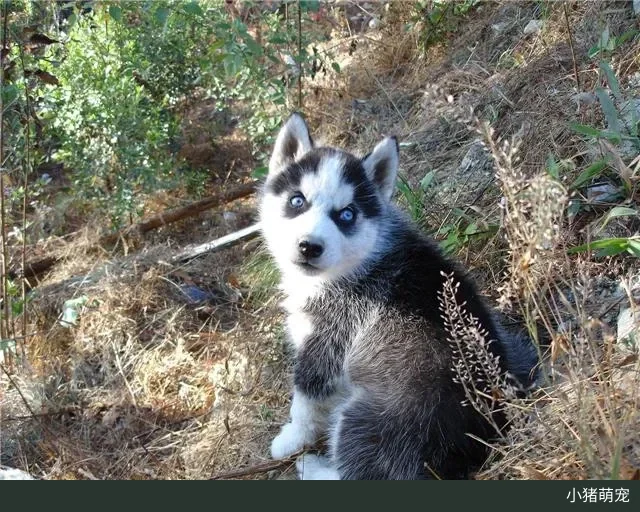
Blue eyes are a well-known Siberian Husky trait, but the breed standard equally accepts brown eyes, heterochromia, and parti-colored eyes. Author: Chrishonduras; source: Wikimedia Commons; license: CC BY-SA 3.0.
On temperament, AKC and FCI use the same description: friendly and gentle, yet alert and outgoing; without the possessiveness of a guard dog, not overly suspicious of strangers, and not aggressive toward other dogs; with maturity comes a measure of dignity and reserve. SHCA is blunter: they greet guests warmly and are not watchdog material; they are intelligent, but an independent streak “will sometimes tax your ingenuity.” Another side must be known up front—SHCA warns that prey drive is strong; squirrels, rabbits, birds, guinea pigs, hamsters, and cats may all look like prey. Households with small animals should think carefully.
Exercise and training needs
If you remember one thing: this is a dog born to run. The Royal Kennel Club (formerly The Kennel Club) lists exercise need as “more than 2 hours a day” and grooming as “more than once a week.”
SHCA offers a vivid contrast: many dogs put in the front yard in the morning will sit there all day; a Siberian Husky will not. Breeding gave it the urge to run, and its build makes running effortless—but one dash across a busy road can be its last. So SHCA strongly advises never allowing free, uncontrolled roaming; keep the dog fenced or under control. Adequate exercise can mean leashed walks, a large secure yard, or—ideally—harness work pulling a cart or sled. SHCA is blunt: if you find that kind of containment inconvenient or cruel, this is not your breed.
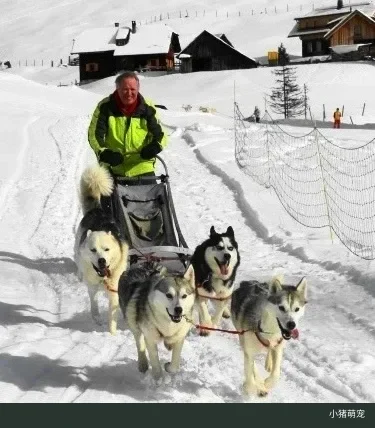
Siberian Huskies in the Siberian Husky Longtrail, at Feldpannalpe, Feld am See, Carinthia, Austria. Author: Naturpuur; source: Wikimedia Commons; license: CC BY 4.0.
On training, SHCA public-education chair Deb Kreider told AKC that owners must teach the dog not to bolt when the leash comes off—that takes training and consistency; the breed likes positive feedback and interacting with you, “or they will find something more fun to do.” She recommends AKC companion events such as Rally, Fast CAT, and Canine Good Citizen to burn energy and build partnership.
Day-to-day care has two more “surprises.” Digging: SHCA admits many Siberians love to dig; you can redirect, manage, or—if possible—set aside a digging spot. Coat blows: they shed heavily at least once a year; with a brush and a big basket you finally see how dense that coat is. On the bright side, SHCA describes them as naturally clean, odor-free, and “easy keepers” that, for their size, do not eat a great deal.
Common health issues
Eyes need the closest watch. SHCA lists three hereditary eye diseases of greatest concern: hereditary (juvenile) cataracts, corneal dystrophy, and progressive retinal atrophy (PRA)—any eye color can be affected. Juvenile cataracts can appear as early as three months, ranging from reduced vision to blindness; corneal dystrophy is more common in young adults and usually affects vision little; PRA in this breed is X-linked (XLPRA), more severe in males, with night vision lost first and eventual blindness. SHCA cites 1999 American College of Veterinary Ophthalmologists (ACVO) figures: among 1,345 examined Siberians, about 8% had hereditary cataracts, 3% corneal dystrophy, and under 1% PRA. That is more than twenty years old and from examined dogs only—useful as background, not today’s prevalence.
Hip dysplasia and two neurological genetic diseases are also on the screening list. SHCA’s health statement, adopted September 2024, requires breeding stock: annual exams by an ACVO-boarded veterinary ophthalmologist after 12 months of age; hip evaluation via OFA, OVC, PennHIP, or equivalent; and University of Minnesota Canine Genetics Lab testing for SPS1 (Siberian Husky shaking puppy syndrome type 1) and SHPN1 (Siberian Husky polyneuropathy type 1). Notably, SHCA does not call for discarding all carriers—to protect genetic diversity—but recommends pairing carriers only with clear dogs.
On skin, the Merck Veterinary Manual notes that Arctic breeds such as Siberian and Alaskan Huskies may develop zinc-responsive dermatosis: tightly adherent fine scale, crusts, and redness on the face, especially around the eyes and mouth, possibly from higher individual zinc need or dietary deficiency. See a veterinarian first; whether and how much to supplement is a veterinary decision.
Buyers should, per SHCA, review eye-exam reports for both parents; per the health statement, ask also about hip evaluation and genetic test results.
References
-
American Kennel Club. Official Standard of the Siberian Husky, approved 9 February 2021, effective 12 May 2021.
-
Fédération Cynologique Internationale. FCI-Standard N° 270 Siberian Husky, published 14 November 2022.
-
American Kennel Club. Siberian Husky Dog Breed Information (publication date not stated).
-
Elaine Waldorf Gewirtz. Siberian Husky History: From Arctic Protector to Active Companion. American Kennel Club, 24 June 2025.
-
Siberian Husky Club of America. The Siberian Husky (publication date not stated).
-
Robert H. Thomas (revised). The Siberian Husky a Brief History. Siberian Husky Club of America, revised 1998.
-
Siberian Husky Club of America. Genetic Defects of the Eye (publication date not stated).
-
Siberian Husky Club of America. SHCA Health Statement, adopted 10 September 2024.
-
The Royal Kennel Club. Siberian Husky | Breeds A to Z (publication date not stated).
-
Jason B. Pieper. Miscellaneous Systemic Dermatoses in Animals. Merck Veterinary Manual, updated September 2024.