The Affenpinscher’s ancestors hunted rats in German stables in the 17th century. In time, people brought the dogs into their kitchens, where they continued to catch rodents and kept their owners company. Today the American Kennel Club (AKC) places the Affenpinscher in its Toy Group. The breed owes its name to its monkey-like face, but its old job explains something you might see at home. A dog curled up on your lap may give a small animal its full attention the moment it scurries past. [1]
To recognize an Affenpinscher, start with its outline when standing. The breed standard gives an ideal height of 9½ to 11½ inches (about 24 to 29 centimeters), measured from the ground to the highest point of the shoulders. The distance from the point of the shoulder to the buttocks is about the same as the dog’s height. A short, level back and sturdy legs give it a nearly square profile. Look next at the face. Beneath dark, round eyes sits a short, blunt muzzle, about as long as the distance between the eyes. The eyebrows stand out from the face, and a beard frames the mouth, lending the dog its rather earnest expression. [2]
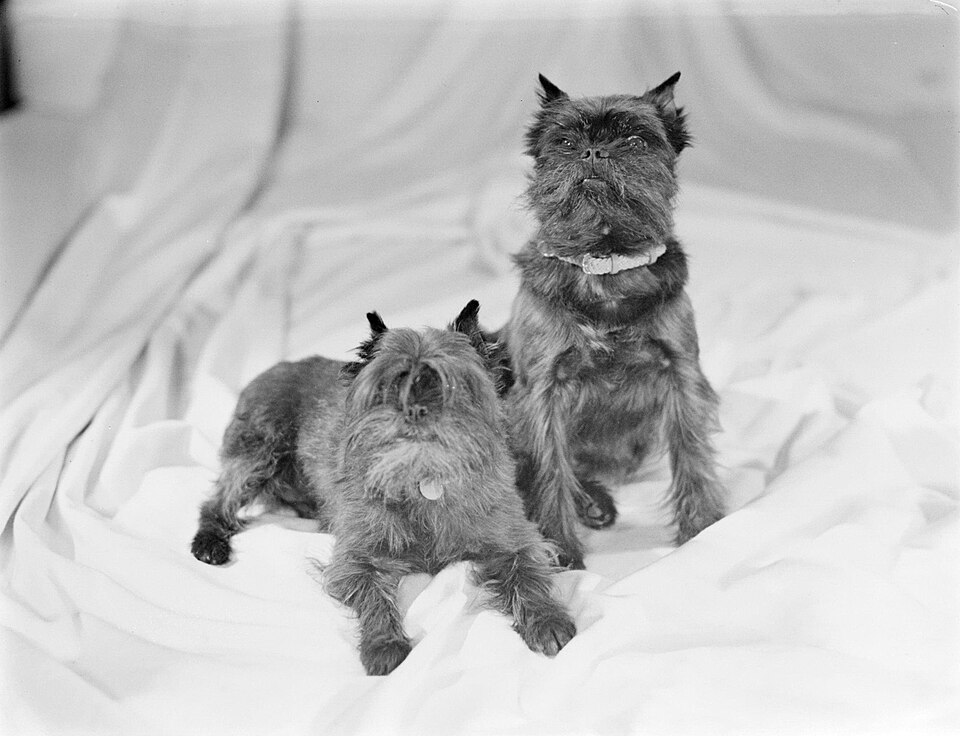
图:Two Affenpinschers in 1932. Willem van de Poll, Wikimedia Commons[4]

What does a day in an apartment look like?
A living room gives an Affenpinscher space to play. It also needs to get outdoors every day. The AKC describes the breed as moderately active and recommends one or two brisk walks a day. Think of your busiest working day. Who has time for a walk in the morning? Who can take the dog out in the evening? Even a large living room does little to help if every outing depends on someone finding a spare moment. A small apartment can suit the dog well if there’s a good walking route nearby and someone can make those outings part of the day. [1]
A walk can include a brisk stretch and a pause to watch people go by. Affenpinschers are curious and bold. Yours may decide to greet a much larger dog coming the other way. Leave space early enough for your dog to watch from a distance where it can still respond when you call, then walk on together. Back home, clear a little floor space and join in a game with a toy. Give the dog a chance to play with the toy on its own, too. Walks offer a chance to see other people and dogs, and a favorite toy gives it something to do indoors. [1][2]
That short muzzle matters when planning a walk. Dogs cool themselves by panting, and an Affenpinscher that overheats in hot weather can have trouble bringing its temperature down. In summer, go out during the cooler part of the day and choose a route where you can turn back early. Keep fresh water available at home. If the dog is visibly struggling to breathe on a walk, stop immediately, move it somewhere cool and contact a veterinarian right away. [1]
Practice at the front door
Affenpinschers often enjoy working with someone they know, and they have minds of their own. Repeat the same exercise for too long and something else may catch the dog’s interest. An ordinary trip outside makes a good opportunity to practice. With the door still closed, say your dog’s name. Reward it when it turns to look at you, then open the door. Try that same small exercise the next time you go out. Once the dog responds in a quiet hallway, practice outside somewhere with few distractions. Work on one action at a time and finish while the dog is still interested. That gives it practice throughout the week without saving a long session for the weekend. [1]
If you have young children, think about how they usually show a dog affection. Affenpinschers often dislike being hugged tightly, squeezed or chased, which is why the AKC urges families with young children to consider the fit carefully. An adult can sit with a child and show them how to offer a toy, giving the dog room to decide whether to come closer. When the dog walks away, the game is over. A child may be big enough to pick up this little dog and still be too young to let it leave. If the child tends to give chase and an adult can’t be there to supervise, it will be hard to keep play comfortable for both. [1]
If you already keep a hamster or gerbil, think through the times it spends outside its cage. A small animal darting across the floor can set a former ratter off in pursuit. A separate room with a door that closes is more dependable than counting on someone to call the dog back in time. Before bringing an Affenpinscher home, picture feeding the smaller pet, cleaning its cage and letting it out for exercise. Can someone settle the dog in another room before the cage door opens? [1]
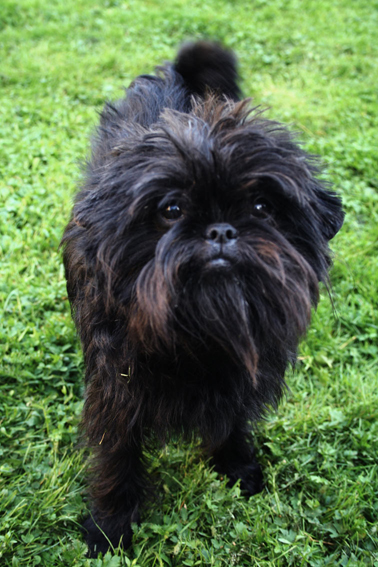
图:The Affenpinscher’s eyebrows and beard. Ingunn Axelsen, Wikimedia Commons[5]

How do you groom that shaggy face?
An Affenpinscher’s coat naturally varies in length. The hair across the shoulders and back is dense and wiry. It grows longer on the head, chest and legs, and the eyebrows and beard still stand out from the face after grooming. The AKC recommends grooming twice a week. Work through the coat with a brush first, then go over it section by section with a metal comb. When the teeth catch on a tangle, stop and gently tease the hairs apart with your fingers until the comb passes through. It’s easy to miss the longer hair under the chin and on the legs if you only run the brush over the dog’s back. [1][2]
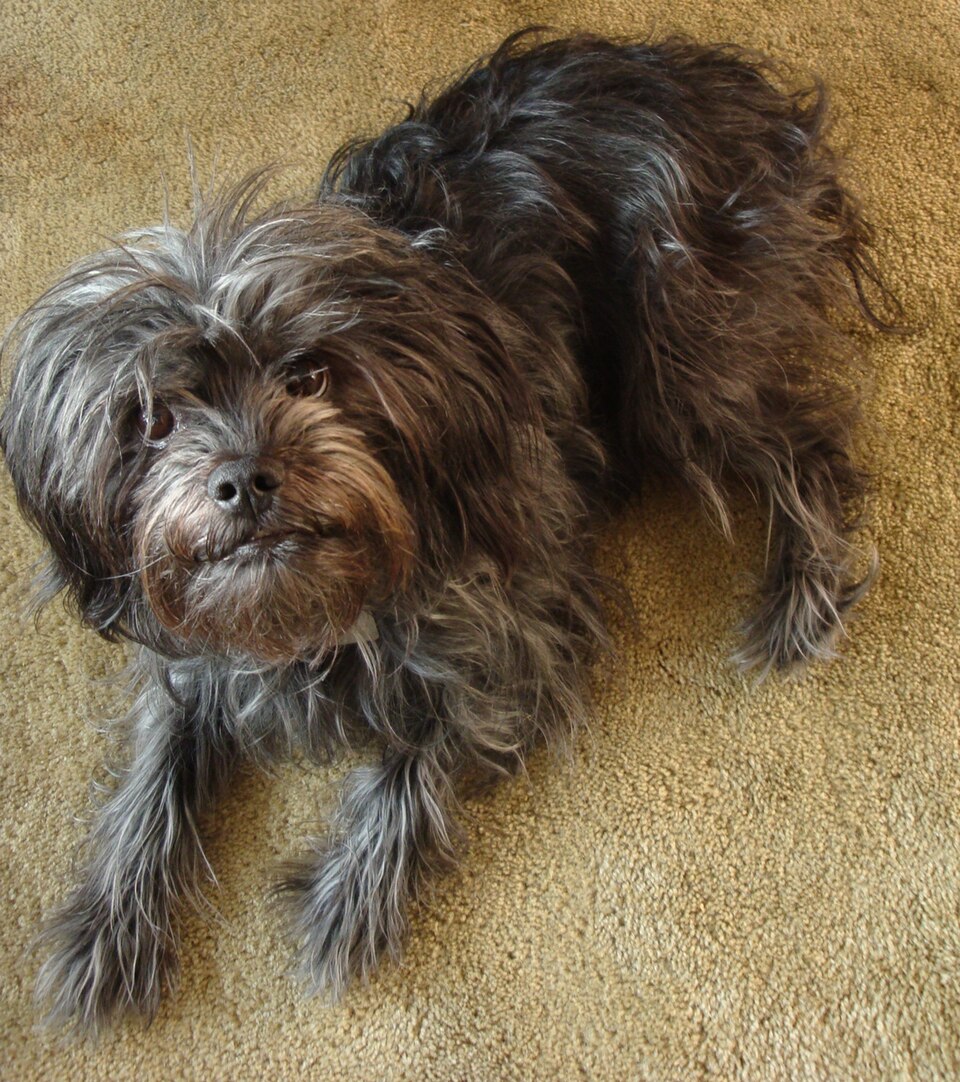
图:Long hair on Molly’s face and forelegs. Dean Jarvey, Wikimedia Commons[6]

Once you’ve combed the face, look at your dog from the front. Can you see both eyes? The hair on top of an Affenpinscher’s head is usually combed forward, with an inverted V left open in front of the eyes. The hair on the bridge of the nose is shaped to fan out to either side. At the first grooming appointment, ask the groomer to show you which hairs give the brows and beard their shape and which are starting to block the dog’s view. The coat grows slowly, so a family dog may only need an overall trim every few months. Between trims, keep up with combing, toothbrushing and regular nail care. [1]
Ask about each parent’s health checks
If you’re considering a puppy, ask the breeder to show you the kneecap evaluation and eye examination results for each parent. The kneecap, or patella, is the small bone at the front of the knee. In this breed, one concern is whether it slips out of place. The Affenpinscher Club of America identifies the knees and eyes as priorities for screening breeding dogs. Its health statement also notes that some breeders have their dogs’ hips or hearts evaluated. Asking which checks each parent had and what the results showed gives you more information than a general assurance that both dogs are healthy. [1][3]
Once your dog is home, get to know its usual stride, how it follows a toy with its eyes and how easily it manages a familiar walk. If it starts limping, seems to have trouble seeing or tires sooner than usual, you’ll have a specific change to describe to your veterinarian. [1] An Affenpinscher takes up little room, but its week calls for hands-on care. A household that can shift a walk to a cooler hour, let the dog leave a game in peace and sit down to work a small tangle out of its beard has room for it in the ways that count.
References
-
[1] American Kennel Club. Affenpinscher Dog Breed Information.
-
[2] American Kennel Club. Official Standard of the Affenpinscher. Effective July 27, 2000.
-
[3] Affenpinscher Club of America. Health statement on breeding dogs. Adopted by the club’s board on May 12, 2015.