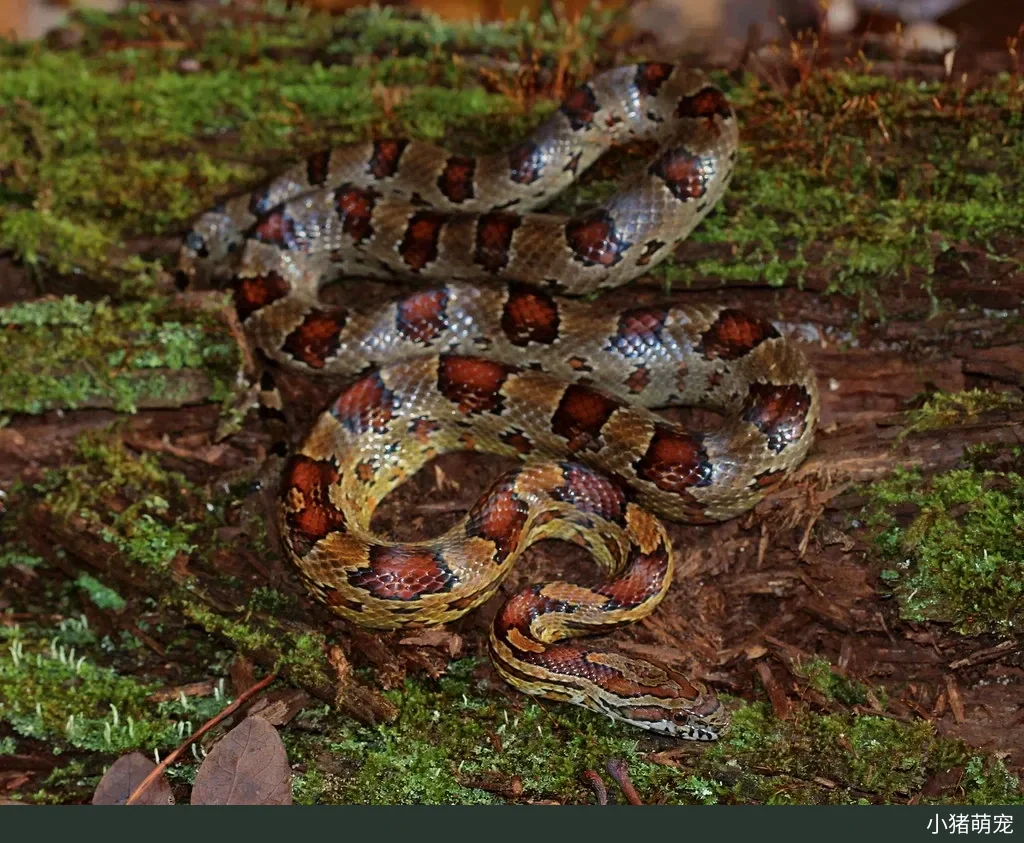
A subadult corn snake coiled on mossy rotting wood, with clear black-edged red-brown blotches on the back; per the photographer, this was a wild individual encountered on a forest road in Anderson County, Tennessee, USA. Photo: Peter Paplanus (2ndPeter); source: Flickr; license: CC BY 2.0.
The corn snake (Pantherophis guttatus) is native to the southeastern United States. It is non-venomous and generally mild-tempered; veterinary sources often list it as an entry-level pet snake. In the home it may live a decade or more than twenty years, and it needs an escape-proof enclosure, a warm–cool temperature gradient, and thawed whole-rodent prey. On the IUCN Red List it is Least Concern and it is not on the current CITES Appendices; in China it is a non-native species, and releasing or discarding it without approval can bring legal penalties.
Range and wild habits
The corn snake is a non-venomous colubrid that subdues prey by constriction. Per the University of Georgia Savannah River Ecology Laboratory (SREL), it ranges across the southeastern U.S.: from southern New Jersey through the Carolinas south to the Florida Keys and west to eastern Louisiana. It is common in open pine woods, abandoned fields, hardwood hammocks, and farmland edges, and often near barns and sheds where mice are plentiful. Wild adults are usually 0.9–1.2 m total length; a few exceed 1.5 m. Body color runs from orange to red-brown, with a row of black-edged blotches on the back and a spear-shaped mark on the head; the belly is a black-and-white checkerboard often likened to colorful Indian corn—the usual explanation for the common name.
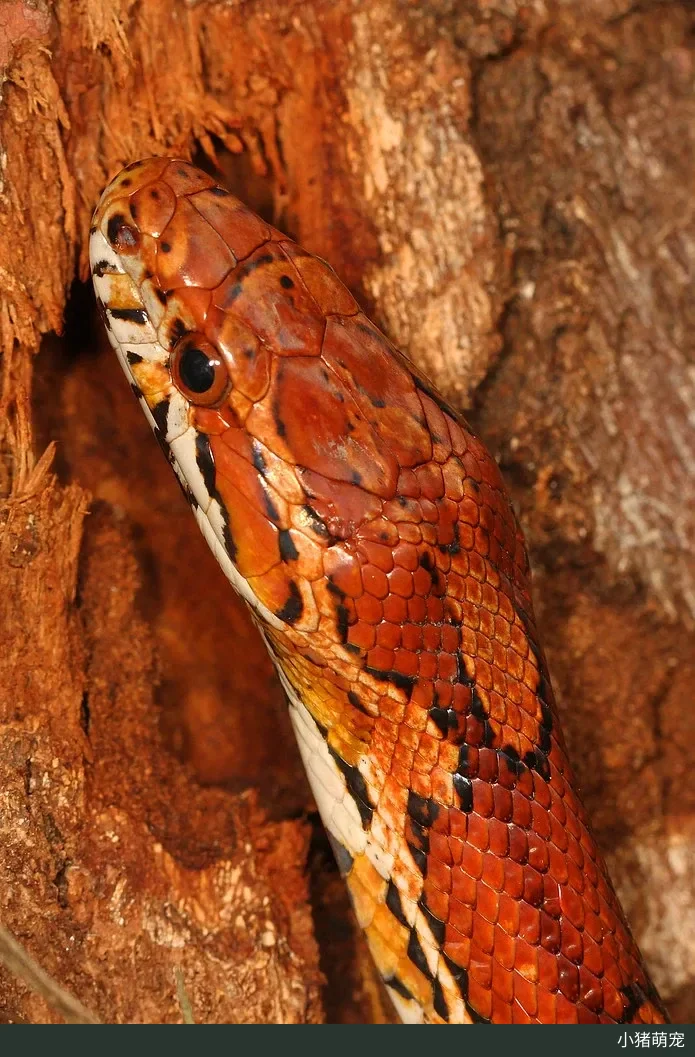
A wild corn snake emerging from a gap in rotting wood; orange-red scales, fine black head stripes, and a white lower jaw are clear. Photographed May 2014 on Sapelo Island, Georgia, USA. Photo: Judy Gallagher; source: Flickr; license: CC BY 2.0.
SREL materials note that corn snakes are mainly crepuscular and lean more nocturnal in midsummer; by day they hide under logs, bark, debris, or in burrows. They climb, but are more terrestrial than the closely related eastern ratsnake. Diet shifts with age: juveniles mainly eat frogs, lizards, and other ectotherms; adults turn to rodents, birds, and bird eggs. Breeding is in spring; females lay eggs in early summer in rotten wood, burrows, and similar cover, averaging 10–20 eggs per clutch, hatching in about 60 days. Hatchlings are 20–30 cm long and reach sexual maturity in 2–3 years. Knowing these wild habits helps explain why captives need hides, climb branches, and a warm–cool gradient.
Housing and diet
Start with the enclosure and temperature–humidity. Corn snakes are slender and curious; PetMD’s veterinary care guide calls them escape artists—the tank must be ventilated and fitted with a secure, lockable lid. The guide suggests at least a 10-gallon (about 38 L) enclosure for juveniles and 40 gallons (about 150 L) or larger for adults, housed singly, not mixed with other snakes or animals. Snakes are ectotherms, so the enclosure needs a temperature gradient: PetMD suggests a warm end around 29°C (85°F) and a cool end about 21–23°C; VCA Animal Hospitals cites husbandry temperatures of 25–30°C. Keep everyday humidity about 40%–60%, rising to around 70% during shed; place a thermometer at each end plus a hygrometer. Heat pads must use a thermostat to avoid burns. Substrate options include paper, reptile carpet, coconut fiber, or aspen shavings—avoid pine and cedar; put a hide at each end and add a few climb branches. PetMD also suggests 8–12 hours of UVA/UVB lighting daily, with white light off at night so the snake can rest.
Diet next. Captive corn snakes eat mainly whole rodents; VCA notes that whole prey is nutritionally balanced and usually needs no extra vitamins. Veterinary sources consistently advise frozen-thawed dead rodents, not live ones: live rodents can bite and cause serious infection, and the prey animal suffers. Prey width should be about the same as the snake’s mid-body; start hatchlings on pinkies and move to larger mice or small rats as they grow. Feeding frequency varies with age and size: VCA says juveniles often twice a week and adults every 1–2 weeks; PetMD’s schedule is similar but not identical—ask a veterinarian to adjust to body condition. Thaw food in a sealed bag in cold water then warm water; do not microwave, do not feed still-frozen prey, and do not refreeze leftovers. Use long tongs, not bare hands. Keep clean water available in a tip-resistant dish and change it daily.
Common health problems
PetMD’s list of common corn-snake problems includes incomplete sheds (retained skin or eye caps), respiratory infection, mouth infection (stomatitis), cloacal prolapse, gastrointestinal blockage or constipation, dystocia (egg binding), internal and external parasites, bite wounds from live rodents, burns from heating gear, and inclusion body disease. Many tie directly to husbandry: low humidity favors incomplete sheds; feeding on loose substrate can lead to substrate ingestion and gut blockage; unthermostated heaters can burn. VCA also notes that most snakes have only one functional lung and no diaphragm, so they cannot cough to clear mucus—a simple respiratory infection can become pneumonia. Do not pick at retained eye caps yourself; leave that to a veterinarian.
VCA advises a reptile-experienced veterinarian exam within a week of purchase, then at least yearly checkups with fecal parasite testing each time; if other snakes are already in the home, quarantine newcomers alone for a month. Seek care promptly for cloudy eyes (except brief pre-shed cloudiness), blistering, ulceration or retained skin, cloacal discharge, lumps, lethargy, sudden loss of movement in a body segment, or several missed meals outside shed. All reptiles may carry Salmonella—wash hands before and after handling the snake and enclosure items.
Conservation status, Chinese rules, and ethics
On the IUCN Red List the corn snake is Least Concern (LC). In CITES Appendices I, II, and III as published by the Secretariat and valid from 5 March 2026, only a few colubrids are listed; the corn snake is not among them. In its native U.S. range it is not on the federal endangered species list; the Florida Fish and Wildlife Conservation Commission (FWC) notes that the Lower Keys population was removed from the state list on 11 January 2017 but remains part of a state threatened-species management plan, and state rules still ban taking that population; SREL notes Georgia and South Carolina also protect corn snakes. SREL also points to habitat loss, road mortality, collection for the pet trade, and killing after mistaken identity as the venomous copperhead as pressures on wild populations.
In China the corn snake has no natural range and counts as an “alien species” under the Measures for the Administration of Invasive Alien Species. It is not currently on the Key Managed Invasive Alien Species List issued by six ministries and effective 1 January 2023 (the only reptiles on that list are the alligator snapping turtle and the red-eared slider), but that does not mean free disposal. Article 60 of the Biosafety Law provides that no unit or individual may, without approval, introduce, release, or discard alien species; Article 81 provides that unauthorized release or discard shall be ordered remedied by capture or recovery, with a fine of not less than 10,000 and not more than 50,000 yuan. Article 40 of the Wildlife Protection Law effective 1 May 2023 requires State Council wildlife-protection authority approval to introduce wildlife species from abroad; Article 59 provides fines of 10,000 to 100,000 yuan for releasing or discarding wildlife introduced from abroad. On whether personal keeping requires a permit, a 2022 Fujian forestry reply used this test: whether the species is on national key protection, CITES Appendices I and II, provincial key protection, or the “three-haves” list; for alien species that reply advised individuals not to keep them. Local practice may differ; this article did not check every provincial list—confirm with local forestry authorities before keeping one.
A few ethical notes close the piece. Keeping a corn snake is a long commitment: VCA cites 12–15 years; PetMD says well-cared animals may live more than 20. They need regular whole-rodent meals; VCA is blunt—if feeding rodents makes you uncomfortable, a snake may not be the right pet. Prefer captive-bred animals: VCA notes wild-caught snakes adapt poorly, refuse food more often, and carry more parasites, and SREL notes pet-trade collection harms wild populations. Most important: never release or discard, whatever the circumstance. In China, releasing or abandoning introduced wildlife is prohibited; it can also leave a snake suffering in unsuitable habitat and risk local ecology. If you cannot keep it, ask local forestry authorities or seek reliable rescue and rehoming channels.
References
-
Savannah River Ecology Laboratory, University of Georgia. Corn Snake (Elaphe [Pantherophis] guttata). Undated; accessed 2026-10-17.
-
Florida Fish and Wildlife Conservation Commission. Red rat snake. Undated; accessed 2026-10-17.
-
Gregory Rich, DVM; Rick Axelson, DVM. Snakes: Colubrid. VCA Animal Hospitals, accessed 2026-10-17.
-
Gregory Rich, DVM; Laurie Hess, DVM; Rick Axelson, DVM. Owning a Pet Snake. VCA Animal Hospitals, accessed 2026-10-17.
-
Gregory Rich, DVM; Laurie Hess, DVM; Rick Axelson, DVM. Snakes: Feeding. VCA Animal Hospitals, accessed 2026-10-17.
-
Maria Zayas, DVM. Corn Snake Care Sheet. PetMD, updated 2025-07-31.
-
Echternacht, S. & Hammerson, G.A. Pantherophis guttatus. The IUCN Red List of Threatened Species.
-
CITES Secretariat. Appendices I, II and III valid from 5 March 2026. 2026-03-05.
-
Standing Committee of the National People’s Congress. Biosafety Law of the People’s Republic of China. NPC website, 2020-10-17 (2024 amendment did not affect Articles 60 and 81).
-
Standing Committee of the National People’s Congress. Wildlife Protection Law of the People’s Republic of China. NPC website, 2022-12-30, effective 2023-05-01.
-
Ministry of Agriculture and Rural Affairs and five other ministries. Announcement No. 567: Key Managed Invasive Alien Species List. Effective 2023-01-01.
-
Ministry of Agriculture and Rural Affairs. Measures for the Administration of Invasive Alien Species. Effective 2022-08-01.
-
Fujian Provincial Government portal. Do I need a permit to keep corn snakes or hognose snakes?. 2022-11-30.