In seventeenth-century England, riders followed packs of hounds across fields and over hedges as the dogs tracked the scent of a red fox. The breeders who developed the English Foxhound valued the nose and stamina of stag hounds as well as the speed and agility of long-legged hounds such as the Greyhound. Both abilities still matter when you take an English Foxhound for a walk. You can see where a footpath ends at a road. With its nose to the ground, your hound may be following a trail that continues on the other side.[1]
Seen from the side, the English Foxhound has long, straight forelegs, a deep chest and a back that stays level from behind the shoulders to the loin. In the full-length photograph, the male hound’s black back stands out against his white underside. Follow the outline to see how low the chest reaches and how the legs support the body. Look next at the head. The muzzle is long and broad, and the low-set ears hang close to the cheeks. These features are a good place to start when identifying the breed. Coat color can come last.[1]
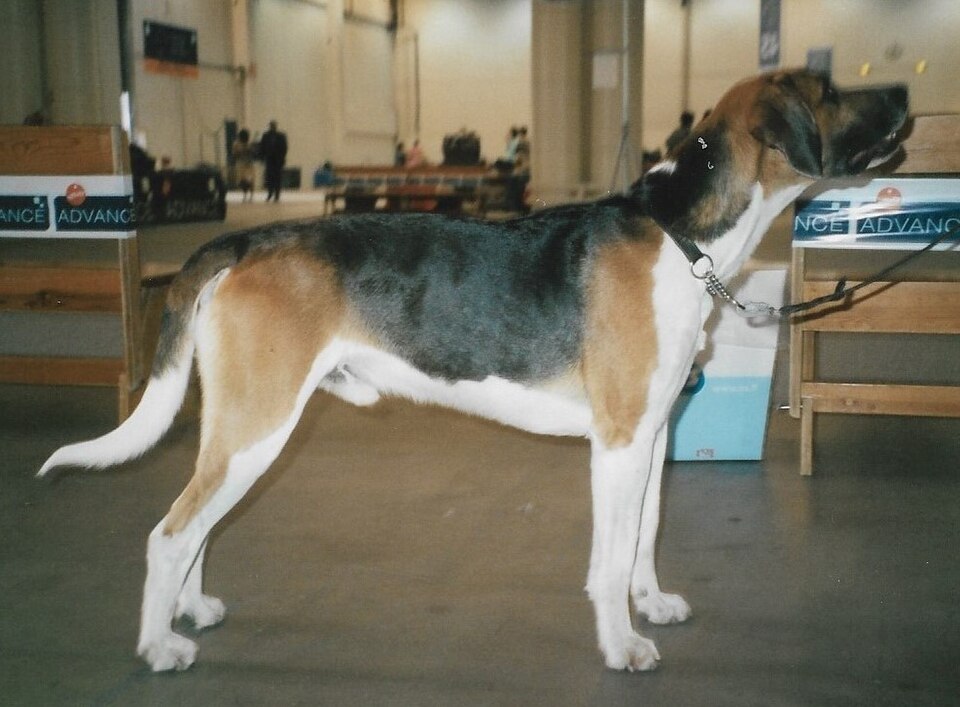
An English Foxhound stands in profile. Canarian, Wikimedia Commons[5]

Start with a route you can walk on a weekday
The American Kennel Club (AKC) recommends long, brisk daily walks for an English Foxhound and a leash anywhere outside a secure enclosure. Before bringing one home, walk out of your front door at the time you would normally take the dog on a workday. Where can you keep up a brisk pace? Which driveways will you cross? Is there a patch of grass where the dog can stop to sniff? If a lap around the parking lot is all you can fit in during the week, and the good walking trails are a weekend outing, work out how you would make time for that longer walk each day.[1]
One walk can have more than one pace. Walk briskly along the path, then slow down somewhere clear of traffic and give the hound time to explore the grass within reach of the leash. In a fenced yard, scatter a few pieces of food in the grass or hide a favorite toy for the dog to find. That gives the hound both a stretch of steady exercise and a chance to use its nose to find something. If your family enjoys hiking, a fit adult hound can join you. Choose the distance to suit the dog walking with you.[1][2]
Before unclipping the leash for a run, walk the boundary. Does the gate latch? Are there gaps beneath the fence? What lies on the far side of the hedge? The answers matter more than the size of the field. Even if you can see clear across it, an open field has nothing to stop a hound from turning to follow a scent. On unfenced ground, keep the leash clipped to a well-fitting harness. If you use a long line to give the dog more room to explore, choose a stretch well away from traffic, with space to move.[1][2]
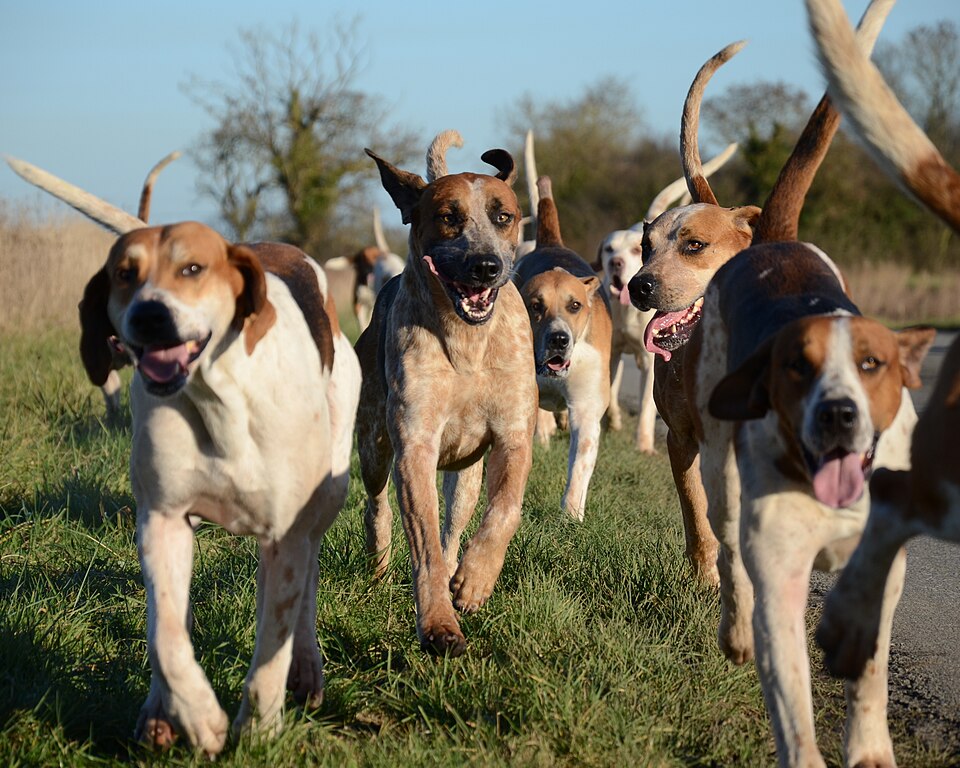
English Foxhounds head out for morning exercise. South Wold Hunt, Wikimedia Commons[6]

Practice recall before a scent draws the hound away
An English Foxhound is accustomed to working with other hounds and can decide for itself which scent to follow. Start teaching the dog to come when called at home. Agree on one short recall cue for the whole family. With the dog a few steps away, say its name. When it turns toward you, give the cue and take a step back. As soon as the dog reaches you, offer praise and a small treat it likes. Once that comes easily indoors, practice in a securely fenced yard. Gradually call from farther away, then try again with a mild distraction nearby.[1][3]
Watch for the moment it becomes hard for the dog to turn back to you. If your hound is leaning forward, eyes fixed on a small animal, and no longer responds to your call, go to the dog and guide it somewhere quieter. Next time, leave more distance between you and the distraction. Practice while the dog can still turn its head easily when you call. Give it a warm welcome even if it took a while to get back. When family members take turns walking the hound, using the same cue and rewarding the return in the same way helps the dog learn to respond to each person. On an open trail, keep the leash on.[1][2][3]
These pack hounds generally enjoy the company of people and other dogs. With enough exercise, they can be gentle companions indoors. If you already have a dog, start with a walk together, with someone handling each dog and enough room for them to walk comfortably apart. For a puppy, plan for early socialization and puppy classes. The AKC favors an active household with plenty of space and advises against a cramped city apartment for this breed. Think about a rainy day or an evening when work runs late. Who can take the hound on that long walk? Who will have time to spend with the dog afterward? Those questions still apply if you have a yard.[1][2]
Check ears and paws after a walk
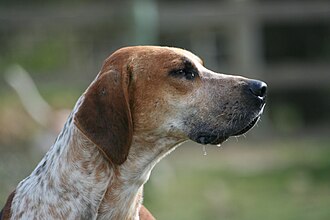
An English Foxhound’s ear hangs close to its cheek. Thowra_uk, Wikimedia Commons[7]

In the portrait, the ear flap covers the opening of the ear canal. Gently lift each flap for a regular look underneath. When cleaning is needed, use soft gauze and a canine ear cleaner recommended by your veterinarian. Check the nails, too. If walking hasn’t worn them down enough, give them a trim before their length interferes with the dog’s stride. A weekly brushing with a soft brush or hound mitt lifts loose hair and dirt from the short, dense, firm coat. Use a mild dog shampoo when a bath is needed, and brush the dog’s teeth regularly with canine toothpaste.[1]
That deep chest is also a reason for everyone in the family to know the signs of an emergency. Deep-chested dogs are at greater risk of gastric dilatation-volvulus, in which the stomach expands and twists. It can quickly become life-threatening. If your hound suddenly starts retching repeatedly without bringing anything up, call an emergency veterinarian and take the dog in immediately. Restlessness, drooling or a swollen abdomen can occur as well. Act on the retching even if the belly still looks normal. Before the hound comes home, give everyone who will walk the dog the emergency clinic’s number and directions. It’s as simple a preparation as putting the leash by the door.[1][4]
References
-
[1] American Kennel Club. English Foxhound.
-
[2] Dogs Trust. How to Stop Your Dog Chasing Cars or Animals.
-
[3] Dogs Trust. Recall Training - Come Back When Called.
-
[4] American College of Veterinary Surgeons. Gastric Dilatation-Volvulus.