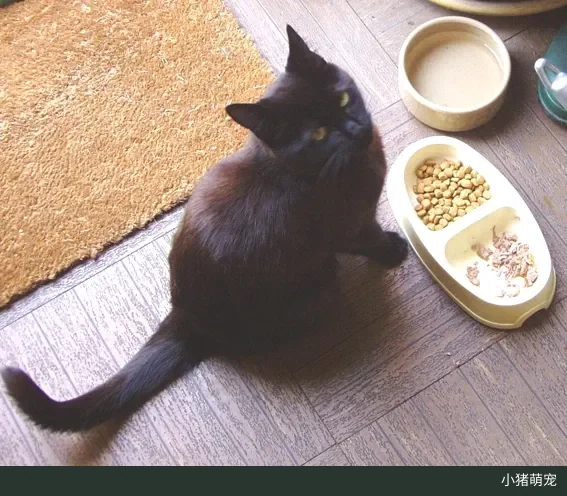
Figure: Robdav69 (English Wikipedia), from Wikimedia Commons (File:Catfood.jpg), public domain.
Food left in the bowl does not necessarily mean the cat is full. A team led by Professor Masao Miyazaki at Iwate University, published online in Physiology & Behavior on 31 March 2026, found that when 12 cats repeatedly ate the same dry food, intake fell round after round; switching to another food—or even only changing the odor—brought intake back up. Industry outlet PetfoodIndustry reported the study on 19 October 2026.
Research team and experimental design
The study was carried out by seven authors including Professor Masao Miyazaki of Iwate University’s Faculty of Agriculture and graduate student Takumi Takahashi. The paper is titled “Olfactory habituation and dishabituation dynamically regulate feeding motivation in domestic cats,” published in Physiology & Behavior volume 311, article 115328, DOI 10.1016/j.physbeh.2026.115328. Europe PMC records the electronic publication date as 31 March 2026; Iwate University records it as 1 April Japan time; the print issue is July 2026. The paper is open access under CC BY 4.0, with funding including the Japan Society for the Promotion of Science; the conflict-of-interest statement in the English press release says the authors have no competing interests.
Per PetfoodIndustry, subjects were 12 healthy mixed-breed house cats, ages 3 to 15, six males and six females, all intact, housed singly; the experiment used six commercial dry foods bought at Japanese pet stores. Cats were first fasted for 16 hours. Researchers first confirmed that most cats, even when hungry, would stop of their own accord before finishing a given portion. The main experiment then used rounds of “10 minutes feeding, then 10 minutes with only an empty bowl,” for six consecutive rounds, comparing how much was eaten each round under different conditions.
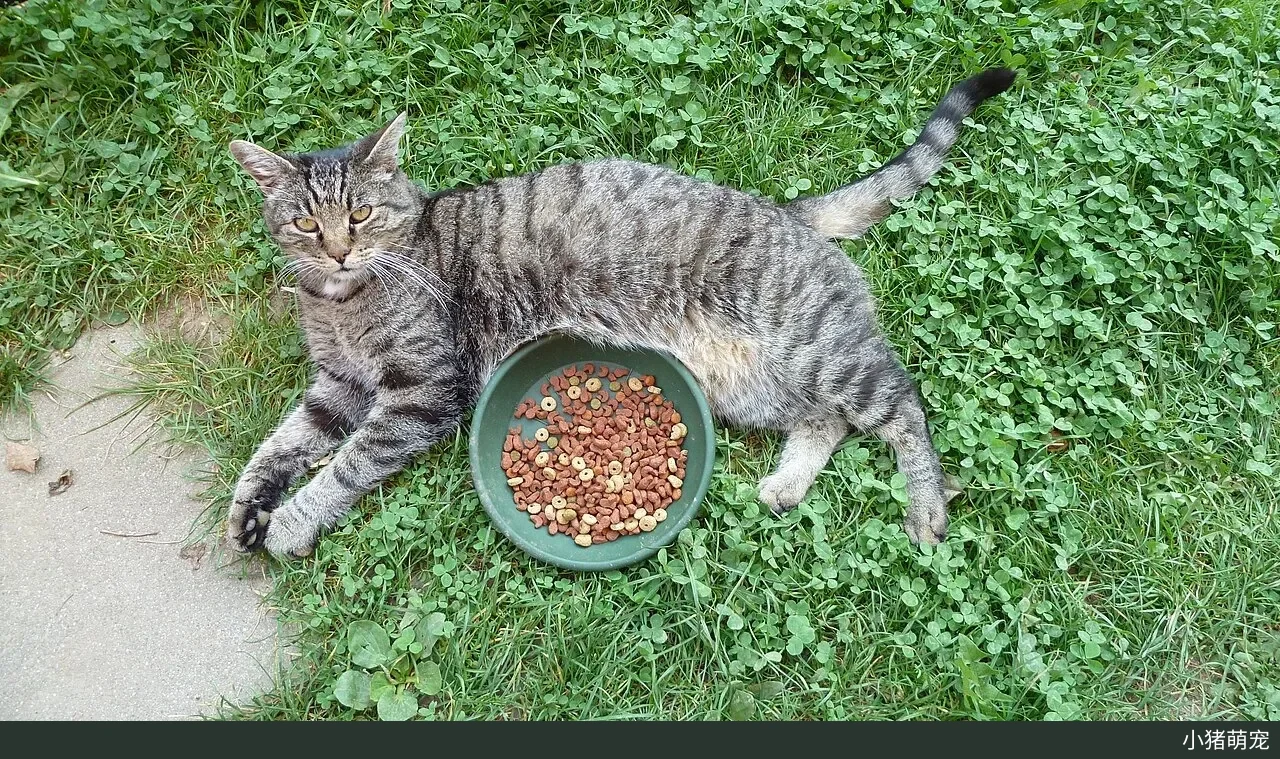
Figure: Thomas Schilling, from Wikimedia Commons (File:P1070226 Cat.jpg), license CC BY-SA 4.0.
Four main findings
- Six rounds of the same food: intake fell significantly round by round; when food was switched in sequence across six different foods, the decline slowed markedly and total intake was higher.
- Five rounds of the same food, then a different food on round 6: intake rebounded—whether the new food was more or less preferred than the original.
- Change only the odor, not the food: researchers used a two-layer special bowl so cats could eat only from the upper layer while odor from the lower layer could pass up. The upper layer always held the same food; when upper and lower stayed the same, intake kept falling; when only the lower layer was switched to another food on round 6, intake of the upper layer rebounded.
- Smelling the same odor throughout rest: during the 10-minute rest between rounds, a perforated covered container kept the cat smelling the same food; subsequent intake was lower than with no odor; switching the rest odor to another food kept intake higher.
The team concludes that cats gradually “habituate” (olfactory adaptation) to the same food odor, which pushes them to stop eating; a new odor brings “dishabituation” and restores feeding motivation. They also argue this helps explain cats’ habit of many small meals a day. Note that the abstract’s wording is that olfactory habituation “contributes to” stopping eating—odor is one factor that makes cats stop, not the only cause. Professor Miyazaki’s press-release phrasing is likewise that cats “do not stop only because they are full.”
Strength of evidence and limits
The design is relatively solid, ruling out alternatives step by step: first using food switches to separate “full” from “bored,” then a double-layer bowl to separate odor from taste and nutrition, then conversely keeping the cat smelling the same odor to test whether appetite drops. Each cat was tested under different conditions, so each was its own control; figure captions in the Iwate University press release show Wilcoxon paired tests with Holm correction for multiple comparisons. The paper appeared in a peer-reviewed journal.
It remains a small-sample, short-duration behavioral experiment. Judgments below are this site’s, based on the publicly described design: only 12 cats, all intact, singly housed, tested within about two hours after a 16-hour fast, all on dry food. Most house cats are neutered, free-roaming, often on wet food or mixed feeding, with different daily feeding rhythms—whether results hold under those conditions was not tested. The study did not directly measure brain or hormone changes; “habituation” is inferred from intake changes; publicly available materials also lack data on long-term food rotation effects on weight and health, and no trials in sick or poor-appetite cats. PetfoodIndustry’s summary also frames leftover food as “not because they are full,” which is more absolute than the paper’s own wording.
Implications for feeding cats at home
Iwate University’s press release says the findings may help feeding strategies for cats with reduced appetite, nutrition management for senior or sick cats, and adding odor variation in pet-food design. PetfoodIndustry also reports that researchers hope the findings will help owners maintain appetite when a cat is ill and reduce overeating in cats prone to weight gain. These are researchers’ hopes for applications, not yet experimentally verified.
Combining the results, this site offers a few everyday points. They are inferences, not study conclusions:
- Leftovers are not necessarily pickiness or fullness. The cat may only be temporarily tired of that bowl’s smell and come back later—consistent with small, frequent meals.
- Food left out constantly may not make the cat eat more. In the experiment, continuous exposure to the same odor during rest lowered later intake. One might guess that leaving the same bowl out for long periods is not necessarily helpful, but home conditions differ greatly from the lab, and there is no direct evidence on this point.
- Weight-prone cats should watch “eating more when rotated.” Rotating different foods raised total intake in the experiment; when managing weight, portion by daily total, not by whether the cat still wants more.
- If appetite truly drops, see a vet first. If the cat clearly eats less than usual, stops eating entirely, or has vomiting, weight loss, and so on, have a veterinarian rule out disease first—do not rely only on switching food or odor; cats on prescription diets should also consult a vet before any food change.
References
-
Takahashi T, Ichizawa S, Kikuchi S, Hara N, Uenoyama R, Miyazaki T, Miyazaki M. Olfactory habituation and dishabituation dynamically regulate feeding motivation in domestic cats. Physiology & Behavior, 2026, 311: 115328. doi:10.1016/j.physbeh.2026.115328
-
Alma Buelva. Japanese study reveals why cats don’t finish their food. PetfoodIndustry, 2026-10-19. link
-
Iwate University. ネコがごはんを残す理由を解明 ―同じ餌でも匂いを変えると再び食べる―. 2026-04-08. link
-
Iwate University. Press release materials (PDF). 2026-04-07. link
-
Iwate University. Why cats stop eating — it’s not just fullness. EurekAlert!, 2026-04-06. link
-
Europe PMC. PMID 41933775 paper record. link