The Beauceron takes its name from the Beauce, a farming region southwest of Paris. When moving sheep with a shepherd, the dog worked a little way out from the flock, approaching quietly to keep the sheep moving without startling them. The job called for stamina and judgment. The dog had to keep pace with the flock and know when to close the distance and when to ease off. Few families have sheep to move today, but play raises a similar question of timing. When a big dog is thoroughly enjoying a game, will it let go of what it’s holding when you ask? [1]
Look at a Beauceron standing side-on. From the point of the shoulder to the rump, the body is slightly longer than the dog is tall at the shoulder. The back is level, the chest reaches nearly to the elbows, and the hind legs are muscular. A large adult can stand nearly 70 cm at the shoulder and weigh about 45 kg. The black-and-tan dog on the grass seems to be wearing short, rust-red socks, the markings behind the French nickname Bas-Rouge, or “red stockings.” Picture a dog that size putting both front paws on you, and it’s easy to see why a family might agree on the rules of play while the dog is still a puppy. [1]
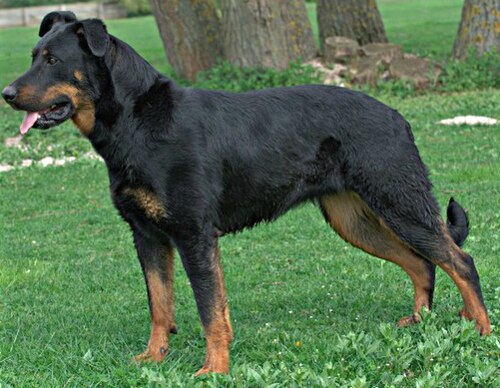
A Beauceron stands in profile. Stefan Schmitz, Wikimedia Commons[4]

Now look at the face. The head has a long, clean outline from between the ears to the tip of the nose, with the muzzle and skull about equal in length. On the black-and-tan dog, there’s a small tan spot above each eye and a patch of the same color on either side of the muzzle. The breed also comes in a pattern called harlequin, or arlequin in French. Gray and black patches break up the coat, while the face and legs still have tan markings. Compare the dog at the water’s edge with the one on the grass to see how different two Beaucerons can look. [1]
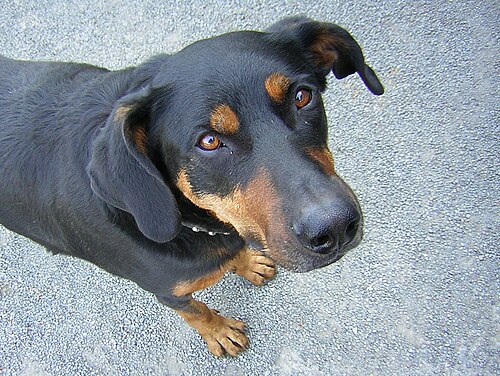
Tan markings frame the Beauceron’s eyes and muzzle. zenera, Wikimedia Commons[5]

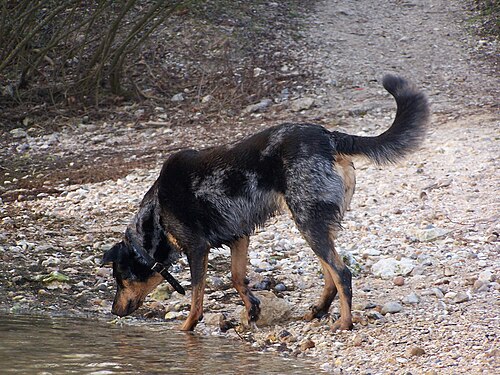
This Beauceron has a harlequin coat. W olivier, Wikimedia Commons[6]

Make time to work together on a walk
Even on a familiar route, a herding dog had to pay attention as the sheep changed position. A Beauceron living with a family still needs both exercise and something to think about. The American Kennel Club (AKC) recommends varied outdoor activities every day and opportunities to explore different settings. A single outing can offer some of that variety. Walk on leash along a quiet road, slow down so the dog can sniff, then bring out a toy when you reach a safe, open spot. You can take a different route or stop somewhere new along a familiar one to practice together. [1]
To see how that would fit into your life, think about an ordinary workday. Who has time to take the dog out in the morning? Who can give the dog their attention in the evening, play a game and watch how it responds? The same questions apply if you have a yard. Opening the door takes a moment. Going outside to do something together is the part to make room for. How far you walk and how long you play can vary with the dog’s age, fitness and energy that day. A household that enjoys teaching a dog as much as going for long walks is a good match for this work. [1]
Start with a toy your dog can give up
The AKC notes that some Beaucerons jump up or take hold of people or objects with their mouths when excited. To teach “drop it,” choose a quiet moment at home and have one adult lead the game. Offer a toy the dog likes but can part with fairly easily. Let the dog hold it for a few seconds, then bring a small treat it likes even more up to its nose. The instant the dog lets go, praise it and give it the treat. When it finishes eating, give the toy back and start playing again. That last step matters. Giving up the toy earned the dog a treat and another turn. [1][2]
Once your dog readily releases the toy at the sight of the treat, give the action a name. Say “drop it,” pause briefly, then show the treat. Gradually lengthen the pause. When the dog lets go on hearing the cue, you can reach into your pocket for the reward. If the dog watches the hand hiding the food and keeps its grip on the toy, return to the last step it could do. For a dog that loves tug, the game itself can be the reward. After a few pulls, hold your end of the toy still. When the dog lets go on its own, praise it and invite it to tug again. Releasing the toy gets the game moving. [2]
Before you try the cue with everyday objects, agree on how everyone will play. If one person encourages the puppy to chase a sleeve and another needs it to let go of a cuff on the way to work, the puppy has two sets of rules for the same game. Use toys for tug and choose one cue for ending each round. If there are children at home, have an adult handle the practice and put the children’s stuffed animals away first. Introduce distractions gradually. Once the dog can trade with someone it knows in a quiet room, try one easy exchange while another person walks by. Beaucerons can be sensitive to harsh corrections. Clear rules leave less occasion for pulling or scolding when the dog gets excited. [1][2]
Check the inside of the hind legs at brushing time
A Beauceron’s coat is short, but it sheds heavily. The outer coat feels coarse and lies close to the body, with a soft, dense undercoat beneath it. Brush weekly with a medium-bristle brush or a rubber grooming mitt, switching to daily brushing during the two heavy shedding periods each year. While the dog is standing quietly, check the nails on all four feet. Feel along the inside of each hind leg for the pair of dewclaws. They’re easy to miss if you only look at the toes from the front, and those nails need regular trimming too. [1]
Before bringing a puppy home, ask the breeder for both parents’ hip evaluations, cardiac exams and eye evaluations by a veterinary ophthalmologist. These are the three breeding screens the AKC lists. The records tell you which checks the parents had. Your puppy will still need its own veterinary follow-up. Another practical step is to save the number and route to an emergency animal hospital that sees dogs overnight. The Beauceron’s deep chest makes gastric dilatation-volvulus (GDV), also called bloat, a concern. If your dog suddenly retches repeatedly without bringing anything up, go to an emergency veterinarian immediately, especially if the abdomen looks swollen or the dog seems restless. Making time to play on an ordinary day and knowing how you would get a dog this size to a hospital at night are both part of deciding whether a Beauceron fits your home. [1][3]
References
-
[1] American Kennel Club. Beauceron Dog Breed Information.
-
[2] American Kennel Club. How to Teach Your Dog to Drop It.
-
[3] Cornell University College of Veterinary Medicine. Gastric dilatation volvulus (GDV) or “bloat”.