The World Cat Federation (WCF) lists the breed as Ragamuffin, under the code RGM. The Cat Fanciers’ Association (CFA) calls it the RagaMuffin. Both spellings refer to the same cat. The breed shares some ancestry with the Ragdoll, and each has its own standard. To get a sense of the Ragamuffin’s build, start at the shoulders and follow the line of the back to the hips. The back stays broad all the way, giving the cat substance at both ends. Once you can pick out that shape beneath the long coat, it is easier to recognize across different colors and patterns.[1][2]
The WCF describes a broad, rounded chest, wide shoulders and hips, and well-developed muscles. Viewed from the front or the side, the outline of the torso is roughly rectangular. When the cat stands and the coat falls along its flanks, you can see the legs that support it. They are heavily boned and of medium length, with the hind legs slightly longer than the front. The large, round paws bear the cat’s weight without the toes splaying. Tufts grow between the toes and underneath the paws. The bushy tail is medium in length, very broad at the base and gently tapered to a blunt tip.[1]
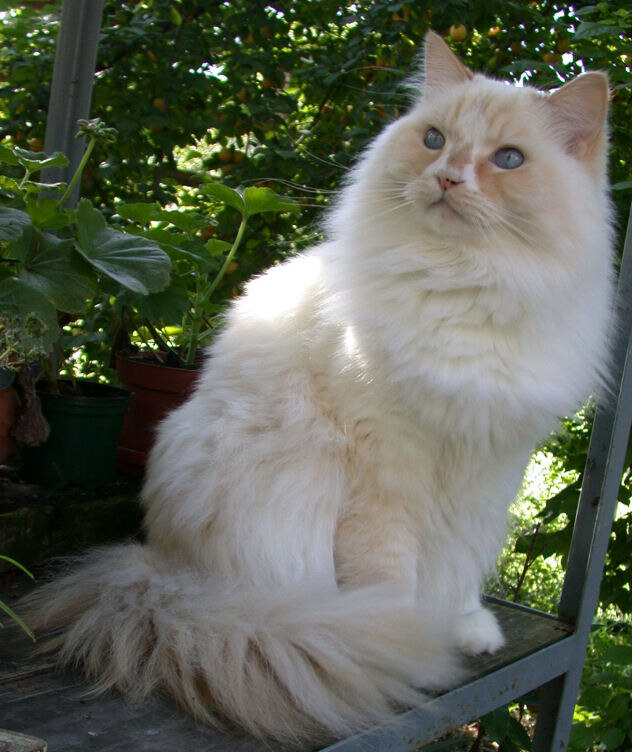
Figure: The ruff of a seated Ragamuffin. "Iris Preyler-Hamertinger", Wikimedia Commons[5]

Seen head-on, the head is broad through the cheeks and narrows gently toward a short, wide muzzle. Full whisker pads give the muzzle its rounded outline. The ears sit well apart, with rounded tips and a slight forward tilt. The large, walnut-shaped eyes are also widely spaced and set at a slight angle. Coat markings vary considerably. The WCF accepts solids, tabbies, patterns with white, and pointed colors. The CFA places pointed Ragamuffins in its breeding-only category. When looking at photographs from the two associations, pay attention to the proportions of the face even when the markings look quite different.[1][2]
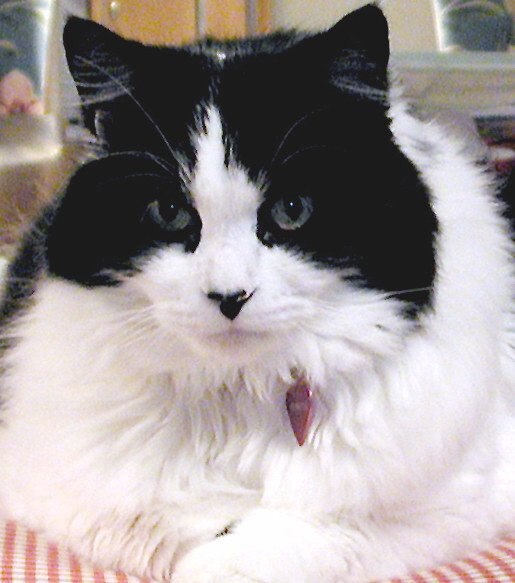
Figure: The muzzle seen from the front. Ariele at English Wikipedia, Wikimedia Commons[6]

The longest furnishings are easy to locate. Follow the outer edge of the cheeks down to the neck, where the fur forms a ruff. Behind the hind legs it hangs like a pair of trousers. Over the torso, the coat is medium-long to long, dense and silky, with an outer coat and undercoat of much the same length and texture. A kitten may have only a short ruff, and coat density changes with the seasons. The CFA suggests using a long-toothed comb once or twice a week to remove debris. Part a small section so you can see into it, then comb gently, especially through the longer hair on the chest and hind legs.[1][2]
Before buying a bed, watch how much room your cat takes up asleep. A round bed with a thick padded rim can look generous but leave little space inside for a cat lying on its side. When yours stretches out on a familiar mat, note where the front paws, shoulders, hind legs and tail come to rest. Compare that space with the bed’s inside dimensions. For a covered bed, check whether the shoulders will clear the entrance and whether there is room to turn around inside. A good indication of fit is a cat that walks in on its own, changes position and goes back to sleep.[1][3]
Trace the route to a favorite window perch in both directions. Once the front paws reach the sill, the hind paws still need a firm place to land. The cat also needs enough clear surface to turn for the trip down. Moving a flowerpot or adding a stable intermediate step may make an unused perch accessible. In a home with several cats, trace the paths from each resting spot to water and litter boxes. If every path passes a chair where another cat keeps watch, placing some resources along a different route gives both cats a choice. These needs are common to indoor cats. Broad shoulders make the clearance along the way particularly worth checking.[1][3]
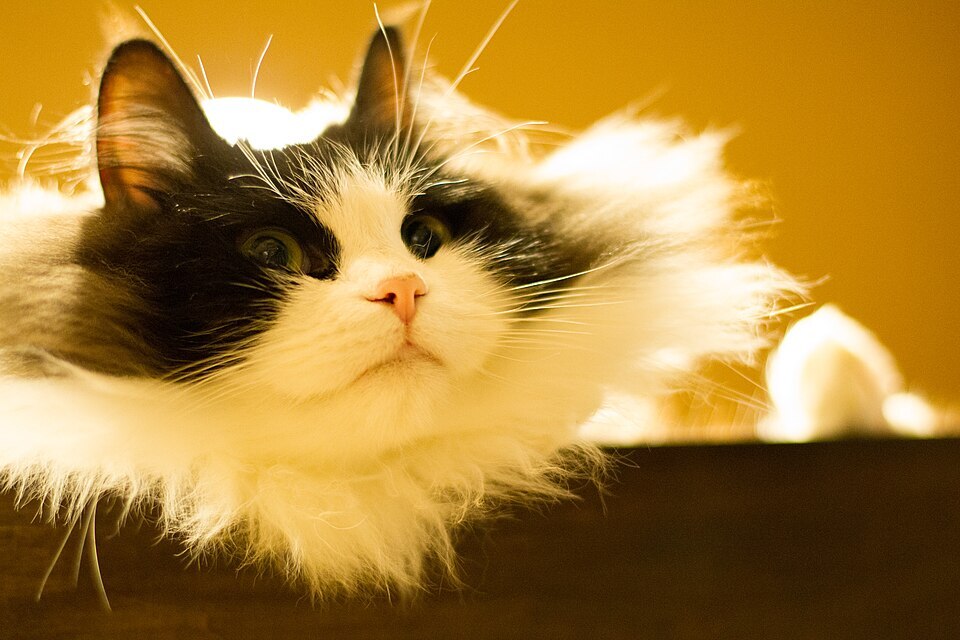
Figure: Cheek furnishings at rest. Takashi Hososhima, Wikimedia Commons[7]

A Ragamuffin may choose to sit close and still prefer to keep all four paws on the ground. The CFA describes the breed as affectionate, and the Feline Veterinary Medical Association recommends positive, predictable contact with people. Sit within reach and give the cat time to approach. If it rubs a cheek against your hand, offer a few strokes, then pause to see whether it leans in again. A cat that settles beside you can enjoy your company right there. Even if it climbed into your lap a moment ago, give it a clear way down when it turns to leave.[2][3]
Play offers another way to spend time together. For a cat that likes to crouch and watch, leave some cover and draw a toy past its edge. Pause where the cat can spring and catch it. Give it time to wait, chase or head back to its resting place. Use the spaces it already visits. A clear stretch of floor beside the bed can lead to a stable platform with room to turn. Watch where the cat pauses along that route. That spot can help you decide where to bring the toy into view on the next pass.[3]
How can you judge body condition under all that fur? The WCF describes a lower abdominal fat pad in adults, and a dense coat can hide the waist. Neither feature gives you a target weight. The Cornell Feline Health Center describes an assessment that uses touch as well as sight. Gently feel for the ribs along both sides of the chest, then look at the waist from above and the abdominal outline from the side. Ask your veterinarian to demonstrate on your cat and record its weight and body condition score together. That gives you a point of comparison when the winter coat comes in. If weight keeps rising and the ribs become harder to feel, take those records and the usual feeding amounts to your veterinarian to discuss whether gradual weight loss is appropriate.[1][4]
References
-
[1] World Cat Federation. Ragamuffin (RGM). January 1, 2010.
-
[2] The Cat Fanciers’ Association. RagaMuffin.
-
[3] Feline Veterinary Medical Association. New Feline Veterinary Medical Association Position Statement Reimagines Life for Indoor Cats. August 28, 2025.
-
[4] Cornell Feline Health Center. Obesity.