The Pointer—registered by the Fédération Cynologique Internationale as FCI Standard No. 1, the English Pointer—first appeared in England around 1650.[1][2] Before firearms made wing-shooting common, British hunters paired Pointers with coursing hounds such as Greyhounds to hunt hares: the Pointer ranged ahead to locate and freeze on quarry while the hounds gave chase.[1] With the rise of bird shooting in the 1700s, the breed became the premier open-country gundog of British estates; it was among the first eight breeds registered in the United States in 1878 and was recognized by the AKC at its founding in 1884 within the Sporting Group.[1][3]
Every line of the Pointer reflects speed, endurance, and scenting efficiency. Under the AKC standard, adult males stand 25 to 28 inches at the shoulder and weigh 55 to 75 pounds, while females stand 23 to 26 inches and weigh 45 to 65 pounds; FCI gives 63 to 69 cm for males and 61 to 66 cm for females.[1][2] In profile, the noble, proudly carried head displays a well-defined stop, soft thin ears set at eye level that taper slightly toward the tip, and a slightly concave, “dish-faced” muzzle—an anatomical contour The Royal Kennel Club notes helps lift the nose to catch windborne scent at a gallop.[1][2][3] The chest is deep to the elbow rather than wide so forelegs move freely, the hindquarters are muscular with decided angulation for propelling leverage, and the tapering “bee-sting” tail lashes from side to side in motion, all wrapped in a fine, short, glossy coat in lemon, orange, liver, or black with white, as well as solid or tricolor patterns.[1][2][3]

A black-and-white English Pointer locked in a classic pointing stance. J04n, Wikimedia Commons[6]

Distance-Searching Stamina and Where Pointing Comes From
Prospective owners quickly ask how much running a Pointer genuinely needs each day, and the honest answer flows straight from its working purpose. Centuries of selection created a dog engineered to cover vast acreage with head held high and smooth, ground-covering drive—what the AKC calls its renowned “hunt all day” endurance.[1][3] The Royal Kennel Club places the Pointer in its highest exercise tier of more than two hours per day, and the AKC similarly states that the breed needs abundant daily exercise combining long walks, vigorous interactive play, and—ideally—a securely fenced area where the dog can run flat out so it settles calmly indoors afterward.[1][3] Exact daily volume still varies with age, health, and individual drive rather than a rigid one-size mileage formula.[1]
Equally defining is the frozen stance that gave the breed its name. Catching the scent of sitting game birds on the breeze, a Pointer halts dead in its tracks and locks into a rigid point aimed toward the quarry—an instinct the AKC notes many puppies begin displaying as early as two months of age.[1][3] That deep-wired drive to range and run shapes whether city living is realistic. The Royal Kennel Club lists the breed as adaptable to town or country yet pairs that with recommendations for a large house and large garden.[3] Urban apartment life is only feasible when an owner already follows an athletic routine—committing two-plus hours a day to brisk runs, safe enclosed off-leash sprints, and mentally engaging sports such as obedience, tracking, agility, or rally—whereas a household limited to brief leash strolls down city blocks will struggle to satisfy an athlete bred to roam open country.[1][3][4]
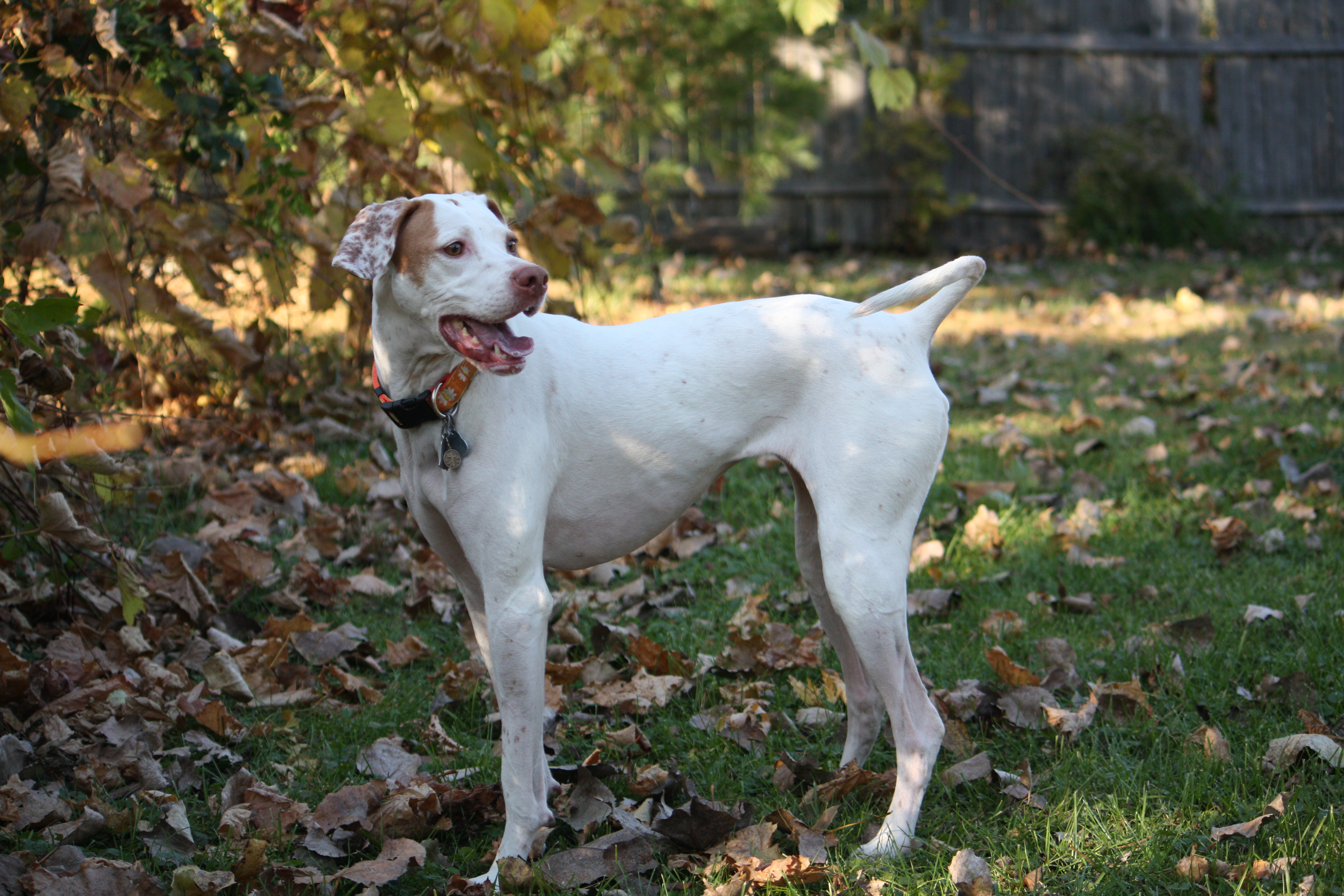
A liver-and-white English Pointer showing its deep chest and sleek coat. Anne Hornyak, Wikimedia Commons[7]

Grooming, Training, and Health Care for a Deep-Chested Athlete
Next to its exercise demands, coat care is refreshingly light. The short, dense, glossy coat sheds and stays clean with a weekly brushing using a soft-bristle brush or hound glove.[1][3] Ears should be checked regularly and cleaned with soft gauze and a veterinarian-recommended cleanser when needed; nails need frequent trimming if not naturally worn down so overly long nails never interfere with walking or running stride, alongside regular tooth brushing with dog toothpaste.[1] Temperamentally, Pointers are amiable, even-tempered, and highly trainable: both the AKC and the American Pointer Club highlight their versatility across field trials, hunt tests, show rings, obedience, rally, agility, search-and-rescue, and service or therapy work.[1][4] They generally get along very well with other dogs, though owners should respect their keen instinct toward birds and small wildlife outdoors, and monitor calories and treats carefully so a healthy adult does not become overweight.[1]

Side head profile of an orange-and-white English Pointer showing its concave muzzle. mjk23, Wikimedia Commons[8]

Pointers are generally robust companions with an AKC lifespan of 12 to 15 years (12 to 14 years in the American Pointer Club’s 2025 health statement).[1][4] Both the AKC and the American Pointer Club recommend four core health screenings reported to the Orthopedic Foundation for Animals (OFA): Hip Evaluation, Elbow Evaluation, Eye Evaluation, and Thyroid Evaluation for autoimmune thyroiditis.[1][4] The parent club also notes that, like other short-coated breeds, Pointers can experience skin hives from contact allergies or autoimmune causes, as well as hip dysplasia, epilepsy, and certain cancers.[4] Crucially, the AKC warns that as a large, deep-chested breed, Pointers are vulnerable to bloat—Gastric Dilatation-Volvulus (GDV). According to the American College of Veterinary Surgeons (ACVS), urgent warning signs requiring immediate emergency care include restlessness or looking at the belly, standing and stretching, drooling, a swelling abdomen, unproductive retching, panting, and weakness; feeding smaller split meals and managing weight help lower day-to-day risk.[1][5] Ultimately, a Pointer belongs with runners, hikers, or dog-sport enthusiasts who can reliably provide more than two hours of active daily movement and safe space to stretch its legs—not a sedentary routine.[1][3][4]
References
- American Kennel Club. Pointer Dog Breed Information.
- Fédération Cynologique Internationale. FCI-Standard N° 1: English Pointer.
- The Royal Kennel Club. Pointer Breed Information.
- American Pointer Club, Inc. Health Statement for AKC (February 2025).
- American College of Veterinary Surgeons. Gastric Dilatation-Volvulus.
- J04n. File:Daisy the English Pointer, pointing.jpg, Wikimedia Commons.
- Anne Hornyak. File:English Pointer 001.jpg, Wikimedia Commons.
- mjk23. File:Pointer - world dog show 2010.jpg, Wikimedia Commons.