Mention zebrafish (Danio rerio) and many people picture rows of clear plastic racks humming inside a university laboratory. Since George Streisinger and colleagues adopted the species in 1981, its compact size, rapid generation time, large clutches, external fertilization, and transparent embryos (hatching in 48 to 72 hours) have made it a cornerstone vertebrate model for genetics and developmental biology. Long before it entered research facilities, however, this South Asian minnow was already a beloved home aquarium fish—and keeping it well at home means respecting its wild floodplain biology rather than mimicking a high-density lab rack.
An Energetic Shoaler From South Asian Floodplains
According to the Animal Diversity Web (ADW) and FishBase, Danio rerio is native to inland freshwaters across the Ganges and Brahmaputra river basins of India, Bangladesh, and Nepal, with additional records in Pakistan, Myanmar, and Bhutan. Classified as Least Concern on the IUCN Red List and Not Evaluated under CITES, it is primarily a floodplain species thriving in shallow, slow-moving or standing water along stream edges, canals, ditches, ponds, and irrigated rice paddies. Shaped by South Asian monsoons, wild zebrafish tolerate extraordinary seasonal temperature swings—from 6 degrees Celsius in winter to 38 degrees Celsius in summer—and persist readily in human-altered agricultural waterways.
Physically, zebrafish have slender, laterally compressed bodies averaging around 25 mm (FishBase lists a maximum standard length of 3.8 cm, while ADW notes a captive record up to 64 mm). Five uniform dark-blue horizontal stripes run along each flank all the way onto the tail fin, complemented by a striped anal fin, two pairs of tiny barbels, and an upturned mouth with a protruding lower jaw. Stomachless and toothless like other cypriniform minnows, they are diurnal, upper- and mid-water omnivores that suction-feed on zooplankton, aquatic insect larvae (including mosquito larvae), terrestrial insects at the surface, and algae. While wild fish live roughly a year around seasonal monsoon cycles, captive zebrafish average about 3.5 years (42 months) and occasionally reach 5.5 years.
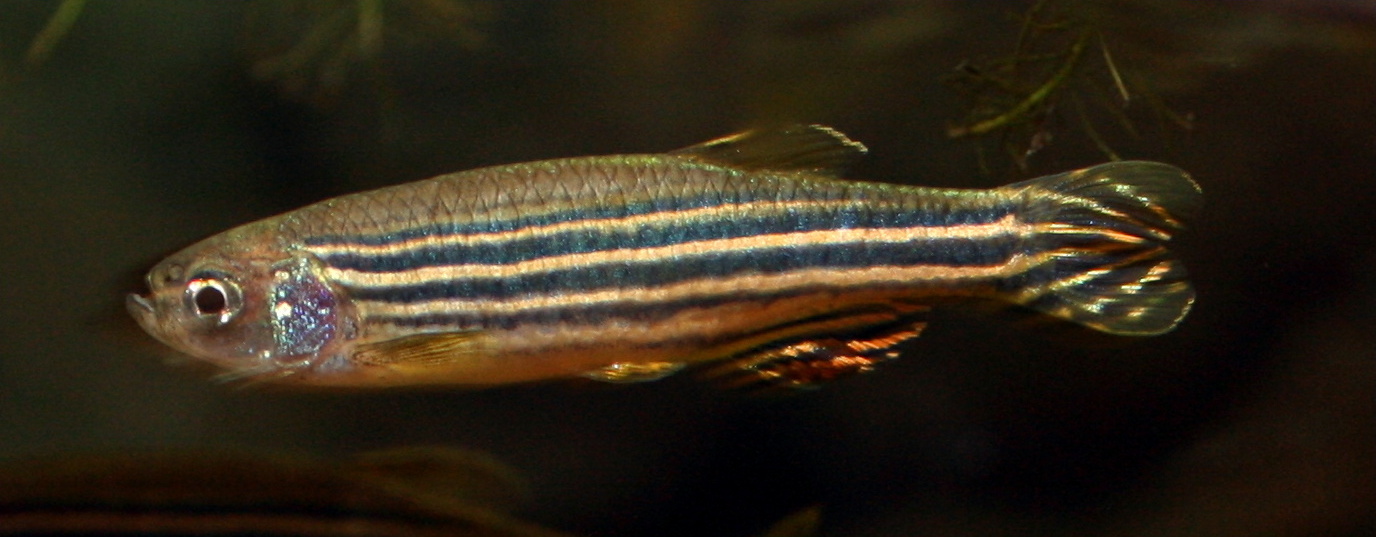
Figure: A wild-type zebrafish displays five dark longitudinal stripes extending into the caudal fin and an upturned mouth suited to surface feeding. Soulkeeper, Wikimedia Commons

Translating Laboratory Practice to a Home Aquarium
So how should you keep laboratory zebrafish in a home aquarium? Borrow the welfare safeguards developed by research guidelines, while giving the fish far more swimming space and naturalistic shelter than a bare lab tub. First and foremost, put a tight lid on the tank. Both the RSPCA zebrafish housing guidance (Reed and Jennings, 2011) and the Canadian Council on Animal Care (CCAC) 2020 guidelines stress that zebrafish are accomplished jumpers: every enclosure needs a secure cover—ideally translucent to admit light while buffering shadows from overhead movement—plus screened drains or filter intakes.
Second, prioritize horizontal swimming length and a genuine shoal. Zebrafish cruise briskly across the upper water column all day, so FishBase advises a tank at least 60 cm long with five or more fish. Social research summarized by ADW and the RSPCA goes a step further: both males and females form dominance hierarchies through chasing and nipping, and aggression can spike sharply in small groups of fewer than six fish. Keeping six or more conspecifics disperses chasing, lowers anxiety, and speeds recovery from sudden noise or vibration.
Third, separate laboratory breeding goals from everyday home comfort. Research racks often hold water warmer (around 27 to 28 degrees Celsius, with Merck's laboratory-animal table listing 27 to 32 degrees Celsius for warm-water lab fish) on a strict 14-hour light, 10-hour dark photoperiod to maximize continuous egg production. In a home display tank where constant breeding is unnecessary, FishBase's moderate 18 to 24 degrees Celsius range (pH 6.0 to 8.0, hardness 5 to 19 dH) keeps them energetic without heavy heating. Maintain a predictable day-night lighting schedule—never constant 24-hour light or darkness—and pair open upper swimming lanes with live plants that offer visual shelter.

Figure: A shoal of zebrafish swims inside a numbered laboratory rack tank built for biomedical research facilities. Pleple2000, Wikimedia Commons

Strain Regulations and Aquarium Health Guardrails
Alongside wild-type striped zebrafish and conventionally bred spotted 'leopard danio' morphs, fluorescent transgenic zebrafish engineered with fluorescent protein genes also circulate in parts of the aquarium world. Official oversight varies sharply by jurisdiction: in the United States, the FDA reviewed several fluorescent Danio rerio genomic constructs and exercised enforcement discretion not to require pre-market approval for non-food aquarium use; across the European Union, by contrast, notices from Ireland's Environmental Protection Agency (EPA) and Dutch authorities under Directives 2001/18/EC and 2009/41/EC state that genetically modified ornamental zebrafish lack authorization and remain illegal to import, sell, or keep privately outside licensed contained laboratories. Prospective keepers should review local rules before choosing any strain and rely on legally sourced, conventionally bred fish.
Even hardy zebrafish rely on solid biosecurity and water chemistry. Following the Merck Veterinary Manual, complete full nitrogen cycling to prevent new tank syndrome, perform regular dechlorinated water changes, quarantine new arrivals for at least 30 days with dedicated nets and hoses, and never dose prophylactic antimicrobials blindly. Merck's fish disease chapters highlight several documented zebrafish pathogens—including freshwater velvet (Piscinoodinium, causing fine golden skin dusting, lethargy, and piping), the intestinal nematode Pseudocapillaria tomentosa, bacterial Edwardsiella ictaluri (skin hemorrhage and pale gills), and mycobacteria that non-lethal quarantine cannot rule out—while ADW notes age-related spinal curvature after year two in captivity. If fish show skin dusting, bleeding, labored breathing, wasting, or sudden deaths, test ammonia, nitrite, and pH immediately and consult an aquatic veterinarian.

Figure: The spotted leopard danio is a conventionally bred ornamental color morph of Danio rerio kept in home aquaria. Roundish, Wikimedia Commons

Who Keeps Zebrafish Well and When to Reconsider
Conventionally bred zebrafish are an engaging match for keepers with a cycled, firmly covered 60 cm planted aquarium, steady moderate room temperatures, and open upper-water lanes for six or more fast-moving shoalers. They are a poor fit for open-top desktop bowls (where jumping is a constant hazard), tiny unfiltered jars, solitary or two-fish setups that intensify social chasing, or tranquil community tanks stocked with slow, long-finned species easily stressed by nonstop darting. Give them a tight lid, a long horizontal runway, and a proper shoal, and this famous research fish settles smoothly into everyday home life.
References
- Animal Diversity Web · Danio rerio
- FishBase · Danio rerio (Zebra danio)
- Merck Veterinary Manual · Management of Aquarium Fish
- RSPCA · Guidance on the housing and care of Zebrafish Danio rerio
- CCAC Guidelines · Zebrafish and other small, warm-water laboratory fish (2020)
- U.S. FDA · Intentional Genomic Alterations (IGAs) in Animals: Risk-Reviewed IGAs
- EPA Ireland · Information Notice on GM zebrafish (Danio rerio) in the EU