Across multiple nations, escalating veterinary and everyday care expenses are substantially altering companion animal healthcare. Recent independent studies from the United Kingdom, the United States, and Canada reveal that between nearly a third and half of pet owners have postponed or forgone necessary veterinary visits due to financial strain. Routine preventive vaccinations and emergency services have been hit the hardest. Simultaneously, marked perception gaps persist between veterinary professionals and pet households regarding lower-cost treatment alternatives and staged payment options.
United Kingdom: 30% of Pet Owners Delay Care, Annual Boosters Suffer Most
According to an early 2026 survey of 2,000 pet owners conducted by UK pet retailer Jollyes, nearly a third (30%) of respondents delayed or skipped veterinary treatment over the preceding 12 months due to cost considerations. In higher-cost regions like London, that figure jumped to 46%. Among delayed or skipped procedures, annual vaccine boosters made up the single largest share at 50%, followed by primary puppy and kitten immunizations at 28% and microchipping at 26%.
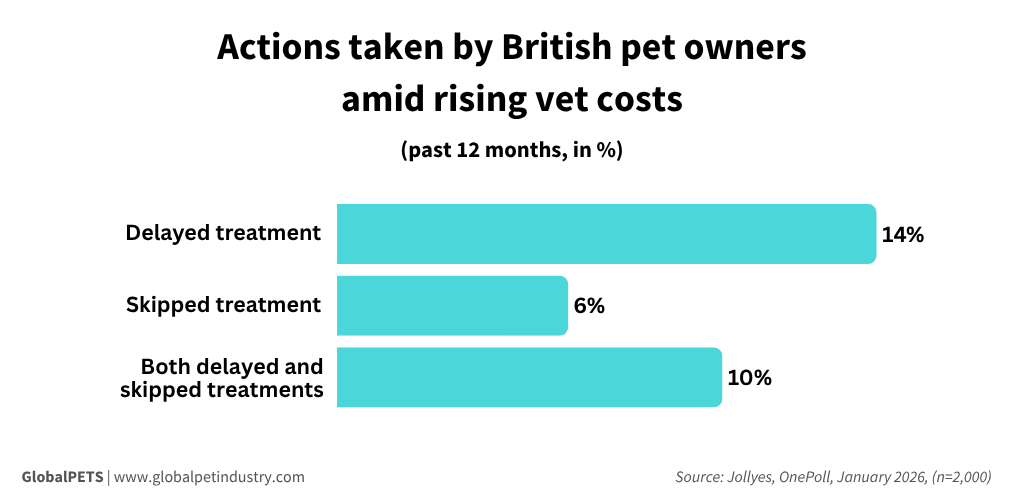
Distribution of actions taken by British pet owners in response to rising veterinary care costs. Source: Jollyes survey / GlobalPETS chart.
Rising clinical expenses are directly impacting statutory compliance alongside household budgets. Although microchipping has been legally mandatory for all pet cats in England since June 2024, 31% of owners with unchipped cats reported that appointment and implantation fees impeded compliance, and only 33% of cats in the surveyed cohort were microchipped. Additionally, 23% of UK households cut back on other essential living expenses to cover veterinary bills—a figure reaching 33% in London and 46% in Northern Ireland. A resounding 92% of respondents called for transparent in-clinic and online displays of core service pricing, while 63% advocated for standardized nationwide fee schedules.
United States: Routine Care Pressured by Fragile Emergency Payment Confidence
Across the Atlantic, pet owners in the United States face comparable financial headwinds. A joint survey of 1,536 American pet owners by the American Society for the Prevention of Cruelty to Animals (ASPCA) and YouGov indicated that 58% were deeply concerned about climbing veterinary invoices, while half felt strained by day-to-day pet food and baseline care expenditures.
The study further highlighted that approximately 60% of surveyed US pet owners lacked the financial confidence to manage sudden emergency veterinary procedures. According to ASPCA projections, this financial vulnerability leaves roughly 100.4 million companion animals nationwide at risk of missing timely emergency interventions during acute trauma or sudden illness. Furthermore, 40% of respondents acknowledged struggling to secure long-term financial reserves for routine preventive healthcare.
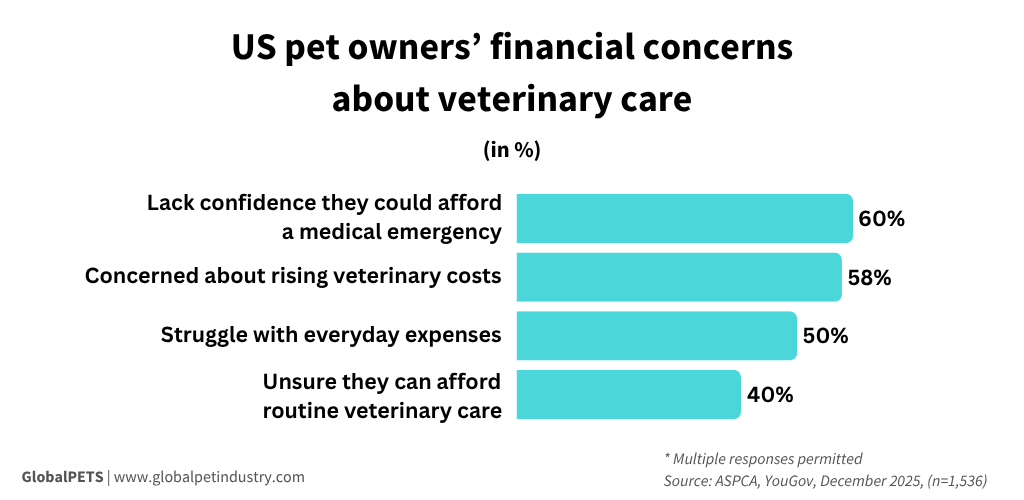
Proportion of US pet owners reporting financial concerns regarding vet bills, pet food expenses, and emergency care affordability. Source: ASPCA & YouGov survey / GlobalPETS chart.
Clinical Disconnect: Perception Gaps on Low-Cost Alternatives and Payment Plans
A cross-sectional investigation conducted across North America by Gallup analyzed the clinical drivers behind treatment delays from the veterinary perspective. In the United States, 97% of surveyed veterinarians cited client treatment cost as the primary reason pet owners sometimes, often, or always decline recommended clinical courses.
However, significant discrepancies emerged regarding how clinicians and clients perceive discussions surrounding lower-cost alternatives. Paired data from Gallup covering 933 US veterinarians and 2,500 cat and dog owners revealed that 73% of owners who declined treatment due to cost reported their veterinarian never offered a lower-cost alternative. In stark contrast, 81% of veterinarians reported that they frequently (44%) or always (37%) proactively suggest alternative treatment options.
Regarding payment flexibility, 70% of surveyed clinics offered third-party deferred financing, and 24% maintained in-house installment programs. Yet across the profession, only 20% of veterinarians routinely informed clients about installment options upon admission. Most clinicians only engaged in payment discussions when clients explicitly articulated financial hardship (57%), directly inquired about financing (48%), or when total invoices crossed a steep threshold (23%), preventing financial safety nets from easing client hesitation early in consultations.
Spectrum of Care: Bridging Veterinary Education and Clinical Communication
In a parallel survey of 369 practicing veterinarians across Canada, 93% demonstrated awareness of the "Spectrum of Care" framework—an approach designed to deliver tiered diagnostic and treatment options balancing therapeutic efficacy and accessibility based on the individual animal's health, family financial capacity, and clinical resources. However, nearly half (49%) reported that their veterinary school education provided little (31%) or no (18%) practical guidance on implementing tiered care conversations in clinical practice.
The study also revealed entrenched habits in clinical consultation: only 19% of Canadian veterinarians began by exploring client treatment goals and expectations immediately following a physical examination. Instead, 72% routinely presented a menu of diagnostic or treatment options for clients to navigate on their own, while 9% started with the most advanced gold-standard protocol and only scaled down when encountering client pushback. When addressing financial considerations, only 21% inquired about a household's budget prior to presenting treatment recommendations, 51% discussed finances only after outlining options, and 28% waited until an owner resisted or declined care. These findings emphasize that expanding clinical access requires not only transparent pricing and tiered medical protocols, but also an early, proactive shift in veterinarian-client communication.