The name Altai originally referred to a line of domestic cats from the Altai region of Kazakhstan. In the 1990s, some cats there had one or two blue eyes despite having very little white fur. Breeders began working with that trait and drew up the first draft standard in 1999. Seminar notes from LOOF, the French feline pedigree registry, record World Cat Federation (WCF) registrations from 2016 and a second standard in 2018. The clearest way to connect a particular cat to that history is through its pedigree.[1]
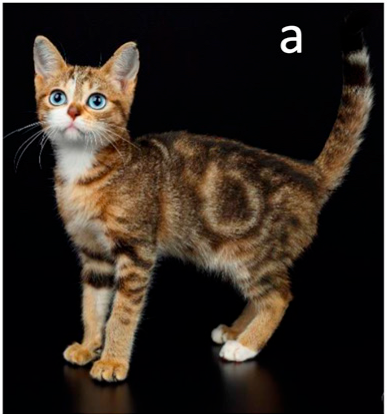
An Altai cat appears in Figure 1a of the study. Marie Abitbol and colleagues, Animals
Roxi appears in two pedigrees
Roxi was a male recorded as an Altai. One of his male descendants helped establish the Céleste line in France. Roxi also appears in the history of the Topaz breeding project, which began in Ukraine in 2016 with two founding males. The other was Seymour, a cat from Russia whose ancestry was unknown. Roxi therefore links the Céleste and Topaz pedigrees. For a blue-eyed Topaz descendant, either founder’s branch may be relevant.[1][2]
The French registry records give those names a more precise meaning. LOOF’s 2022 seminar notes discussed the Altai and the Topaz separately and recorded that neither had LOOF recognition at the time. The Céleste had its own registration history. LOOF granted it preliminary recognition in 2021 and moved it into the new breed category (Nouvelle Race) on 1 January 2023. Litters born from that date entered the RIEX register. When reading a pedigree, look at the issuing registry, the name under which the cat is registered and the names of its ancestors. A cat registered as a Céleste can have an Altai in its ancestry.[1–3]
Blue eyes can accompany just a few white toes
Riviera, a four-month-old female, shows how little white fur a blue-eyed cat can have. In the photograph where she lies on a cushion, dark tabby stripes frame both pale blue eyes. A small patch of white is visible on her outstretched front toes. In the seated portrait, the spots along her flank and the paler fur under her throat are easier to see. The photographer identifies her by name, age and Altai lineage in both descriptions, so the two poses give us different views of the same kitten.[4][5]


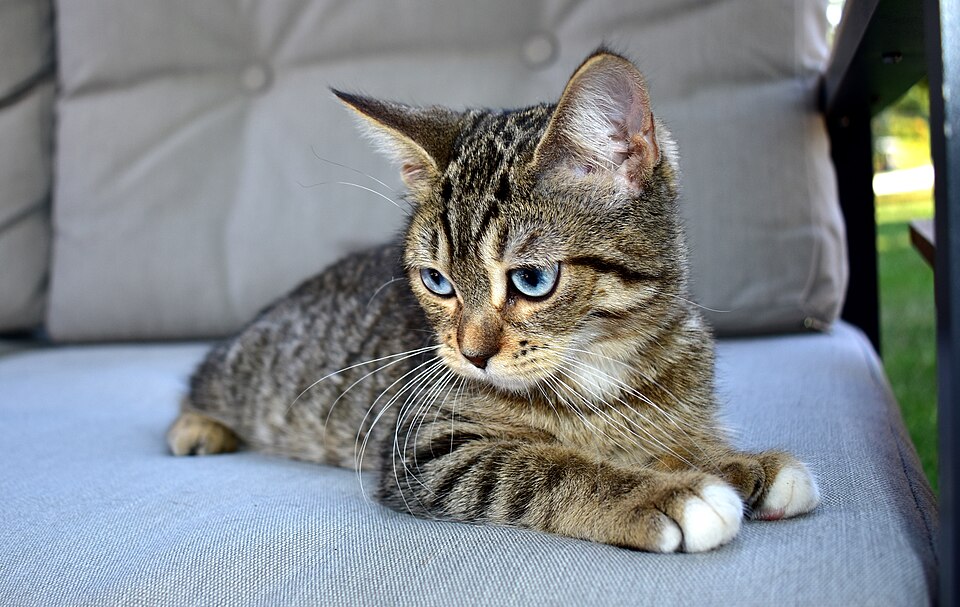
Riviera has two pale blue eyes. Felinlove, Wikimedia Commons[4]
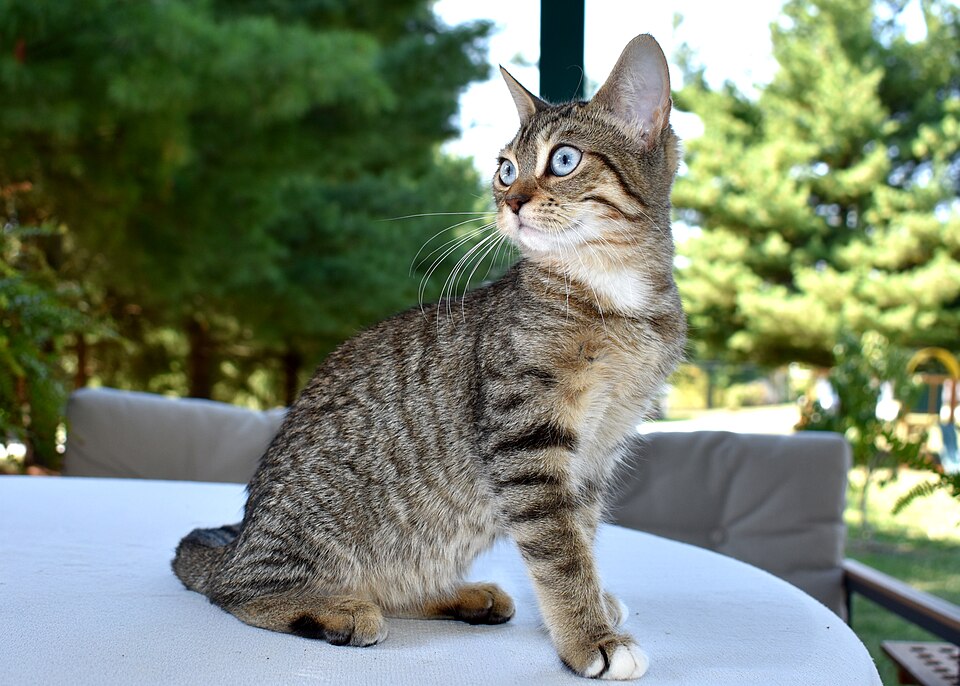
Spots mark Riviera’s flank. Felinlove, Wikimedia Commons[5]
Eye colour can vary even within a single line. A cat may have two blue eyes, one blue eye or a patch of blue in just one iris. In families with documented pedigrees, researchers also found cats that carried a variant associated with dominant blue eyes yet showed no visible blue in either eye. Other domestic cats can have blue eyes for different genetic reasons, including colourpoint or dominant white. A photograph can show the eye colour, coat pattern and position of white markings. Establishing ancestry takes records that can be traced to the individual cat.[1][2]
Look for a hearing result for each ear
What does an entry such as “dominant blue eyes” tell you about a cat’s health? In 2024, researchers examined descendants of different founders separately. All 15 Altai cats in the study that showed the dominant blue-eye trait carried one copy of DBE-ALT, a 433-base-pair insertion in the PAX3 gene. The researchers also found it in Seymour’s descendants. The variant passed down through Roxi’s line to the Céleste was DBE-CEL, a 395-base-pair insertion at a different site in the same gene. The distinction matters when reading a DNA report. Roxi was recorded as an Altai, and the variant traced through his branch bears the name CEL.[2]
One litter brought together the branches descending from Roxi and Seymour. Two white kittens each carried one copy of DBE-CEL and one of DBE-ALT. Both were recorded as deaf in both ears. The study also documented deafness in both ears in cats with two copies of DBE-ALT. For the Altai cats with a single copy of DBE-ALT, the study table lists hearing as presumed normal. Separate results for the two ears were unavailable for that group. The cases show that hearing loss has occurred with particular combinations of variants. They leave open how common deafness in one or both ears is across the Altai line.[2]
When taking in a cat, ask the previous caregiver for its brainstem auditory evoked response (BAER) report. Check that the report identifies your cat, then look for the result for the left ear and the result for the right. A cat that turns at the clink of a food bowl has responded to that sound. A cat that hears with only one ear can do that too. If you have a pedigree, a DNA result or simply the observation that the cat turns when called, take what you have to your veterinarian to discuss testing each ear. The family history can guide the question. The cat’s own test can answer it.[2]
Let the cat choose when to approach
At home, give the cat a quiet place to retreat and set up separate places for eating, drinking and using the litter tray. In a home with several cats, crouch down and look at the routes between them. If one cat sits in the doorway, can another still get to water? Two bowls side by side can both be blocked by the same cat. A second bowl in a spot with its own approach gives the other cat a choice. Keep familiar bedding and scents around, and let the newcomer decide when to leave its hiding place.[6]
For play, start by moving a toy where the cat can see it. Give the cat time to watch, stalk and pounce. If it walks away, let that game end. Approach in a familiar, predictable way each day and watch what happens. Does the cat come to meet you, or settle a little way off where it can watch? You can use those responses to adjust how you play together. Over time, the cat’s choices will tell you which games it enjoys and how close it likes to be.[6]
References
-
[1] Marie Abitbol. Panachure classique, blanc dominant et « panachure minimale - yeux bleus » chez le chat. LOOF, 23 November 2022.
-
[2] Marie Abitbol et al. Different Founding Effects Underlie Dominant Blue Eyes (DBE) in the Domestic Cat. Animals, 2024, 14(13), 1845.
-
[3] LOOF. Modalités d’enregistrement des Céleste au 1er janvier 2023. 8 March 2023.
-
[4] Felinlove. Altai Cat with DBE Gene.jpg. Wikimedia Commons, 12 September 2024.
-
[5] Felinlove. Altai Kitten with DBE Gene.jpg. Wikimedia Commons, 12 September 2024.
-
[6] Feline Veterinary Medical Association. New Feline Veterinary Medical Association Position Statement Reimagines Life for Indoor Cats. 28 August 2025.