The International Cat Association (TICA) lists the Highlander as a domestic cat with longhaired and shorthaired varieties. In the side view of one-year-old Hugo, follow the line of his back to his rump and you can see a short, furry tail turning upward. In the portrait, the tip of each ear curves back. Both features are easy to pick out. When you have a wand toy in hand, though, one of the clearest ways to tell whether your Highlander wants to keep playing is to stop moving the toy and see what the cat does next. [1][2][3][5][7][8]


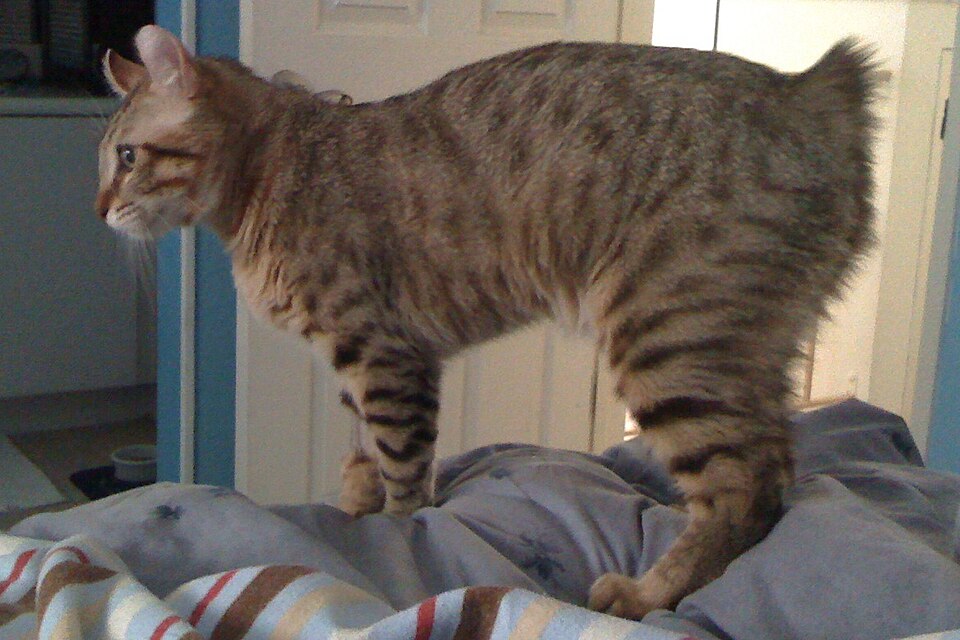
Hugo’s natural bobtail turns upward. TAnthony, Wikimedia Commons[3]
Get to know your Highlander’s resting outline
Hugo’s tail tip extends just past his rump. Another Highlander’s tail may look quite different. TICA describes a natural bobtail ranging from about an inch (2.5 cm) long to one that reaches the hock, the backward-pointing joint low on the hind leg. The tail is thick, and some tails have bends. When your cat gets up and walks past, look from the side. Where does the tail end, and how does the cat lift it as it walks? The outline is easier to see then than when the cat is curled up asleep with only a tuft of fur showing. [1][3]
In Hugo’s portrait, trace either ear up from its broad base. Most of the ear stands upright. The loose backward curl begins in roughly the upper third. The sloping forehead, broad nose and somewhat square muzzle complete the profile TICA describes. The longhaired Scottish Fold and Scottish Straight belong to a separate breed group, although their Chinese names can also include the word for “Highland.” Highlander breeders selected domestic cats for a sturdy build and a resemblance to big cats. A spotted coat and a short tail tell you nothing on their own about wild ancestry. [1][2][5]
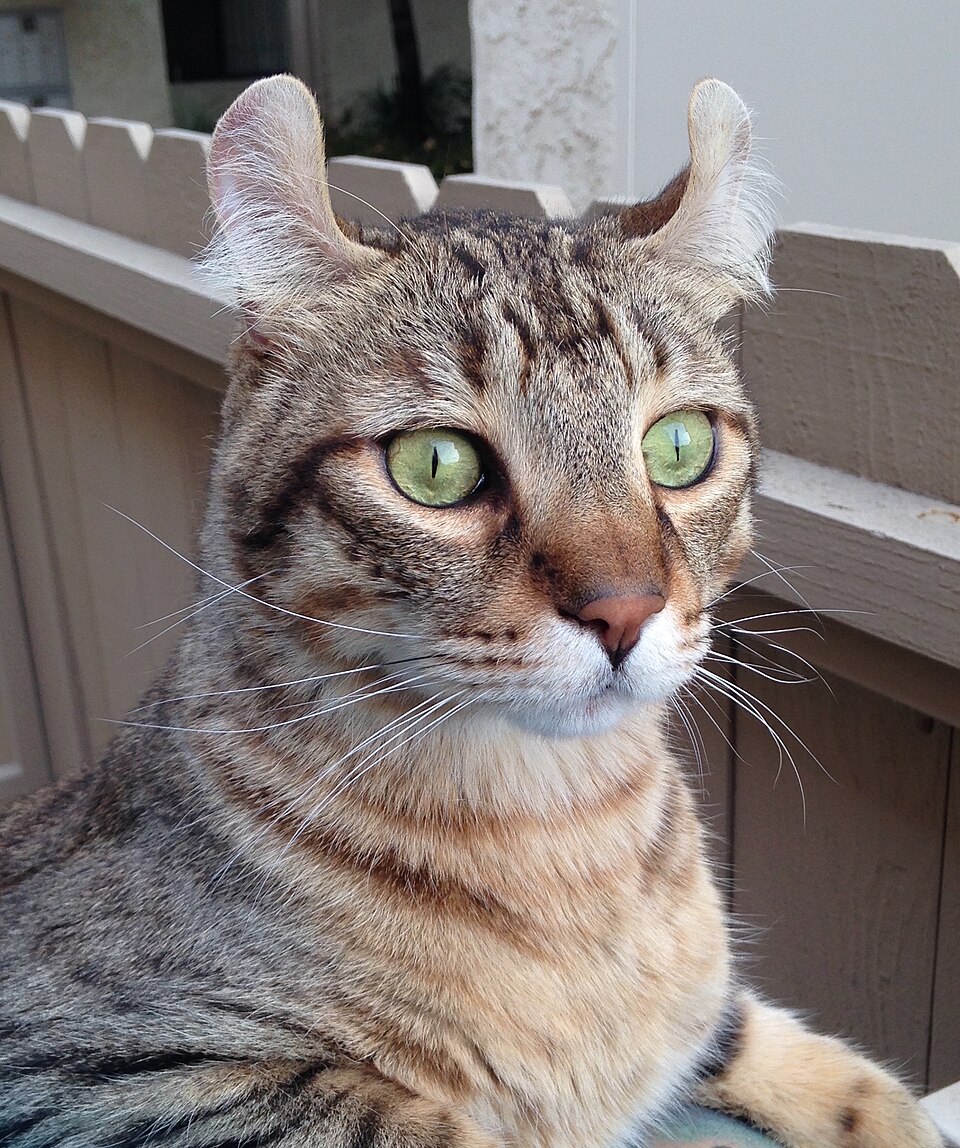
Hugo’s ear tips curl back. TAnthony, Wikimedia Commons[5]
At a cat show, judges assess these features against a shared standard. The Highlander breed group became eligible for TICA championship competition on May 1, 2025, and appears on the championship list in the association’s 2026 rules. At home, the same ear and tail shapes are visible at very different moments. When Hugo stretches out on the bed, his ear tips still curl back. Once you know what your own cat usually looks like, smaller movements are easier to notice, such as a turn of the head toward you or a glance away. [2][4][6]

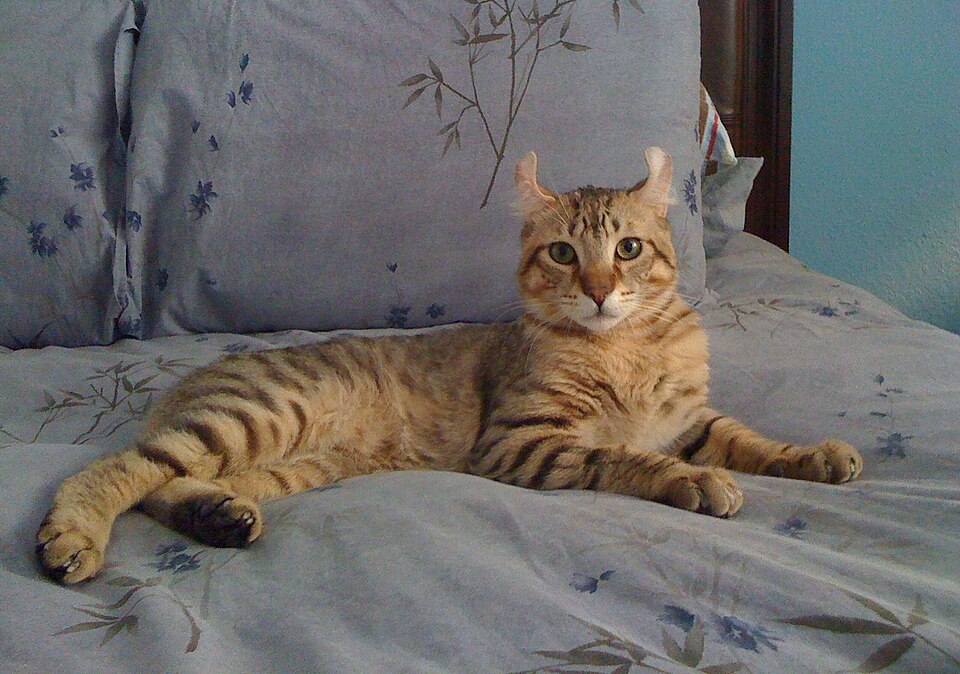
Hugo stretches out on the bed. TAnthony, Wikimedia Commons[6]
Let your cat make the next move
TICA describes Highlanders as sociable cats that often enjoy a chase. Start at floor level to find out how yours likes to hunt. Draw a toy mouse a little way along the edge of a rug, then pause. If your cat crouches and fixes its eyes on the mouse, give it time to choose a spot to pounce from. Once it follows, take the mouse around a corner. Let a paw land on the mouse and hold it there. A successful catch gives that round of play a natural ending. [1][7][8]
To see if your cat wants another turn, lower the wand and wait. It might release the mouse and circle ahead to intercept it, or come back to follow when the mouse moves again. Either gives you a reason to keep playing. If the cat heads for the water bowl or climbs onto a shelf and settles down, end the game there. When several people in the household take turns with the wand, each can offer the same pause so the cat has a chance to leave. A cat that comes over to sit beside you may simply want company. [7][8]
When setting up a play area, walk through the game yourself. Where will the mouse appear? From where can the cat see it, and where will its paws land? Leave a clear stretch of floor beside a sturdy perch. Set a cardboard box to one side so the cat can watch from cover and step out when ready. Leave a quiet resting place at the far end. When the cat is home alone, a window perch offers a view, and a scratching post gives it somewhere to stretch and scratch. When someone is there to play, the same patch of floor has room for a chase. [7][8]
The Feline Veterinary Medical Association identifies safe retreats, resources in separate locations, opportunities to hunt through play, and predictable interactions with people as needs of indoor cats. In a home with several cats, check the view from inside the hiding place. If another cat is sitting in the hallway, can your Highlander still reach water, a litter box or a quiet bed? Spread those resources around the home and give each cat a chance to play with someone individually. Even if one cat always gets to the wand first, the other can still have a turn at its own pace. [7][8]
Which changes need veterinary attention?
The UK’s Governing Council of the Cat Fancy (GCCF) specifically lists the Highlander among its unrecognised breeds because breeders select for two mutations together, the natural bobtail and curled ears. Its welfare concern addresses that breeding choice. For the cat in front of you, a more useful question is whether it can move its tail as it usually does. If the tail gets caught in a door or pulled and then suddenly hangs limp, or the cat cannot lift it, seek veterinary care promptly. A pulling injury can also affect the nerves involved in urination and bowel movements. Tell the vet how the injury happened and about any change in litter box habits. [9][10]
Look for changes in the ears in much the same way. When your cat comes close, take a look at the usual colour and shape of the outer ears. Alongside that familiar curl, you might notice new swelling or discharge, or see the cat repeatedly scratching one ear. The Cornell Feline Health Center identifies these as signs worth attention. If scratching persists, arrange a prompt veterinary examination and leave the ear canal alone. A description such as “Both tips have always curled back, and for the past two days she’s kept scratching her right ear” tells the vet what has changed and when it started. [11]
References
-
[1] TICA. Highlander.
-
[2] TICA. Standing Rules. June 2026, rule 701.4.1.
-
[3] TAnthony. Highlander cat profile (2010) Hugo by TAnthony.jpg.
-
[4] TICA. 2025 Annual Meeting Public Agenda.
-
[5] TAnthony. Highlander cat face (2014) Hugo by TAnthony.jpg.
-
[6] TAnthony. Highlander cat (2010) Hugo by TAnthony.jpg.
-
[7] Feline Veterinary Medical Association. New Feline Veterinary Medical Association Position Statement Reimagines Life for Indoor Cats. August 28, 2025.
-
[8] Cat Friendly Homes. Playing With Your Cat.
-
[9] GCCF. Unrecognised Breeds.
-
[10] VCA Animal Hospitals. First Aid for Tail Injuries in Cats.
-
[11] Cornell Feline Health Center. Feline Ear Disorders.